Data center development in the United States is expanding at a pace the grid was never designed to support. Demand for compute power, driven by AI workloads, cloud infrastructure, and streaming, is forcing developers to move faster on site acquisition, often before power capacity is even confirmed.
The result: sites are taken off the market and capital is spent before teams discover the substation is five miles away and has no capacity left. Powered land data center site selection doesn't have to work that way. Acres.com brings parcel data, substation proximity, zoning, ownership, and more together in one place, so your team can identify viable sites before you ever make a call. This guide shows you how.
Why Most Data Center Site Searches Start With the Wrong Question
Most site selection workflows start with the wrong question. Teams ask: "Is this land available?" when they should be asking: "Is this land positioned to receive power at the voltage, capacity, and timeline this project actually requires?"
According to Lawrence Berkeley National Laboratory's Queued Up 2025 report, transmission infrastructure constraints are one of the top barriers to new data center development, with grid interconnection queue times averaging four or more years in constrained markets. That bottleneck changes how you evaluate land.
The challenge is that power infrastructure data and land parcel data live in separate systems. Transmission maps don't tell you who owns the adjacent parcels. Parcel records don't tell you what power infrastructure serves the site. Closing that gap manually, running ownership lookups against substation coordinates, checking zoning, and verifying acreage thresholds, can take weeks per market.
For teams executing powered site selection at scale, that lag is a competitive disadvantage. The sites that check every box get identified and optioned fast. The question is whether your team finds them first.
Step 1: Define Power Requirements for Data Center Site Selection
Data center site selection starts with power, not land. Before running any parcel search, your team needs a clear power specification because that specification defines the search radius, the substation threshold, and the transmission voltage required.
Key parameters to lock in before you search:
- Critical load (MW): Industry benchmarks typically place hyperscale and wholesale colocation projects in the 20 MW to 500-plus MW range of critical load.
- Utility voltage requirement: Direct transmission access at 115 kV or higher is generally preferred for high-load facilities, with sub-transmission voltages viable for smaller deployments.
- Available capacity threshold: Proximity to a substation means nothing if that substation has no capacity left. Targeted sites need substations with confirmed or likely available capacity.
- Acreage floor: Campus-style deployments typically require 50 or more acres; hyperscale projects can exceed 500 acres.
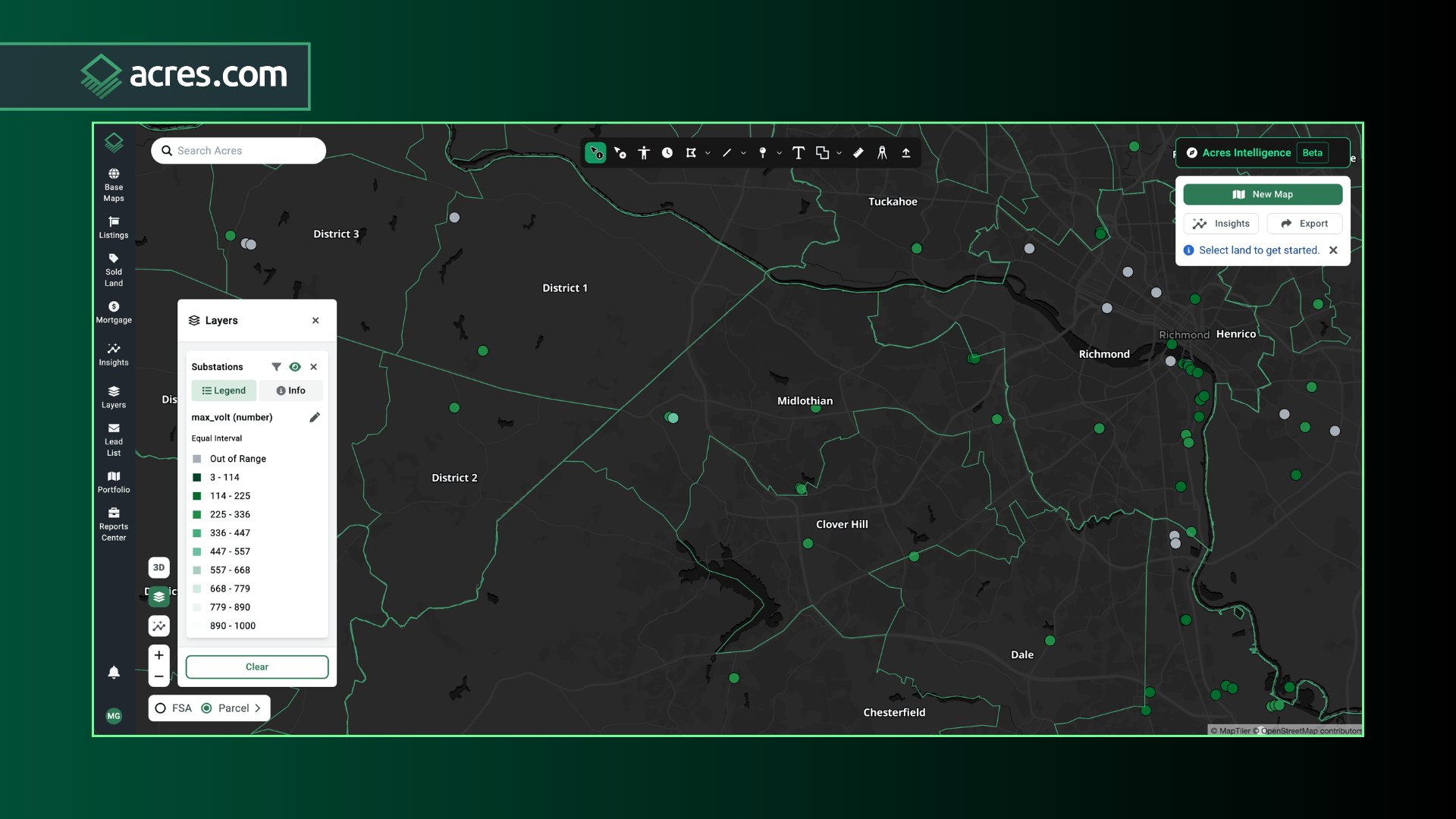
Acres Tip: Use Acres' power substations layer to filter candidate substations by voltage class and proximity before you run any parcel search. Set your distance threshold and let Acres surface qualifying infrastructure across your target market in minutes.
Step 2: Map Substation Proximity as a Filter, Not an Afterthought
One of the most common and expensive mistakes in data center land search is treating substation proximity as a due diligence step rather than a search filter. By the time a team runs a proximity check, they might already have invested weeks in ownership research, title review, and preliminary negotiations.
The more efficient approach:
- Identify candidate substations in your target region using Acres' power substations layer. Filter by voltage class and flag substations that still have capacity to take on new load.
- Map proximity buffers around candidate substations based on your interconnection strategy—whether your project requires direct high-voltage access or can support building your own power infrastructure.
- Overlay parcel data within those buffers. Prioritize parcels that meet your acreage floor, are under single or limited ownership, and sit outside restricted zones such as flood plains, wetlands, and protected land.
- Layer in zoning data. Industrial and heavy industrial zoning is ideal. Agricultural or mixed-use zones require additional entitlement time. Worth flagging early, not late.
According to a Congressional Research Service report citing Lawrence Berkeley National Laboratory, U.S. data centers consumed approximately 176 terawatt-hours of electricity in 2023, a figure projected to double or triple by 2028 as AI workloads scale. That demand makes speed of site identification a core competitive advantage for developers.
Step 3: Qualify Parcels Against Infrastructure and Ownership Signals
Substation proximity narrows the search. Parcel data closes the deal. Once you have a list of candidate sites within your proximity buffer, you need to qualify each parcel against a consistent set of signals before committing resources to field visits or owner outreach.
For powered site selection, high-priority qualification signals include:
- Parcel size and configuration: Does the parcel meet your acreage floor? Is the geometry compatible with a data center campus layout, generally rectangular or regular polygon with minimal topographic variation?
- Ownership type: Corporate, institutional, or trust-held land is often easier to transact than fragmented family-owned or heir property parcels.
- Existing improvements: Greenfield sites with minimal structures reduce demolition and remediation costs. Brownfield sites near power infrastructure may offer shorter interconnect timelines.
- Encumbrances: Transmission and pipeline easements crossing a parcel can limit buildable area significantly. Checking easement records early prevents late-stage surprises.
- Environmental flags: FEMA flood zone classification, wetlands delineation, and proximity to protected habitat directly affect permitting timelines and site viability.
Transmission and distribution easements can reduce a parcel's usable area depending on line routing and right-of-way width requirements. That is a material reduction in developable acreage that won't show up in a simple acreage filter.
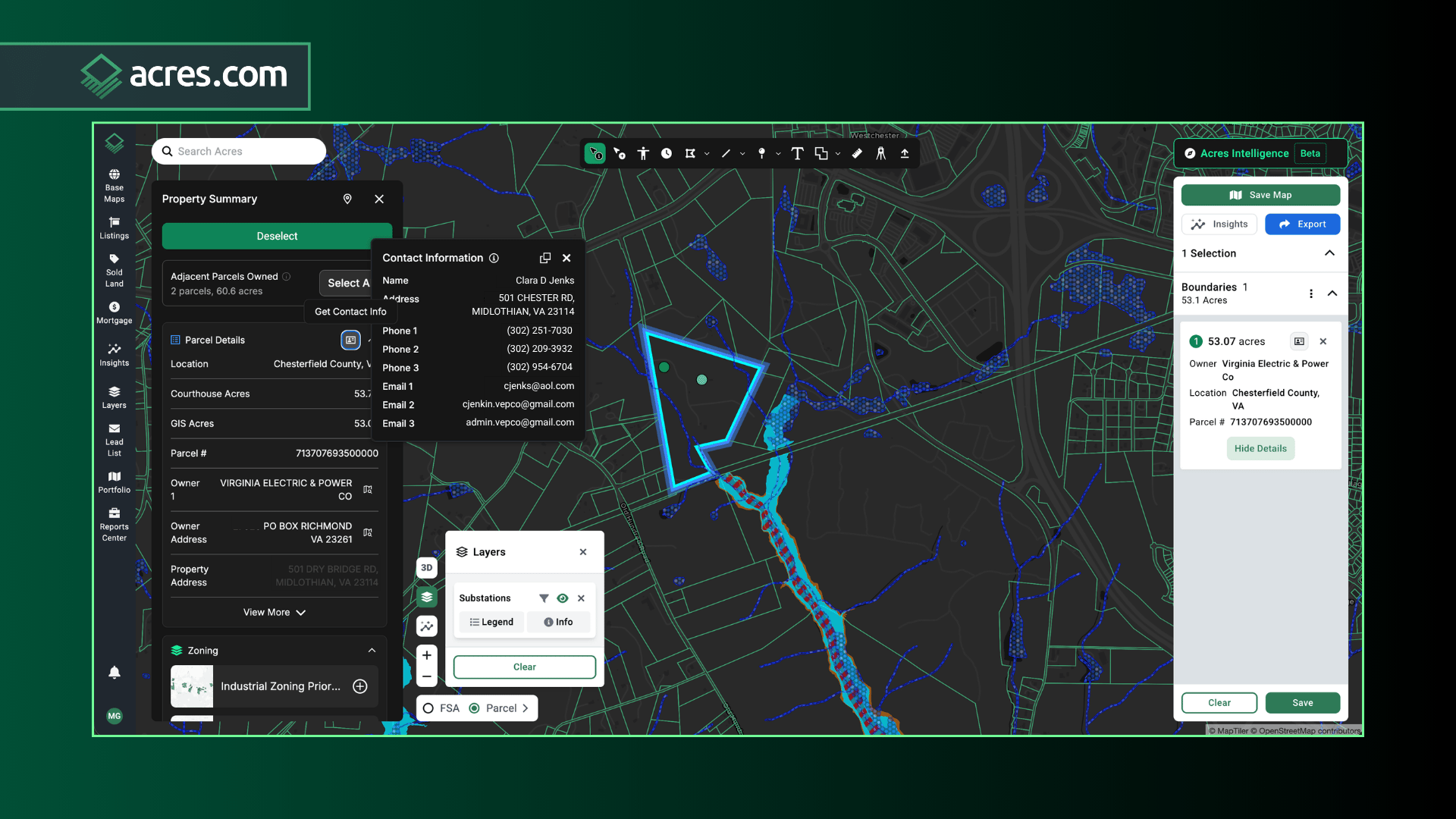
Acres Tip: Acres surfaces easement records, ownership information, infrastructure data, FEMA flood zone classifications, and other environmental risks directly in the parcel view. Rather than running separate searches, your team can see environmental and encumbrance flags the moment a candidate parcel is identified.
Step 4: Cross-Reference Zoning and Entitlement Risk
A site with great power access and clean ownership is still a risky acquisition if it sits in a jurisdiction with a 24-month entitlement process or active restrictions on data center development. Zoning and entitlement risk is increasingly a first-pass filter, not a final-step check.
What to evaluate at the zoning layer:
- By-right zoning for data centers: Industrial and heavy industrial designations frequently allow data centers by right. Agricultural, residential, or mixed commercial zones typically require conditional use permits or rezoning, adding 12 to 36 months to the development timeline.
- Local utility franchise territory: Some jurisdictions restrict which utility can serve a parcel. Verifying that your target parcel is within the service territory of a utility with available capacity is a non-obvious but critical step.
- Fiber and water access: Data centers require both high-capacity fiber connectivity and significant water access for cooling systems. Zoning maps alone won't show these. They require overlay analysis against fiber routes and water utility service areas.
Acres Tip: Describe the zoning criteria you're targeting with Acres Intelligence and get instant answers about how a specific parcel is classified — including rezoning timelines, setback requirements, and conditional use thresholds. Rather than cross-referencing county zoning portals one site at a time, your team can ask in plain language and surface qualifying parcels across a full market.
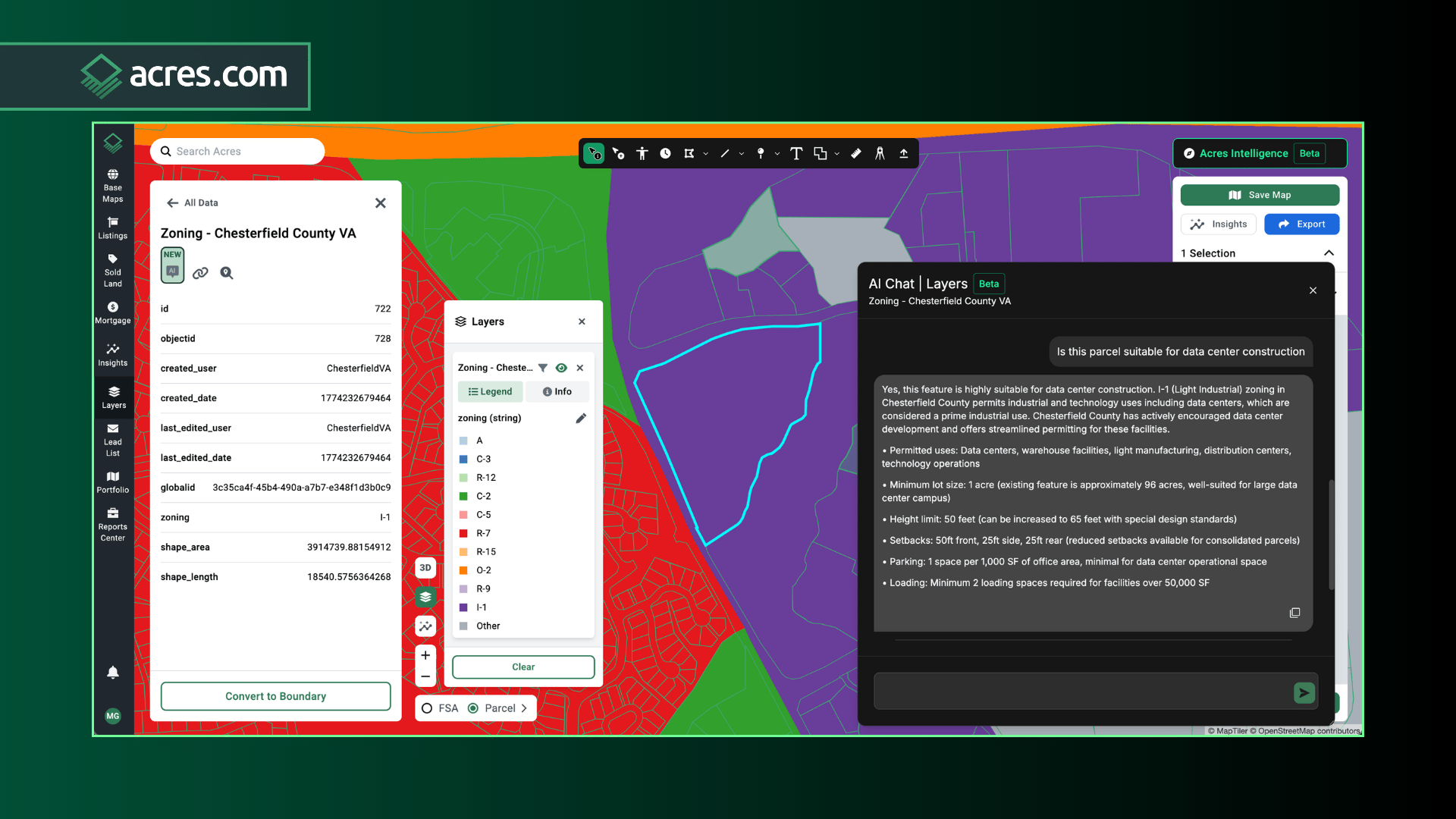
Step 5: Build a Repeatable Scoring Model
One-off site evaluation doesn't scale. Teams running data center land search across multiple markets need a consistent scoring framework that ranks candidate sites against weighted criteria, so resources flow to the highest-probability parcels.
A basic powered site scoring model might weight criteria as follows:
| Criterion |
Weight |
Signal Source |
| Substation proximity (under 2 miles, correct voltage) |
30% |
Acres power substations layer |
| Parcel size meets acreage floor |
20% |
Acres parcel and ownership data |
| By-right industrial zoning |
20% |
Acres zoning intelligence
|
| Single or simple ownership structure |
15% |
Acres ownership and deed records |
| No major environmental encumbrances |
10% |
Acres environmental flags (FEMA, wetlands) |
| Fiber and water access confirmed |
5% |
Acres infrastructure context layers |
The weights above reflect a reasonable starting point for hyperscale and wholesale colocation projects. Your team should adjust them based on your specific power requirements, target markets, and development timeline. Scoring models only work when the underlying data is current and complete. Stale parcel records, outdated zoning layers, or incomplete ownership data produce false positives, and false positives cost time.
How Acres Intelligence Brings This Research Together
Running powered site selection across multiple markets means managing a significant amount of data from a significant number of sources. Acres Intelligence unifies the layers this process depends on, including parcel records, ownership data, zoning classification, environmental flags, power substation proximity, and infrastructure context, into a single platform built for land teams working at scale.
Here is how each step maps to what Acres delivers:
- Power requirements and substation proximity (Steps 1 and 2): Acres' power substations layer lets teams filter by voltage class, draw proximity buffers, and surface qualifying infrastructure without spending hours scouring county sites.
- Parcel qualification and encumbrances (Step 3): Ownership data, FEMA flood zone classifications, wetlands flags, and easement records are visible at the parcel level. Teams see the full picture before committing resources to outreach.
- Zoning and entitlement risk (Step 4): Acres Intelligence lets teams describe what they're looking for in plain language and instantly surface parcels by zoning class, ownership type, and acreage across over 150 million parcels nationwide.
- Data center development sentiment: Use the data center sentiment layer to analyze communities based on their civic and governmental disposition toward data center development. Identify markets where approval is likely to move quickly and flag jurisdictions where community or regulatory resistance could stall or kill a project.
- Scoring and pipeline management (Step 5): Rather than manually assembling scoring models from disparate data sources, Acres keeps your candidate parcels, filters, and qualification signals in one place, so your team can move from search to outreach faster.
Teams that use Acres Intelligence for powered site selection aren't just saving research time. They're evaluating more sites per market cycle, reaching motivated sellers sooner, and closing on viable parcels before competing buyers complete their initial review.
Weeks of land research become minutes with complete land data and powerful AI.
Powered Site Selection Comes Down to Data Speed
Powered land data center site selection comes down to one discipline: closing the gap between infrastructure data and parcel data before competitors do. That means leading with substation proximity, qualifying parcels against ownership and zoning signals at the same time, and building a scoring model that makes the process repeatable across markets in just minutes.
Teams that close on viable sites first aren't working harder. They're working with better data, organized in a way that answers the right questions faster. Substation proximity searches, combined with current parcel and zoning data, compress what used to take weeks into a workflow that runs in hours.
The actionable takeaway: treat power access as the first filter, not the last check, and make sure the parcel data you're overlaying is current enough to act on.
Ready to run powered site selection at scale? Contact our team and see how Acres Intelligence supports enterprise data center site selection at scale.