Zoning trajectory is a leading indicator of data center land cost. It acts as a signal of the direction a jurisdiction's regulatory posture is moving before any formal rezoning application is filed. A jurisdiction trending toward data center permitting creates conditions where land prices reprice upward before the zoning change is official, because development teams act on the trajectory signal rather than waiting for the completed regulatory process. A jurisdiction trending toward restriction compresses land value on the same forward-looking logic.
Current zoning tells you what a parcel is permitted for today. Zoning trajectory tells you what it will be by the time you can build. For development teams evaluating data center site costs, that distinction is worth understanding in detail, because the cost of ignoring the trajectory signal is measured in acquisition premiums paid after the window has closed, or in capital committed to sites where the regulatory environment has already moved against the project.
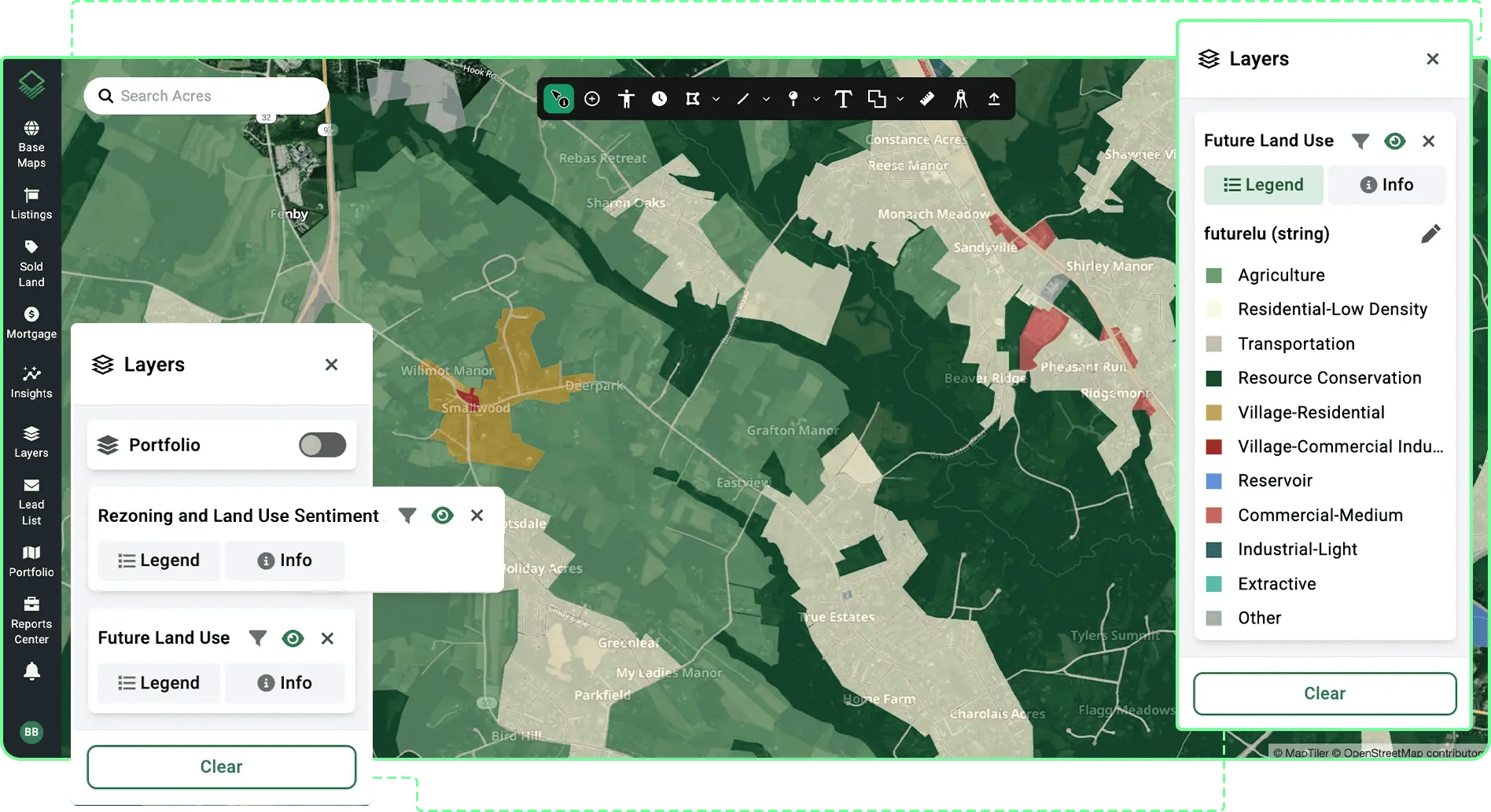
Acres.com surfaces zoning classification and parcel-level context that helps development teams read the trajectory before the market prices it in.
Contents
Why Does Zoning Trajectory Predict Cost Before Rezoning Happens?
What Does a Favorable Zoning Trajectory Signal?
How Restrictive Trajectory Creates Hidden Data Center Costs
Reading Zoning Trajectory in Secondary and Tertiary Markets
How Acres Supports Zoning Trajectory Analysis
The Cost of Ignoring the Trajectory Signal
Why Does Zoning Trajectory Predict Cost Before Rezoning Happens?
Rezoning takes time. In data center development, a key schedule driver is rezoning, which is often required because large sites already zoned industrial and with the necessary infrastructure are increasingly scarce.
According to Data Center Frontier, the rezoning process for large data center sites can take 6 to 12 months or more, and is frequently among the longest lead-time items in the development schedule. That timeline creates a window between when a jurisdiction's regulatory posture becomes readable and when the formal zoning change is complete, and it is in that window that land prices can move.
Development teams with experience in specific markets know how to read the early signals:
- Planning commission agendas that include data center-specific use studies.
- Economic development announcements from county agencies.
- Utility partnerships that indicate developer-friendly infrastructure commitments.
- The emergence of comparable transactions in neighboring jurisdictions that typically precede formal policy change.
These signals arrive before the rezoning ordinance, before the tax incentive announcement, and before the listing services reflect the new market conditions.
The teams that read zoning trajectory early can acquire land at pre-trajectory pricing. The teams that wait for formal rezoning pay the post-trajectory premium. In high-competition secondary markets, that premium can be substantial—the difference between acquiring a 200-acre site at agricultural or light industrial prices and acquiring the same site after it has been identified as a data center opportunity by multiple competing development teams.
The trajectory also runs in the negative direction. More than $150 billion in U.S. data center projects were blocked or delayed in 2025, with community opposition, moratorium proposals, and restrictive zoning changes emerging as outcome-determinative variables. A jurisdiction that is trending toward restriction through active community organizing, legislative proposals, or planning commission guidance, carries zoning risk that should be visible in the trajectory analysis before capital is committed to land acquisition.
What Does a Favorable Zoning Trajectory Signal?
A favorable zoning trajectory does not require that a jurisdiction has already completed a data center-specific zoning amendment. It requires that the regulatory environment is moving in that direction with observable, documented momentum.
Several signal types indicate a favorable trajectory:
Proactive economic development engagement. Jurisdictions that actively court data center investment through utility partnerships, tax abatement frameworks, permitting streamlining programs, or economic development incentive announcements, are signaling regulatory intent before any formal code change. Markets including New Albany in Ohio, parts of Texas, and growing Midwest counties have used proactive economic development positioning to attract development ahead of formal zoning clarity.
Comparable precedent in the market. When a neighboring jurisdiction or comparable market completes a data center approval (particularly for a large-scale facility that required rezoning), it establishes a precedent that adjacent jurisdictions observe. Regulatory precedent diffuses geographically: a successful approval in one county signals to neighboring counties that the policy framework for such approvals exists and is being executed. That diffusion is visible in planning commission records and legislative activity before it shows up in land pricing.
Utility investment and engagement signals. A utility that is actively planning substation upgrades, issuing large-load tariff amendments, or announcing infrastructure investment programs aligned with data center load profiles is demonstrating its regulatory capacity to serve large data center users. That utility signal frequently precedes formal zoning action because utilities move on longer planning horizons than municipal zoning authorities. A parcel in a jurisdiction where the serving utility has clearly positioned for large-load growth is carrying a favorable trajectory signal even if the zoning map has not yet been updated.
Zoning Status and Data Center Land Cost Profile
| Zoning Status |
Typical Land Cost |
Timeline to Break Ground |
Risk Profile |
| By-right industrial zoning |
Baseline industrial market rate; no rezoning entitlement premium added. |
Immediate (no rezoning required).
|
Low - zoning risk resolved.
|
| Favorable trajectory, pre-rezoning |
Below market data center premium; trajectory priced partially in. |
6-18 months after land control. |
Medium - trajectory confirmed, outcome not guaranteed. |
| Neutral/unclear trajectory |
Baseline comparable pricing; no data center premium. |
12-24+ months; outcome uncertain. |
Medium-High - regulatory path not established. |
| Restrictive trajectory (opposition emerging) |
Declining from peak; risk discount applied. |
Indefinite; active opposition present. |
High - moratorium or denial risk active. |
| Agricultural, no trajectory signal |
Lowest per-acre pricing; no premium. |
Longest (rezoning plus entitlement). |
Highest - full regulatory path unconfirmed. |
The cost, timeline, and risk metrics presented in this table reflect trends, benchmarks, and patterns. They are intended solely as general framework guidelines—not absolute pricing guarantees or formal legal/financial advice. Real estate values, municipal entitlement outcomes, and development schedules vary significantly based on hyper-local jurisdiction policies, specific site characteristics, and evolving market conditions.
|
With Acres:
Acres surfaces zoning classification and future land use, parcel boundary data, and transaction history for any candidate site in a single map view. Development teams use Acres to compare current zoning status across a target geography and identify clusters of activity—recent transactions, ownership changes, and infrastructure proximity signals—that indicate a favorable trajectory is developing before it appears in listing prices.
|
How Restrictive Trajectory Creates Hidden Data Center Costs
Zoning trajectory risk is not just a delay risk. It translates directly into data center costs when it is not identified early. A project that acquires land in a jurisdiction with a restrictive trajectory can face several categories of hard cost impact:
Rezoning denial or extended approval timeline. A project budgeted for a 6-month rezoning process in a jurisdiction where community opposition has developed may face a 24-to-36-month delay or an outright denial. At data center construction cost benchmarks, that delay carries material carrying costs on committed land capital, plus the opportunity cost of capital tied up in a stalled project.
Design and planning sunk costs. By the time a rezoning denial becomes apparent, a development team has typically committed to engineering, utility feasibility studies, and preliminary design work. At 2026 data center construction benchmarks of $11.3 million per megawatt for standard facilities, a 100-megawatt project can represent $1 billion+ in total construction value. The sunk costs of design and entitlement work on a project that fails a zoning challenge can reach millions of dollars before construction has begun.
Community opposition escalation costs. Once organized opposition forms around a data center project, its cost profile changes. Legal challenges to zoning approvals, requirements for enhanced environmental review, and negotiated community benefit agreements all add cost and timeline to projects that could have potentially been avoided by reading the trajectory signal before acquiring the site. Some of the most cost-intensive data center development failures in recent years were not caused by infrastructure problems but by regulatory environments that were visibly trending toward restriction when the land acquisition was made.
Reading Zoning Trajectory in Secondary and Tertiary Markets
The zoning trajectory signal is most actionable in secondary and tertiary markets where data center development is emerging but not yet highly established. In primary markets like Northern Virginia, Phoenix, and Atlanta, zoning conditions for data centers are well-understood and priced into land values. The regulatory environment, while increasingly complex, is mapped by extensive precedent.
Secondary markets offer the widest spread between current zoning status and likely trajectory, and therefore the widest window between pre-trajectory pricing and post-trajectory pricing. A county in Texas, the Midwest, or the Southeast that has not yet formally amended its zoning code for data centers but where the economic development posture, utility signals, and comparable transaction activity all indicate favorable trajectory is operating at pre-premium pricing. That window is where zoning trajectory analysis creates acquisition advantage.
The analysis requires monitoring regulatory filings, planning commission agendas, utility rate case filings, and legislative activity, not just the current county zoning map. Rather than pulling these signals from separate portals and databases, Acres consolidates the parcel-level data context—zoning, ownership, transaction history, and infrastructure proximity—that forms the foundation of a trajectory analysis for any target geography.
How Acres Supports Zoning Trajectory Analysis
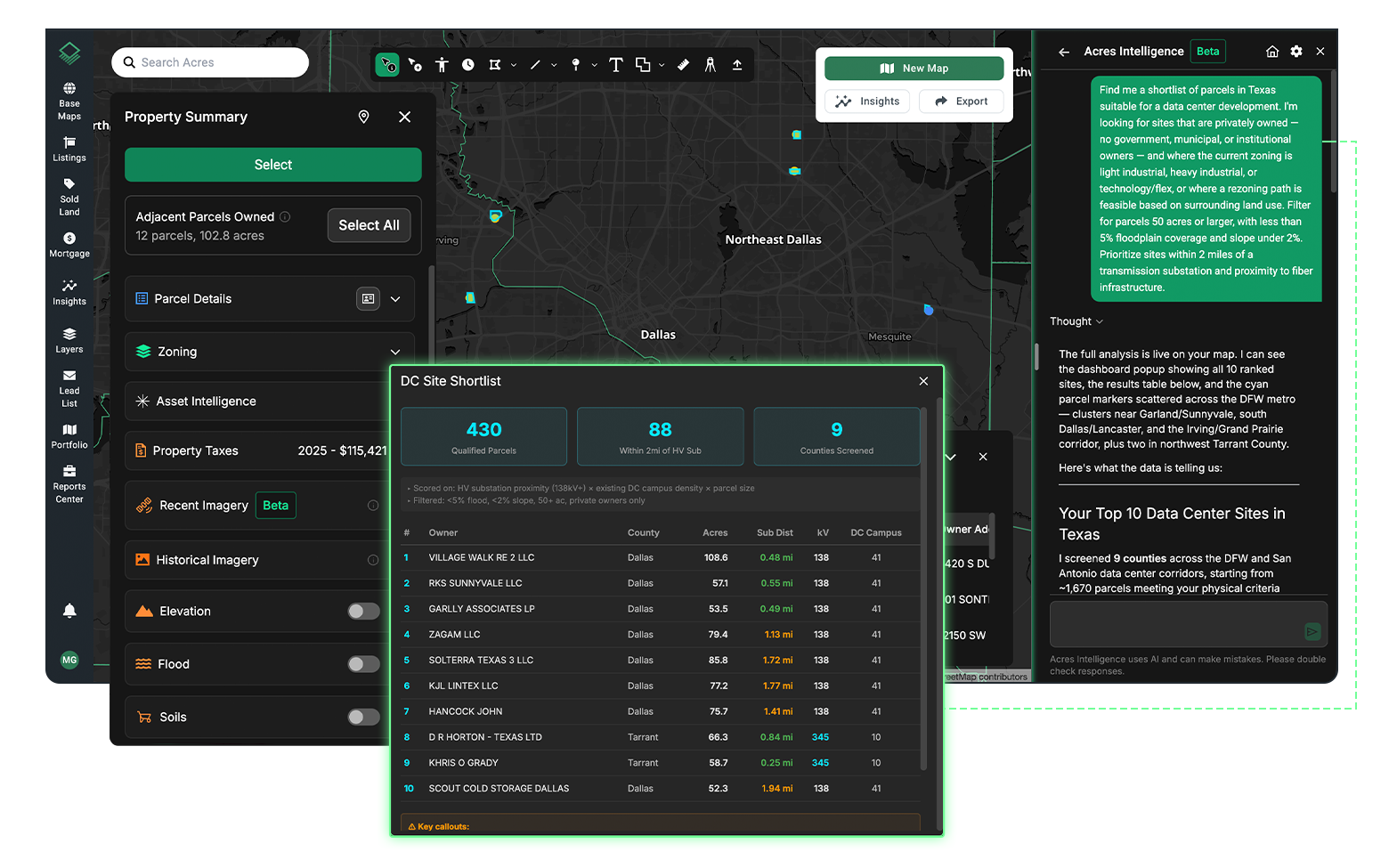
Zoning trajectory analysis requires seeing the full parcel-level picture: current zoning classifications, recent transaction patterns, ownership changes, infrastructure proximity signals, and environmental context, all in the same view. Acres gives data center development teams access to the most extensive, complete view of land data in a single system for over 150 million U.S. parcels. See a complete, connected view of ownership, risk, and opportunity, instantly. Explore zoning and parcel intelligence on Acres for any data center target market.
For teams tracking zoning trajectory across multiple secondary markets simultaneously, Acres provides the parcel-level baseline that makes the trajectory analysis actionable rather than theoretical. Weeks of land research become minutes with complete land data and powerful AI. Use land value and transaction history on Acres to identify the clusters of activity that indicate a trajectory has begun moving—before other development teams have the same picture.
The Cost of Ignoring the Trajectory Signal
Data center land costs are set when the trajectory becomes readable, before the formal process begins. Development teams that read zoning trajectory early can acquire land at pre-trajectory pricing. Teams that wait for formal zoning confirmation can pay a premium that the market has already applied.
The negative trajectory is equally important. Capital committed to sites in jurisdictions with active opposition, pending restriction proposals, or community mobilization faces cost risk that is visible in the trajectory data before it materializes in permit denials or legal challenges. Reading the signal in both directions—favorable and restrictive—is what zoning trajectory analysis provides.
Ready to evaluate zoning trajectory alongside infrastructure signals for your data center target markets? Book a demo and see how your team can start faster data center site analysis on Acres.
.png)