Solar developers are starting to screen land for agrivoltaic compatibility before permitting even begins because it can change local approval odds. Solar projects that propose continued agricultural use on the same land (whether sheep grazing, pollinator habitat, specialty crops, or row crops with elevated panel arrays) are likely to face less community opposition and often move through local approval processes faster than standard utility-scale solar projects on agricultural land.
Agrivoltaics, the intentional co-location of solar energy production and agricultural activity on the same land, has become a mainstream site selection consideration. Developers who understand which parcels in a target geography are compatible with continued agricultural use are building a competitive advantage in markets where community opposition is rising.
Acres.com surfaces parcel-level land use context, ownership records, power infrastructure, and soil, topography, and flood data nationwide, giving solar developers the data foundation to assess agrivoltaic compatibility before formal site engagement begins.
Contents
Community Opposition Permitting Risk for Solar Development
Agrivoltaic Approval Rates Evidence
Screening Variables for Agrivoltaic Compatibility
States Creating Regulatory Frameworks for Agrivoltaics
How Acres Supports Agrivoltaic Site Screening
Agrivoltaic Compatibility Starts With Site Selection Variables
Why Has Community Opposition Become the Largest Permitting Risk for Solar Development?
As of 2025, almost 500 proposed solar projects throughout the country were being actively contested. A U.S. Department of Energy-funded report found that over 30% of all utility-scale wind and solar projects were canceled between 2018 and 2023, with community opposition and local zoning ordinances being some of the leading causes. In 2021 alone, an estimated 1.7 gigawatts of intended solar projects were canceled at the permitting stage due to opposition. The trend has accelerated as solar development has moved into agricultural regions where landowner and community relationships to the land are deeply rooted.
The opposition typically centers on a number of concerns: loss of agricultural production, visual impacts on rural landscapes, and anxiety about long-term land use change. Of those concerns, the loss of agricultural production is the most actionable, because agrivoltaics directly addresses it by maintaining farm income and agricultural activity alongside energy generation.
The visual and land use concerns are partially addressed by the same framing, since a parcel that continues to produce farm income does not register as permanently converted agricultural land in the same way a standard solar installation does.
-4.png?width=1200&height=628&name=Hubspot%20Blog%20Feature%20Image%20(4)-4.png)
What Does the Evidence Show About Agrivoltaic Approval Rates?
Research suggests that solar developers who propose a project with agrivoltaics are more likely to gain local government approval and the necessary permits to build the project. This finding has held across multiple study contexts and jurisdictions. The continuation of farm income for landowners changes the economic calculus for the community and for local elected officials who are accountable to farming constituents.
A peer-reviewed study published in Land Use Policy in 2025 found that agrivoltaics enjoys comparatively high acceptance among members of the public compared to standard open-field solar. Rural residents show lower support than urban residents for both agrivoltaic and standard solar, but the gap between agrivoltaic and standard solar approval in rural communities is still prominent.
Communication efforts that ensure early involvement of rural communities in the vicinity of planned agrivoltaic projects around aesthetic, environmental, and socioeconomic impacts improve approval outcomes.
|
With Acres:
Acres surfaces parcel-level soil data, land use classification, ownership records, and environmental context for any U.S. geography. For solar developers screening candidate parcels for agrivoltaic compatibility, Acres provides the environmental data and land use context that determines whether continued agricultural production is viable alongside solar.
|
What Screening Variables Determine Agrivoltaic Compatibility?
Projects that preserve agricultural use tend to face lower opposition from local governments and farming constituents. Developers who can demonstrate agricultural compatibility are increasingly positioned to benefit from agrivoltaic-specific state incentive frameworks. However, not every parcel is compatible. The agricultural use that continues must be genuinely productive, not a nominal designation that satisfies a zoning checklist without real activity.
The key screening variables for agrivoltaic compatibility are soil type and productivity, parcel topography, existing land use, and the solar panel array configuration needed for the planned energy project.
Sheep grazing (the most common agrivoltaic configuration in the United States) works on flat to gently sloping parcels with native or managed pasture. Specialty crops require elevated panel arrays that allow light penetration and tractor access underneath. Pollinators require specific seed mixes and management plans that must be factored into the site design.
Agrivoltaic Compatibility by Land Use and Configuration
| Agricultural Use |
Compatible Parcel Profile |
Panel Configuration |
Community Acceptance Impact |
| Sheep Grazing |
Flat to gently sloping; native pasture |
Standard height panels clearance |
High - visible agricultural activity maintained |
| Pollinator Habitat |
Any slope; marginal cropland; low productivity soils |
Standard height panels; wildflower seed mix |
High - environmental co-benefit narrative
|
| Specialty Crops (shade-tolerant) |
Flat; irrigated; high-value crop history |
Elevated arrays with tractor clearance |
Moderate-High - requires demonstrated crop plan |
| Row Crops (corn, soybeans) |
Flat; compatible soil types; large parcel |
Very elevated arrays; limited by panel spacing |
Low to Moderate - traditional large-scale machinery movement remains difficult without wide row spacing |
| Orchards and Vineyards |
Gently sloping; frost protection benefit |
Tracking panels with adjustable tilt |
Moderate - site-specific feasibility; early examples promising |
Note: The configurations and compatibility assessments presented above reflect general industry practices and standard benchmarks across current agrivoltaic projects. Specific agricultural viability, engineering requirements, and local regulations vary by crop type, regional climate, and jurisdiction. Developers and landowners should perform localized site studies and consult with agronomic and engineering experts prior to project design.
Which States Are Creating Regulatory Frameworks for Agrivoltaics?
Leading states in the agrivoltaics movement include Colorado, Massachusetts, Maryland, New Jersey, and New York, among others. Colorado's legislature has appropriated funds for agrivoltaic grants and demonstration projects consecutively since 2023. Some states have developed programs and grants, property tax exemptions, standardized siting and permitting for solar projects, and compensation rate adders for dual-use projects.
Developers who can demonstrate agricultural compatibility in these states are positioned to benefit from incentive frameworks that reward agrivoltaic configuration.
For developers in states without specific agrivoltaic frameworks, the community acceptance benefit of agrivoltaic framing still applies. The regulatory benefit, however, is state-specific and requires tracking which jurisdictions have created formal pathways.
The U.S. Department of Energy notes that exploring methods that optimize both energy and agricultural production at co-located sites is an active area of research, with efforts aimed at quantifying potential effects on farmer revenue, ecosystems, rural communities, and solar energy soft costs. Solar energy soft costs (the non-hardware costs of deployment including permitting, community engagement, and interconnection) are where agrivoltaic configuration can deliver project economics benefits by reducing the cost and time associated with community opposition.
How Acres Supports Agrivoltaic Site Screening for Solar Developers
Agrivoltaic compatibility screening requires combining soil productivity data, land use classification, parcel size and configuration, and ownership context in a single analysis. Acres gives solar developers access to the most extensive, complete view of land data in a single system: parcel boundaries, USDA soil data, environmental overlays, ownership records, transaction history, and more, nationwide.
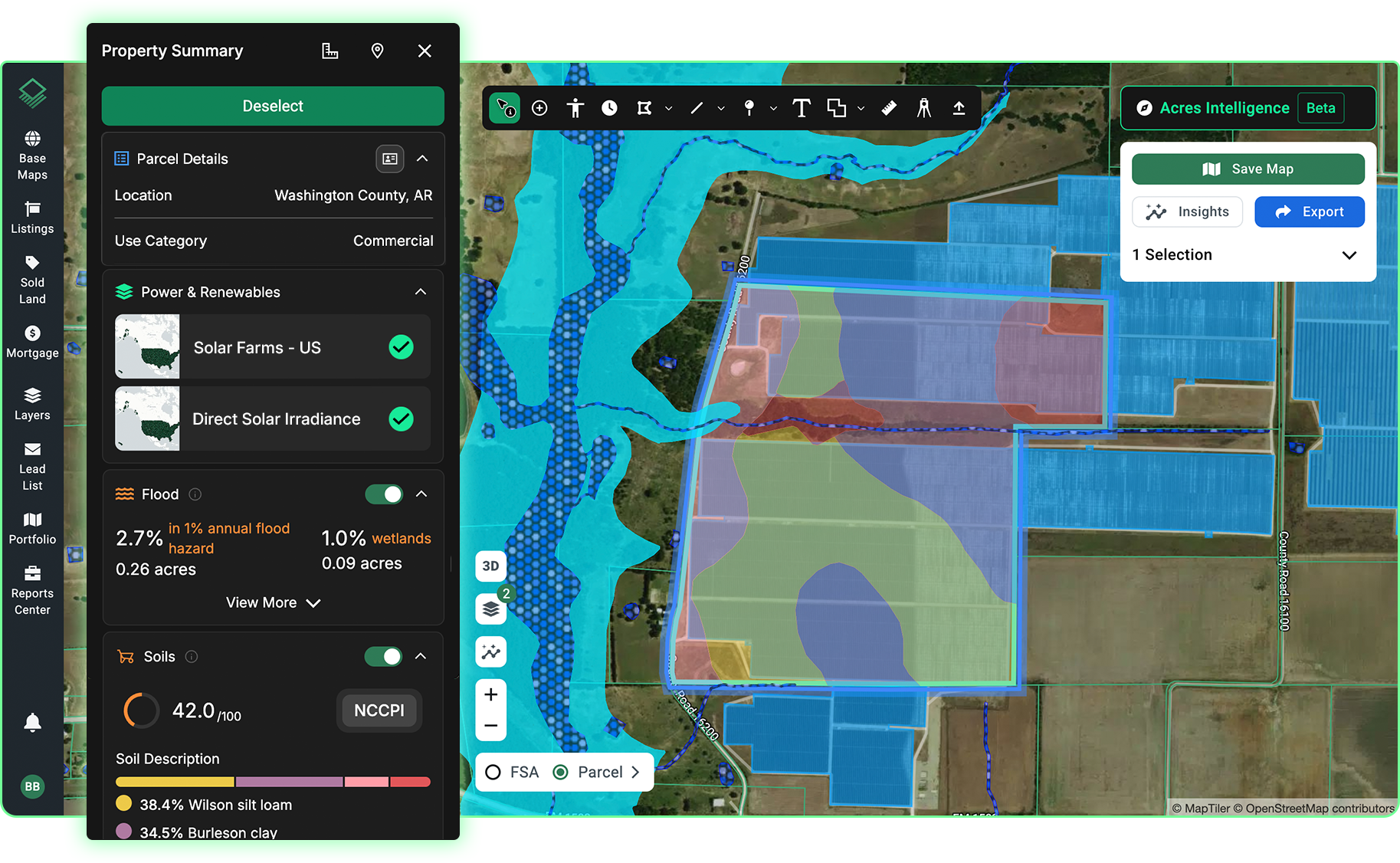
See a complete, connected view of ownership, risk, and opportunity, instantly. For solar development teams evaluating land use and parcel context on Acres, the provided nationwide datasets surface which candidate parcels have the agricultural production history that makes agrivoltaic co-location viable.
Acres' parcel data and prospecting tools identify parcels with the agricultural profile that supports genuine dual-use development before community engagement or formal permitting begins.
Agrivoltaic Compatibility Starts With Site Selection Variables
Solar developers who screen for agrivoltaic compatibility early are making a site selection decision that affects permitting timelines, community approval odds, and in some states, incentive program eligibility.
The screening variable is straightforward: does the parcel's soil type, topography, and existing land use support a genuinely productive agricultural use alongside the planned solar configuration? That question can be answered before permitting begins, before community engagement starts, and before the development team has committed significant capital to the site.
The developers who build it into their initial screening process are the ones avoiding the 30% project cancellation rate that community opposition has been producing in utility-scale solar development.
Ready to screen solar candidate sites for agrivoltaic compatibility and soil productivity data before permitting begins? Surface parcel-level land use, soil data, and ownership context for any U.S. geography on Acres. Start your renewable energy site screening on Acres.
-Aug-26-2026-10-09-39-2001-PM.png)