Battery storage developers know that grid interconnection capacity is what gates a Battery Energy Storage System (BESS) project timeline. A parcel that is 100 acres in a region with strong solar irradiance may be exactly the wrong site for a battery storage project if the nearest substation is fully committed.
Conversely, a 15-acre parcel adjacent to a substation with available load headroom can be an ideal battery storage site even if it would never qualify for a standalone solar project. The screening criteria that determines BESS site viability diverges from the criteria that governs solar or wind at the point where most site screening frameworks begin: land size and resource availability.
Battery energy storage systems are one of the fastest-growing segments of new utility-scale capacity additions in the United States in 2026. The U.S. Energy Information Administration (EIA) projects 24 gigawatts of new utility-scale battery storage will come online in 2026, nearly double the 15 gigawatts added in 2025.
That pace of deployment is producing a wave of BESS-specific site selection challenges that the standard renewable energy site screening framework was not built to address. Acres.com surfaces parcel-level infrastructure proximity signals nationwide, helping BESS developers identify which sites carry the grid access profiles that drive viable project timelines before any formal utility engagement begins.
How Does BESS Site Screening Differ From Solar and Wind?
Battery storage has no irradiance requirement. A parcel facing the wrong direction, shaded by terrain, or sitting in a region with mediocre solar resources can still host a viable battery project, as long as the grid access is there. Irradiance drops out of the constraint set, and substation proximity becomes the filter that does most of the work. This opens up land that would not make a solar developer's list like north-facing hillsides, shaded valleys, parcels in regions with strong transmission infrastructure but modest solar resources—all potentially viable for storage.
For solar, the screening hierarchy is often: solar resource, land size, transmission proximity, environmental clearance,and permitting. For BESS, the screening hierarchy is usually: substation proximity with available capacity, interconnection queue position, fire safety setback compliance, environmental clearance, and permitting.
Applying the solar screening framework to a BESS project can produce a list of sites optimized for the wrong constraint.
A parcel that works for solar might be entirely unviable for batteries once zoning codes, safety setbacks, environmental buffers, and operational constraints are applied. For developers, getting site selection right at the earliest stage of diligence can mean the difference between a fast-moving project and one stuck in permitting or interconnection purgatory.
-Aug-26-2026-09-19-28-9460-PM.png?width=1200&height=628&name=Hubspot%20Blog%20Feature%20Image%20(1)-Aug-26-2026-09-19-28-9460-PM.png)
What Are the Core Screening Criteria for BESS Site Viability?
The BESS site screening framework has five primary factors. Each one either qualifies or disqualifies a candidate site, and they are best applied in the following sequence.
BESS Site Screening Framework - Criteria and Qualification Standards
| Screen |
What to Evaluate |
BESS-Specific Consideration |
Disqualifying Condition |
| 1. Substation proximity |
Distance to nearest substation; available load headroom |
Available capacity for both generation injection and load charging |
Substation committed or no headroom for project MW |
| 2. Interconnection queue |
Current queue position; competing applications |
Flexible siting near substations, but still requires queue studies to ensure charging and discharging do not exacerbate existing congestion |
Multi-year queue with multiple solar projects ahead of BESS |
| 3. Fire safety setbacks |
Compliance; setback from occupied structures |
Required separation distances vary by jurisdiction and battery chemistry |
Residential proximity that makes setback compliance impossible |
| 4. Environmental clearance |
Wetlands, floodplain, environmental covenants |
Shared with solar; similar overlays apply |
Conservation easement, wetland impacts or prohibitive federal/state permitting triggers |
| 5. Parcel size and access |
Minimum acreage for MW capacity; road access for equipment delivery |
BESS footprint is smaller than solar per MW; 1-2 acres per 100MW typical (total parcel size varies based on local setbacks and access) |
Landlocked parcel; no viable equipment delivery route |
Note: The criteria presented above reflect general industry benchmarks and standard site screening practices across major U.S. markets. Specific land, zoning, fire safety, and interconnection requirements vary significantly by state and local jurisdiction. Developers should always verify regional rules and perform localized due diligence prior to site acquisition.
Why Is Interconnection Capacity the Primary Gate?
Grid capacity and limited interconnection analysis stand out as pain points in critical infrastructure project development. High upfront capital can be wasted if a site lacks adequate power to charge the battery or inject the energy back onto the grid. The best sites are not just available land near transmission, but locations where congestion, pricing volatility, interconnection capacity, and infrastructure adjacency align to support revenue stacking and scalable deployment.
The interconnection capacity gate operates differently for BESS than for generation assets. A solar project that generates power during daylight hours places a one-directional load on the interconnection point. A battery project injects power to the grid during discharge and draws from the grid during charging, a bidirectional flow that requires the substation to accommodate power movement in both directions. Substations that can handle solar injection may not have the switching configuration or capacity profile to support a battery system at the same location.
Developers must analyze which projects ahead of them in the interconnection queue have signed interconnection agreements, and identify physical bottlenecks such as thermal limits, voltage constraints, or short-circuit ratio (SCR) limits that trigger network upgrade costs. A BESS site that looks viable based on physical proximity to a substation can still face project-defeating cost allocations if affected grid nodes require extensive network upgrades or deep system reinforcements to support bidirectional throughput.
|
With Acres:
Acres surfaces parcel-level infrastructure proximity signals like substation adjacency, transmission corridor presence, utility easement data, and environmental risk overlays for parcels nationwide. For BESS developers running pre-screening against the site viability framework above, Acres provides the parcel intelligence that identifies which sites are most likely to support battery storage interconnection before formal utility engagement begins.
|
What Does BESS Site Screening Look Like in Practice?
In practice, BESS site screening runs as a sequential process. The first factor, substation proximity with available capacity, eliminates the largest proportion of candidate parcels, typically 80 to 90% of sites in any target geography.
Because interconnection studies and utility approvals can affect project schedules significantly, early coordination is beneficial. Sites with nearby electrical infrastructure may reduce costs and improve project feasibility. Poor soil conditions can increase civil work requirements and affect foundation design, and brownfield or active industrial sites may require additional planning to satisfy BESS foundation and geotechnical requirements. The BESS site screening framework that front-loads interconnection capacity analysis eliminates expensive discoveries before they become sunk costs.
Co-located BESS (storage paired with an existing or planned solar facility) is a different site selection exercise. The solar site already has an interconnection point and utility relationship. The BESS screening question becomes whether that interconnection point can support bidirectional flow at the planned battery capacity, and whether the existing interconnection agreement allows BESS to be added to the project scope without triggering a new queue position. Those are utility engineering questions, not parcel selection questions, but they can only be answered once the parcel and the interconnection point are both identified.
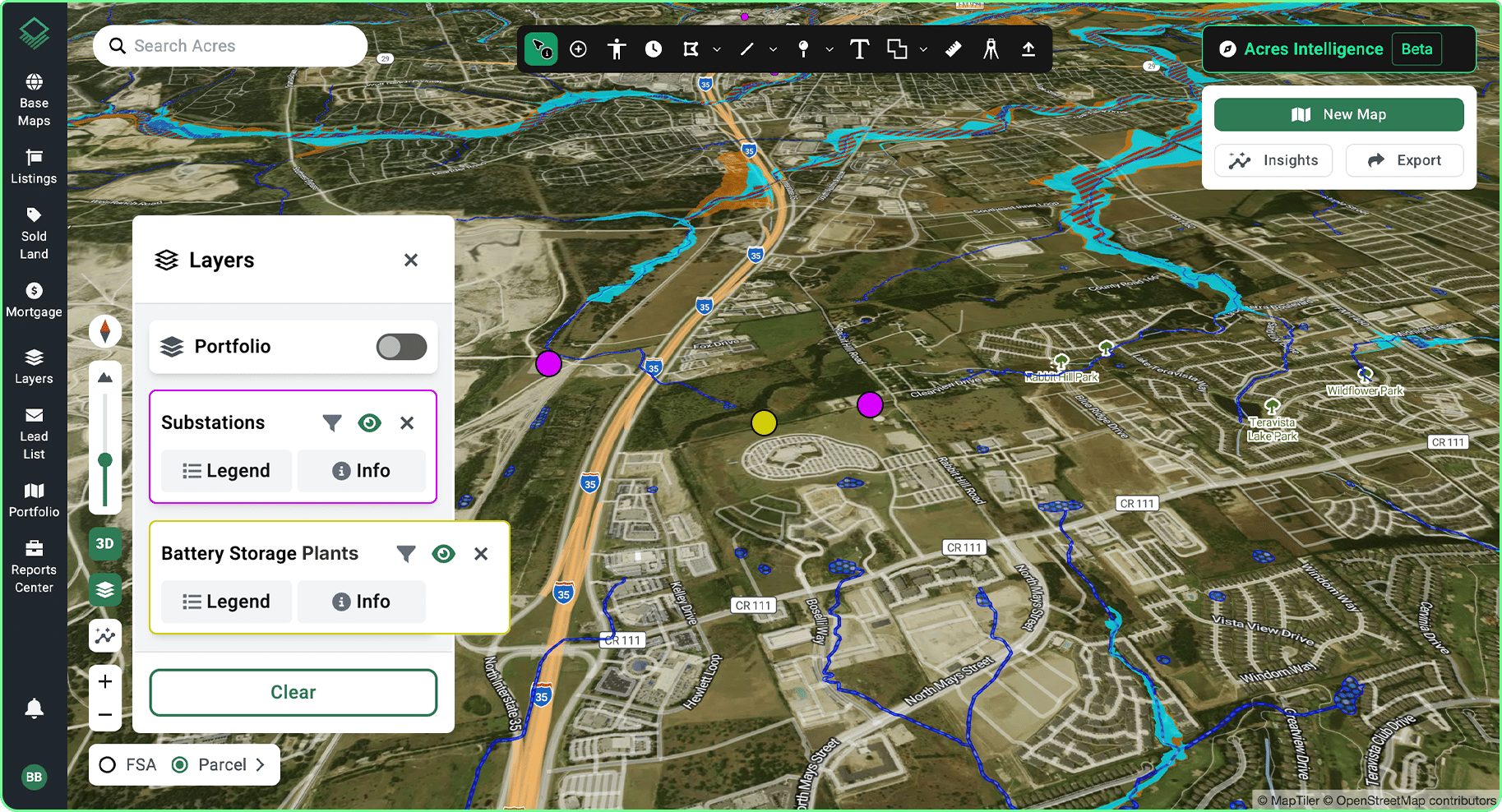
How Acres Supports BESS Site Screening
Rather than pulling substation proximity data from utility service territory maps, setback requirements from individual county planning portals, and environmental overlay data from FEMA and NRCS databases separately, Acres consolidates parcel boundaries, ownership records, infrastructure proximity signals, and environmental context into a single platform. The BESS site screen that front-loads grid access analysis runs in a single Acres session rather than a multi-source research process spread across days.
For BESS developers running multi-site portfolio screening across secondary and tertiary markets, Acres' parcel analysis and prospecting tools identify which candidate parcels sit closest to substations with the infrastructure profiles that support battery storage interconnection—the first filter in any BESS site screening workflow.
BESS Site Screening Is Grid-First, Not Land-First
The constraint that governs BESS project viability is grid access with available bidirectional capacity, and that constraint eliminates most candidate sites in most geographies before any parcel-level due diligence begins.
The developers who build BESS pipelines efficiently are the ones who run the grid access screen first and use it to filter down to a shortlist of parcels worth evaluating in detail. That approach prevents the most expensive BESS development failure: acquiring or optioning land that passes a land-first screen but fails the interconnection capacity screen that should have been run first.
Ready to screen BESS candidate sites against grid access and infrastructure proximity before formal utility engagement? Surface substation adjacency, parcel boundaries, and environmental context for any U.S. geography on Acres. Start your site screening on Acres.
-Aug-26-2026-09-52-35-3791-PM.png)