Agricultural land can generate income through tenant farming leases and long-term appreciation. Timberland through periodic timber harvests and biological growth. Recreational land through hunting, fishing, and outdoor-use leases while appreciating alongside rural land demand. These three categories account for the majority of rural land investment in the U.S., and each serves a different investor goal, time horizon, and risk profile.
The question is not which land type is best, but which one aligns with what you are trying to accomplish, and by when. An investor who needs predictable annual income has a different optimal land type than one who is building a legacy asset over 25 years.
Acres.com covers over 150 million U.S. parcels across all three categories, giving buyers the parcel-level data to evaluate each land type before any capital is committed.
Contents
Why Choosing the Wrong Land Type Is an Expensive Mistake
Land Type Comparison Table
What Makes Agricultural Land a Reliable Long-Term Investment?
Timberland Investment: The Case for Biological Growth as a Return Driver
Recreational Land: Lower Entry Cost, Lifestyle Value, and Appreciation Upside
How Acres Supports Every Type of Land Investment Research
Matching Land Type to Investment Goal
Why Choosing the Wrong Land Type Is an Expensive Mistake
Most land searches start with location and price, but they should also start with a goal. A buyer who purchases timberland expecting immediate annual income will be disappointed, as timber harvests run in cycles of 15 to 40 years depending on species and management approach.
Example: A buyer who acquires prime cropland expecting a quick flip may find the market for large agricultural tracts thin and slow-moving. A buyer who buys recreational land for cash flow may generate only $10 to $50 per acre per year in hunting lease income, a return that rarely covers financing costs.
The three land types do not just differ in what they grow or how they are used. They differ in how returns are generated, when those returns arrive, what kind of management they require, and what kind of buyer market exists when it is time to sell.
This guide profiles each of the three major types of land investment, maps them to the investor profiles they suit, and shows how to evaluate parcels within each category before making an offer.
Land Type Comparison Table
The table below summarizes the key investment characteristics of each land type. Details for each category follow.
| |
Agricultural Land |
Timberland |
Recreational Land |
| Return Type |
Rent + appreciation |
Biological growth + harvest |
Lease income + appreciation |
| Time Horizon |
Medium-Long (5-20 yrs) |
Long (15-40 yrs) |
Flexible (any hold)
|
| Income Cadence |
Annual rent payments |
Periodic harvest (cyclical) |
Seasonal lease income |
| Entry Cost |
High per acre |
Moderate per acre |
Lower per acre |
| Management Level |
Low (tenant-operated) |
Active (harvest planning) |
Low to minimal |
| Financing |
Favorable (ag lenders) |
Moderate (ag/timber banks) |
Harder (low/unstable income stream) |
| Key Risk |
Commodity price volatility |
Timber price cycles |
Illiquidity / thin market
|
| Best Investor |
Income + appreciation |
Long-hold, patient capital |
Lifestyle + appreciation |
Note: Characteristics, returns, and timeframes outlined above reflect general historical trends and industry averages. Individual land performance, lease rates, financing options, and timelines will vary depending on specific parcel location, local market conditions, soil/site quality, management strategy, etc.
What Makes Agricultural Land a Reliable Long-Term Investment?
Agricultural land has a return profile that combines predictable lease income with long-term land appreciation, two independent value drivers that together have historically outperformed many traditional asset classes in risk-adjusted terms.
U.S. farmland averaged $4,350 per acre in 2025, an increase of 4.3% over 2024 values. Cropland commands a higher average at $5,830 per acre, driven by its higher per-acre income productivity. Farm real estate accounted for a forecasted $3.67 trillion, or 83.6%, of total U.S. farm assets in 2025, making it one of the largest tangible asset classes in the country.
-1.png?width=1200&height=628&name=Hubspot%20Blog%20Feature%20Image%20(5)-1.png)
The income mechanism is straightforward: a landowner acquires cropland, leases it to a farmer or agricultural operator, and collects annual rent while the operator handles all farm management. Cash rents on productive cropland run $150 to $300 per acre annually, depending on soil quality, drainage, and local market conditions. The landowner bears no operational risk from commodity price cycles.
Agricultural land can also serve as an inflation hedge. Land values and farm rents have historically tracked inflation over long periods, meaning the real value of the asset is preserved even as purchasing power erodes. This characteristic has made farmland attractive to pension funds, endowments, and family offices as a portfolio stabilizer.
The primary risks for agricultural land investors are:
- Commodity price cycles that affect tenant rent-paying capacity.
- Climate and weather such as drought or flooding.
- Interest rate environments that can affect both financing costs and cap rates for the asset class.
Soil quality, water rights, and drainage infrastructure are the parcel-level variables that most directly determine a specific farmland parcel's long-term productivity and value.
|
With Acres:
Before acquiring any agricultural parcel, use Acres to review the parcel's zoning classification, soil data, drainage infrastructure proximity, and environmental constraints including flood zone exposure. These variables determine whether a parcel's listed acreage translates into productive farmable opportunity.
|
Timberland Investment: The Case for Biological Growth as a Return Driver
Timberland is distinct from other land investments in how it creates value: biological growth accumulates continuously on the property. Because trees add physical volume year after year, owners can delay harvests during down markets, allowing the asset to keep growing in both size and value until timber prices improve.
The practical requirements of timberland investing are more active than farmland. Sustainable harvest scheduling, reforestation planning, stand management, and road maintenance are all ongoing responsibilities. Investors who lack forestry expertise typically work with timber investment management organizations (TIMOs) or experienced local managers. Entry costs may be lower per acre than prime cropland in most markets, but the time horizon is measured in decades.
-3.png?width=1200&height=628&name=Hubspot%20Blog%20Feature%20Image%20(4)-3.png)
Regional timber markets vary significantly. Different regions have distinct species profiles, buyer markets, and pricing dynamics. Investors should acquire timberland in regions where they have access to experienced management and reliable end-market demand.
Timberland can also qualify for favorable tax treatment in many states, particularly through agricultural-use and conservation programs that reduce property tax burdens during the long holding period.
Recreational Land: Lower Entry Cost, Lifestyle Value, and Appreciation Upside
Recreational land covers a wide range of parcel types: hunting land, fishing properties, camping and off-grid parcels, lakefront and waterfront acreage, and rural retreat properties. What they share is that their value is driven by natural amenities, wildlife habitat quality, and outdoor access rather than agricultural productivity or timber inventory.
The income profile for recreational land is generally thinner than agricultural or timber alternatives. Hunting leases are the most common income mechanism, generating income at the lower end of the range per acre per season. Properties with multiple uses like hunting, fishing, and camping, or those within reasonable driving distance of population centers, can command higher lease rates. A 200-acre parcel with strong deer habitat, water access, and food plot infrastructure might generate meaningful annual lease income while requiring minimal active management from the owner.
-4.png?width=1200&height=628&name=Hubspot%20Blog%20Feature%20Image%20(3)-4.png)
Hunting leases bring in roughly $10 to $50 per acre per year depending on location, wildlife quality, and access. Income from recreational leasing rarely covers financing costs on its own, so recreational land investments are typically justified by appreciation potential and personal use value rather than income alone.
The appreciation case for recreational land rests on scarcity and demographic trends. Rural land near population centers, water features, and established wildlife corridors has appreciated consistently as demand for outdoor access grows. Markets in high-demand corridors can double or even triple in value over 5-10-year periods, particularly as urban expansion expands the reasonable driving distance from major cities.
Financing recreational land is harder than agricultural or timber parcels. Many institutional lenders do not have established programs for hunting or recreational parcels, and land loans for raw recreational acreage require higher down payments and carry higher interest rates. Seller financing is common in recreational land transactions.
Choosing between these three types of land investment is ultimately a capital allocation decision that requires matching the return mechanism, time horizon, and management intensity of the land type to the investor's actual goals.
How Acres Supports Every Type of Land Investment Research
The data requirements for evaluating agricultural, timber, and recreational land differ by category, but the research process has the same foundation: accurate parcel identification, ownership verification, zoning context, environmental risk assessment, and comparable sales analysis. Acres gives buyers access to the most extensive, complete view of land data in a single system—ownership, parcel details, zoning, environmental signals, and infrastructure context—for over 150 million parcels nationwide.
For agricultural land buyers, Acres surfaces soil classification data, drainage infrastructure proximity, and flood zone exposure alongside ownership and transaction history. For timberland investors, parcel boundaries, road access, and zoning context are visible in the same map view. For recreational land, wildlife corridor adjacency, water feature proximity, and comparable sales data help establish whether a parcel's asking price reflects its amenity value.
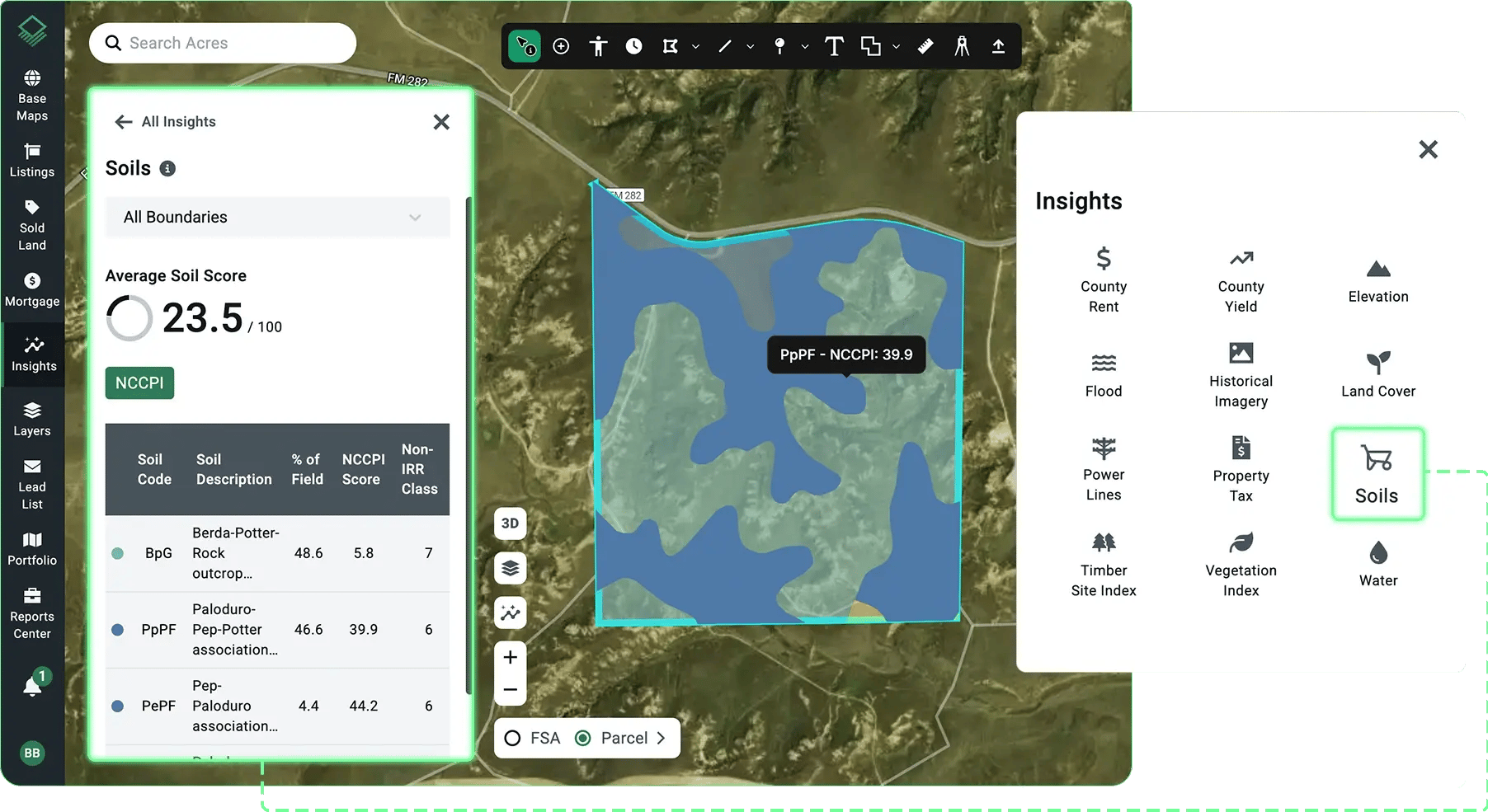
See a complete, connected view of ownership, risk, and opportunity, instantly. Explore the land research tools on Acres for any land type you are evaluating.
Whether you are screening a 400-acre timberland tract in Georgia, evaluating a row crop parcel in the Corn Belt, or researching a hunting property in the Texas Hill Country, the parcel-level data that drives the investment decision is available on Acres.
Matching Land Type to Investment Goal
Agricultural land suits investors who want predictable annual income, inflation protection, and long-term appreciation with minimal active management. Timberland suits patient, long-hold investors who want inflation-resistant returns, low volatility, and a biological growth engine that works independent of economic cycles. Recreational land suits buyers who value lifestyle access, appreciation upside, and lower entry costs, with lease income as a supplement rather than a primary return driver.
None of these types of land investment is uniformly better. The best choice is the one that matches your capital timeline, income requirements, management capacity, and exit strategy. Research the land type first, then research the specific parcel with the most complete land data available, not assumptions.
Ready to research parcels across all three land types? Explore agricultural, timberland, and recreational parcels with full ownership, zoning, and environmental context on Acres. Start your land research on Acres.
-1.png)