Determining the market value of raw acreage is rarely straightforward. A 40-acre parcel in one county can sell for far more than an identical-looking parcel two counties over because the underlying data tells a completely different story. That is why knowing how to value land is one of the highest-leverage skills a buyer or broker can develop.
This article walks through five proven land valuation methods, when to use each one, and how to read them together for a sharper final number.
With Acres.com, buyers and brokers can access the most extensive, complete view of land data in a single system, including ownership records, parcel details, zoning, and transaction history across over 150 million parcels.
Research that used to take days can now happen in a single session.
Contents
Why Is Determining Vacant Land Value So Difficult?
Valuation Methods 1-5
How Acres Supports Land Valuation
Putting It Together
Why Is Determining Vacant Land Value So Difficult?
Land valuation is harder than it looks. Unlike residential homes, raw land has no interior square footage, no comparable rental income stream, and no standard finishes to price against. The data is fragmented across county assessors, public records, and deed filings, each with its own format and update schedule.
That fragmentation has real consequences. A buyer relying on a single data point such as the asking price of a nearby listing, can easily overpay or miss the actual market range entirely. A broker without strong comparable sales cannot make a confident case for their seller's price. The result is slower deals, more renegotiations, and missed opportunities on both sides of the table.
The fix is not more guesswork. It is a structured approach to land appraisal methods that triangulates multiple signals. Here is how to value land the right way.
Method 1: Highest and Best Use Analysis
Highest and best use (HBU) analysis is not a standalone valuation method. It’s a framework that informs all the others. Before applying any of the four methods below, an appraiser or buyer asks: what is the most profitable, legally permissible, physically possible, and financially feasible use of this parcel?
Zoning drives this answer first. A 10-acre parcel zoned for residential subdivision is worth dramatically more than the same parcel locked into agricultural use only. Expired entitlements, development moratoriums, and conservation easements can each reduce what a buyer should pay. Planned infrastructure like highway extension, a utility corridor, or a new interchange can push values in the other direction.
HBU analysis is what separates buyers who understand how to determine land value from those who are just comparing price-per-acre. The methodology rewards the research. Buyers who take the time to analyze zoning, entitlements, and market absorption have a defensible number when it counts.
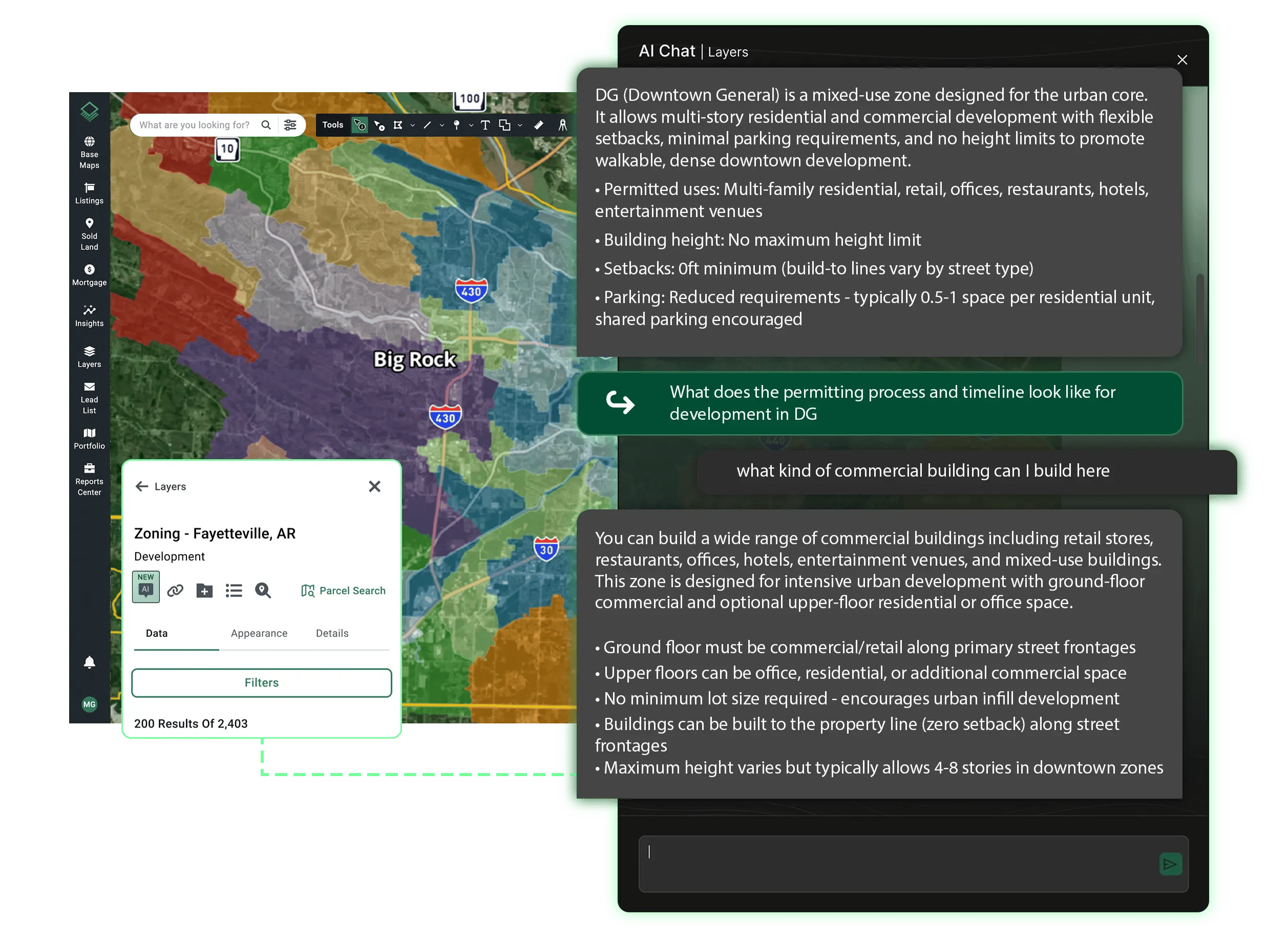
With Acres: Visualize zoning designations with layer datasets or use the Acres zoning AI chat to decode complex requirements and determine setbacks, timelines, and more.
Method 2: Sales Comparison Approach
The sales comparison approach is the most widely used of all land valuation methods. It works by identifying recent sales of comparable parcels in the same market and adjusting for differences in size, location, access, and zoning. Appraisers typically focus on sales within the past 12 to 24 months, sourcing data from public records, MLS filings, and parcel databases.
The core assumption is straightforward: a buyer will not pay more for a parcel than what others recently paid for similar land nearby. When comparable land sales are plentiful and the market is active, this method produces reliable results fast. It works best for residential and rural land in regions with sufficient transaction volume.
The main limitation is that sales comparison is a lagging indicator. In fast-moving or thinly traded markets, the last 12 months of closed deals may not reflect today's pricing reality. That is why most appraisers pair it with at least one other method.
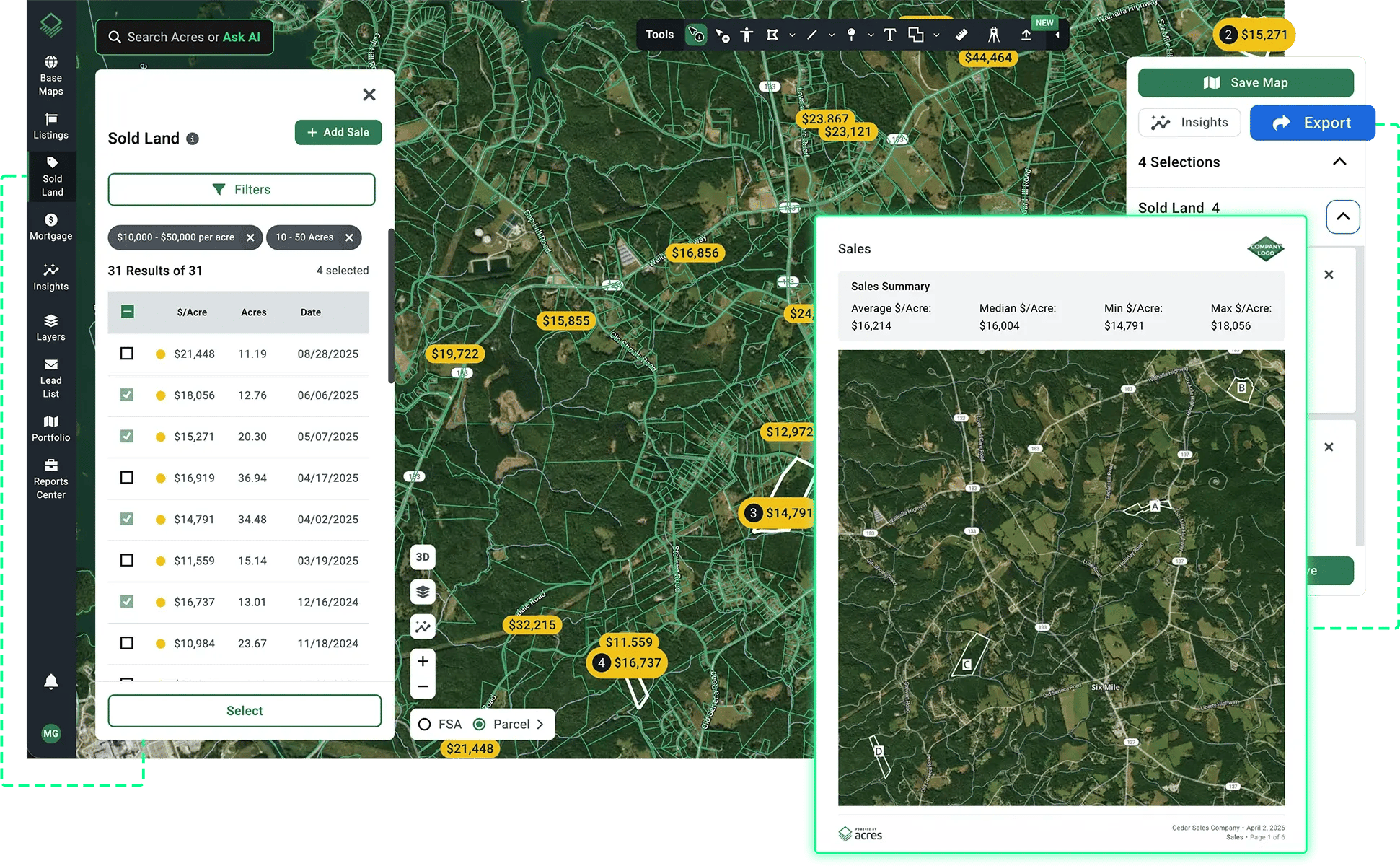
With Acres: Search and filter land instantly by acreage, county, and zoning category to find the exact parcel you need. From there, you can view nearby transaction history and comparable sales right on the map. Rather than pulling deeds from county recorders one by one, Acres surfaces transaction history directly in the parcel view so you can build a comparable sales set in one session.
Method 3: Income Approach
The income approach estimates land value by calculating the income the parcel could generate once developed or leased. An appraiser determines the net operating income a fully performing property would produce, then divides that figure by a market capitalization rate to arrive at a present value.
This method is most useful for agricultural land, timberland, and parcels with clear income-producing potential such as farmland leased to operators or land adjacent to commercial corridors. When comparable sales are sparse but income data is available, the income approach fills the gap that the sales comparison method cannot.
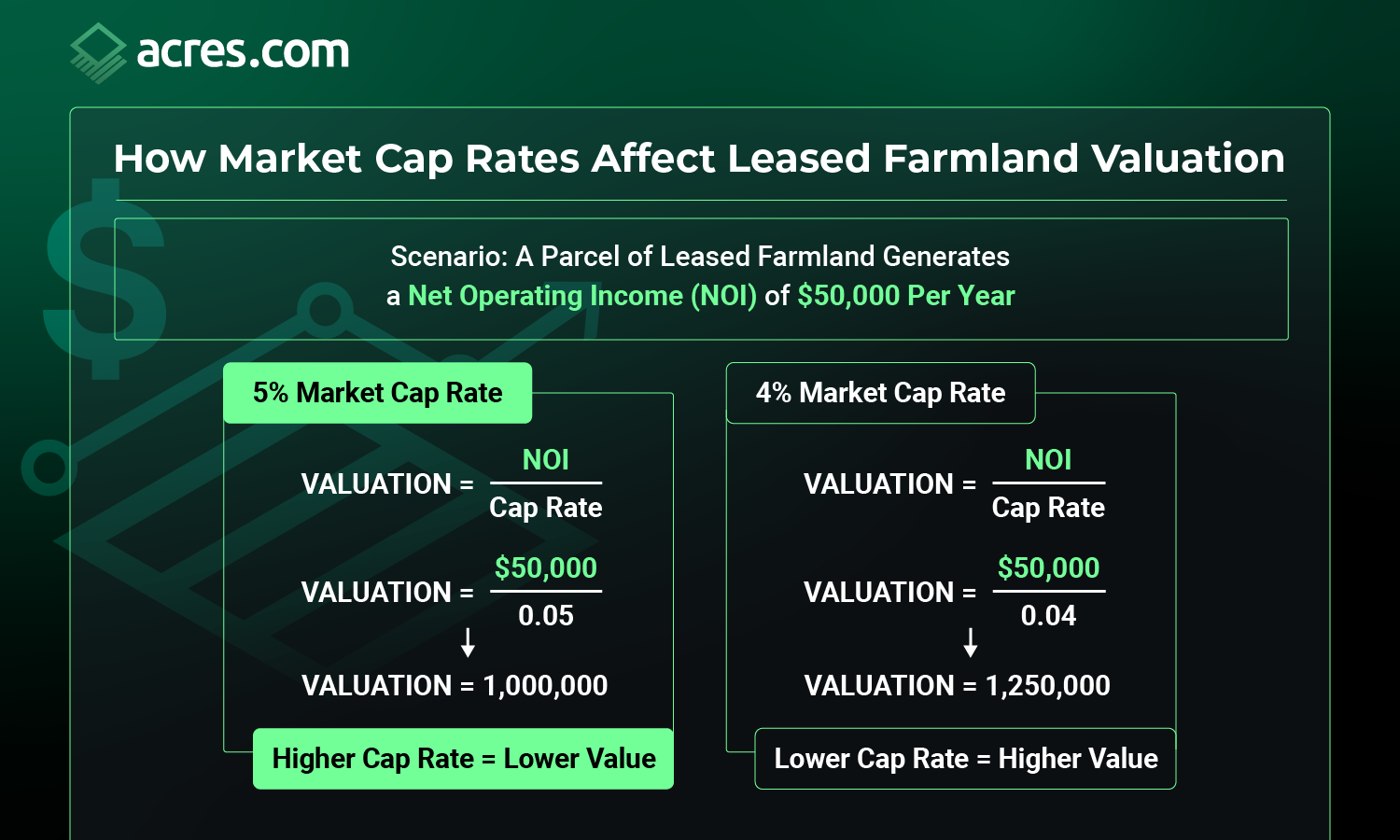
For example: If a parcel of leased farmland generates a net operating income (NOI) of $50,000 per year, its valuation will hinge entirely on the local market cap rate. At a 5% cap rate, the land is valued at $1,000,000 ($50,000 / 0.05). However, if the market shifts and the cap rate drops to 4%, the exact same piece of land jumps in value to $1,250,000 ($50,000 / 0.04).
The risk is sensitivity to cap rate assumptions. A small shift in the rate can produce a large swing in the final value. Buyers using the income approach for land valuation should validate their cap rate against recent transactions in the same asset class and region.
Method 4: Cost Approach
The cost approach estimates value by calculating what it would cost to reproduce or replace the land's improvements at today's prices, then subtracting depreciation and adding the land's base value. For truly raw land with no structures or site work, the cost approach has limited use on its own. It becomes more relevant when the parcel includes existing improvements (e.g. drainage systems, access roads, utility hookups, or structures).
Insurance assessments, new construction feasibility studies, and special-use properties are the most common applications for this land appraisal method. Most analysts treat the cost approach as a cross-check rather than a primary method for raw land.
Method 5: Residual Land Value Analysis
Residual land value (RLV) analysis is a method most used by developers, homebuilders, and commercial land investors. It works backward from the finished product. A developer estimates total revenue from the completed project (homes sold, retail leased, or lots delivered) then subtracts all hard costs (construction, materials, labor), soft costs (permits, engineering, financing, marketing), and a profit margin. What remains is the maximum price the developer can pay for the land and still make the deal work.
This is a forward-looking method that accounts for what the land can become, not just what it is today. That distinction matters in growth markets where entitled land commands a significant premium over its raw as-is value.
The RLV method requires detailed cost data and realistic revenue projections. Errors in construction cost estimates or absorption assumptions can shift the residual land value significantly, so buyers should stress-test their inputs before committing.
With Acres: Before running an RLV calculation, use Acres to review zoning classifications, parcel context, and infrastructure proximity for the target site. Understanding what a parcel is zoned for and what utilities and road access are already in place grounds your cost inputs in data before you run the numbers.
Most professionals do not rely on a single method. Triangulating two or three approaches, sales comparison as the baseline, RLV to test development potential, and HBU to frame the zoning reality, produces a valuation range with real conviction behind it. Rather than pulling each data layer from a separate source, Acres brings ownership records, zoning information, parcel details, and transaction history into a single platform so the research moves fast.
How Acres Supports Land Valuation
Accurate land valuation depends on data quality. An appraiser using stale records or incomplete ownership information will produce a number that does not hold up. Acres gives buyers and brokers access to the most extensive, complete view of land data in a single system—ownership, parcel details, zoning, environmental signals, and infrastructure context—for over 150 million parcels, without the multi-tab research process.
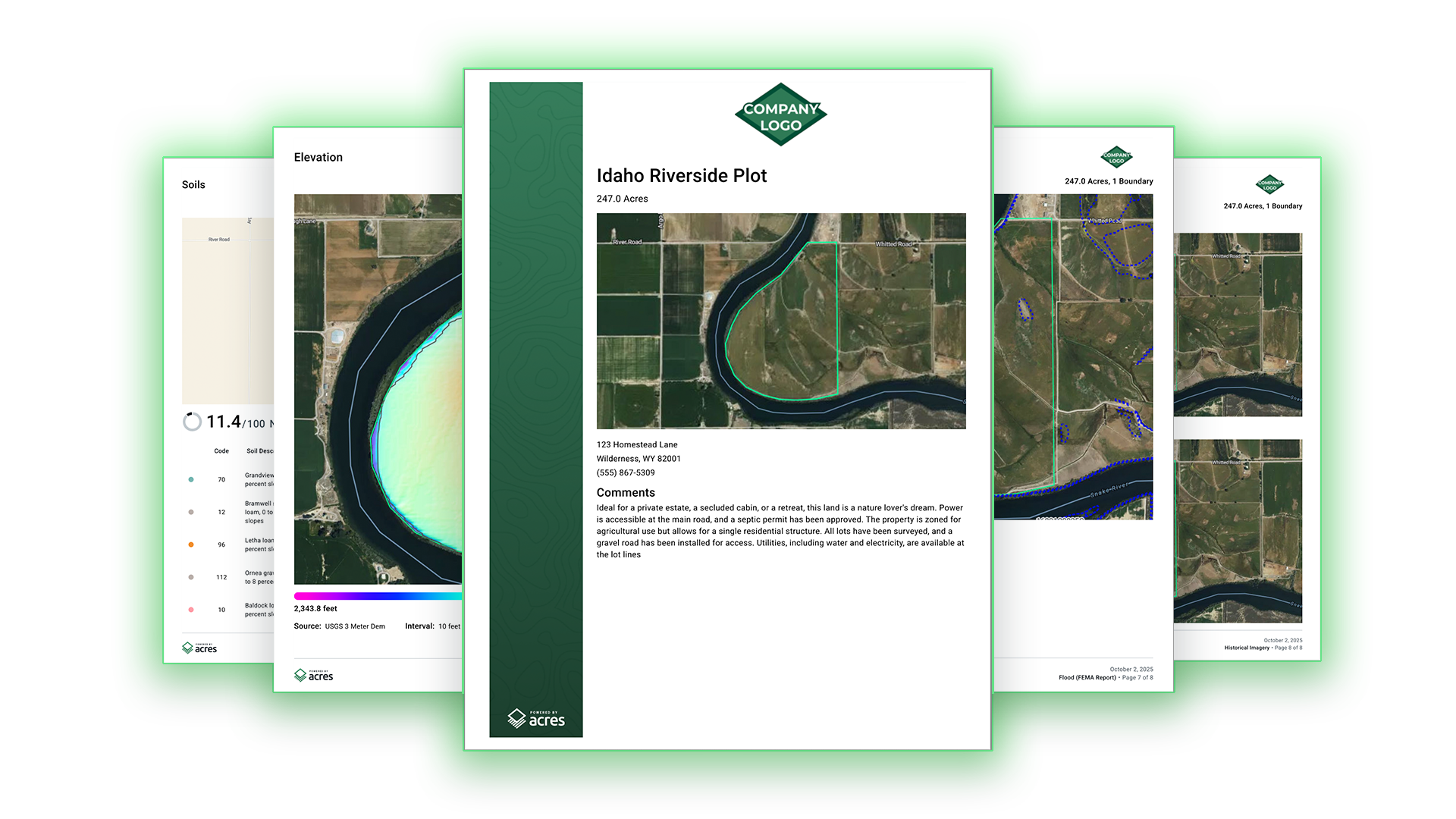
For brokers building a pricing case for a seller, Acres makes it faster to surface relevant transaction history, check zoning context, verify parcel details, and build a report. For buyers running due diligence, the platform surfaces risk signals like flood exposure, environmental constraints, access limitations that affect value before the offer goes in.
Say no faster, focus on viable deals, and outpace your competitors.
Putting It Together
Land valuation is not a single-method exercise. The sales comparison approach grounds your estimate in real transactions. The income and cost approaches add context for parcels with existing improvements or income potential. Residual land value analysis answers what a parcel can support. Highest and best use analysis ties it all together by anchoring the valuation in what the market will actually allow.
The buyers and brokers who price land with confidence are the ones who use all five methods as a system and back each one with reliable, current data. Start with a clear comparables set, layer in zoning and entitlement context, and run the residual math before any offer goes out.
Connect with us to see how your team can streamline land valuation and start building accurate land valuation reports with Acres.