Substation proximity is a land value signal that measures how close a parcel sits to high-voltage electrical infrastructure with available capacity for new large loads. In the data center land market, it is now a primary driver of parcel valuation, outranking location, acreage, zoning, and other traditional real estate variables in determining what a site is worth to a development buyer.
Power availability is the binding constraint on data center development, and a parcel's distance to a substation with available capacity determines whether that constraint can be resolved on a viable timeline. Two adjacent parcels with identical size, price, and zoning can be worth fundamentally different amounts if one sits beside a substation with available interconnection headroom and the other requires a seven-year transmission upgrade.
Acres.com surfaces substation proximity signals at the parcel level across over 150 million U.S. parcels, giving development teams and landowners the data to understand and act on opportunities.
Why Substation Proximity Has Decoupled Land Value from Traditional Real Estate Metrics
Primary North American data center markets ended 2024 at a record-low vacancy rate of 1.9%, with almost no large-scale inventory available in established hubs. That scarcity has pushed development teams into secondary and tertiary markets in search of sites with available power. Doing so has created a land market where the primary valuation variable is no longer location or acreage but confirmed grid access.
Traditional commercial real estate valuation frameworks price land on the basis of comparable sales, income potential, location relative to demand centers, and development costs. In the data center land market, these variables have been partially superseded by infrastructure signals: how close is this parcel to a substation with enough available capacity to power a data center, and how long will it take to energize?
The valuation gap between powered and unpowered land (parcels with and without confirmed substation access) is now one of the widest spread between comparable assets in any real estate category. Understanding substation proximity as a signal, rather than as a binary pass-or-fail condition, is what separates disciplined data center land investors from those relying on simplified rules that miss the nuance that determines actual value.
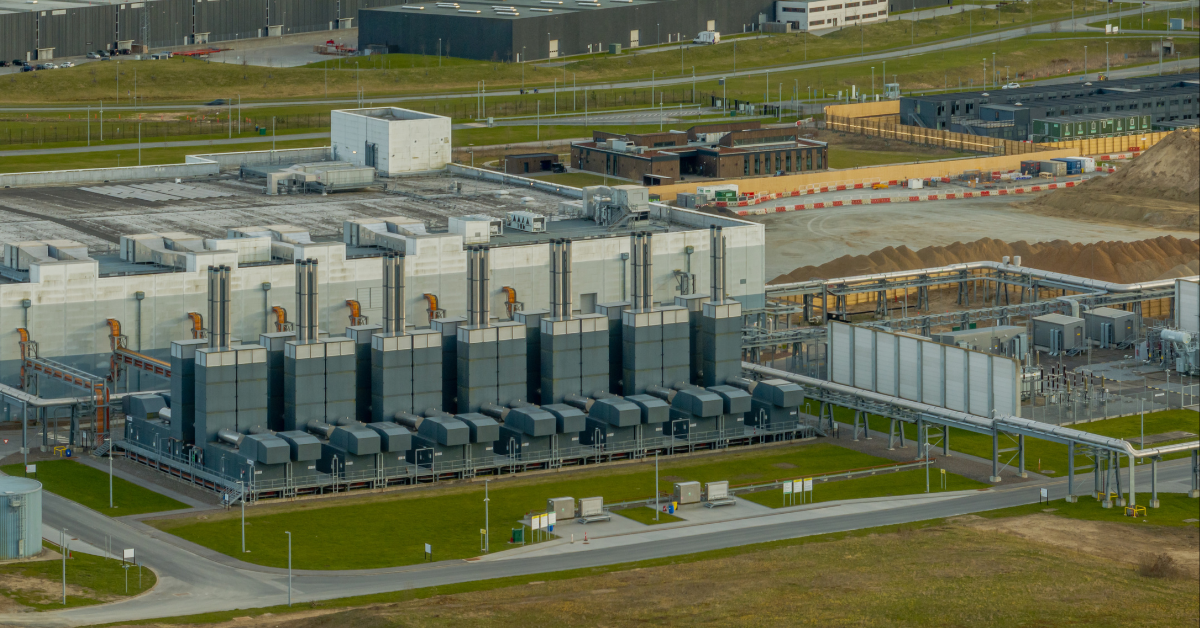
What Does Substation Proximity Actually Signal?
Substation proximity is not simply a measure of physical distance. It is a composite signal with four distinct components, each of which contributes to the land value premium independently.
Transmission voltage level
Not all substations are equivalent. A parcel adjacent to a distribution-level substation (typically below 69kV) is not the same asset as one adjacent to a bulk transmission substation (138kV to 500kV). Data center developers require connection to high-voltage transmission infrastructure for the load volumes they need to deliver. Distance to a distribution substation that cannot support a large load interconnection provides no development advantage.
Available capacity and queue position
A substation's physical capacity and its available headroom for new large loads are separate variables. A fully committed substation with no queue availability provides no practical access advantage to a new applicant, even if it sits on the parcel boundary. Development teams with experience in specific utility service territories can often determine queue availability faster than the utility's formal feasibility study process, because they track publicly filed interconnection queue data alongside their parcel-level screening.
Time to energization
The timeline from interconnection application to first energization is the most commercially consequential component of the substation proximity signal. Sites with available capacity at a well-positioned substation can be energized in 18 to 36 months. Sites requiring transmission upgrades, new substation construction, or navigation of a congested queue can face five-to-ten-year timelines. From a developer's underwriting perspective, a site with a five-year power timeline is a long-dated option, not a near-term project.
Per-megawatt premium
Institutional analysis of data center land transactions shows that the market prices confirmed utility capacity at a premium of roughly $150,000 to $400,000 per megawatt of committed capacity, depending on market tier, entitlement status, and contractual certainty. That per-megawatt framework means that a 100-acre parcel with 200 megawatts of confirmed available capacity is a fundamentally different asset than a 100-acre parcel with no power confirmation—regardless of their physical proximity to the same substation.
|
With Acres:
Acres surfaces substation proximity alongside parcel boundaries, transmission corridor presence, and utility easement data in a single map view. For development teams screening secondary markets for parcels with genuine substation proximity—not just physical distance to infrastructure, but proximity to substations with available capacity profiles—Acres provides the infrastructure context that makes the distinction between a powered land asset and an undifferentiated raw parcel.
|
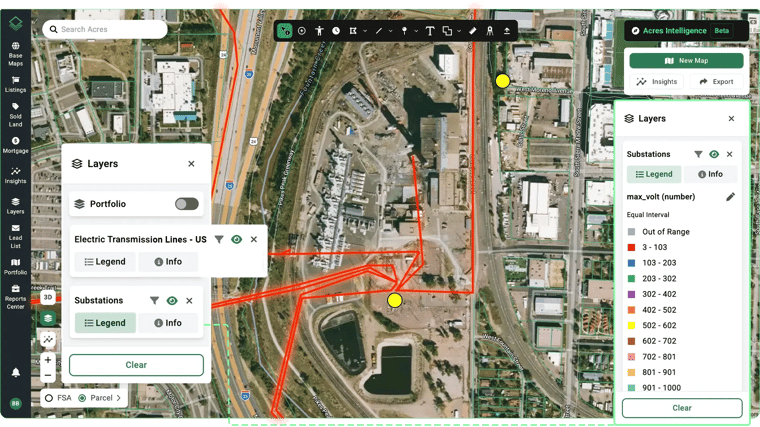
Why Does Distance Matter Less Than Capacity?
The conventional shorthand for substation proximity, expressed in miles or minutes from the nearest substation, is a useful first-order filter but a misleading final measure.
Two parcels at identical substation distance can have vastly different development timelines and value profiles depending on the capacity and queue status of the adjacent substation.
This distinction has consequences for land valuation and investment strategy. A parcel that is one mile from a substation that is fully committed to existing large loads and shows a seven-year queue for new interconnections is not a powered land asset. A parcel five miles from a substation with 500 megawatts of available headroom and an 18-month energization timeline is. The five-mile parcel has greater infrastructure value despite greater physical distance.
The practical implication is that distance-based proximity screens misidentify which parcels have genuine power access. They identify parcels near substations, not parcels near available capacity. In markets where substations are present but heavily committed, this distinction disqualifies a large portion of what would otherwise appear to be the best-positioned sites.
Sites that can deliver 20 or more megawatts of confirmed power access command a serious premium, often doubling or tripling baseline land values in the surrounding geography. That premium is not created by physical proximity alone, it is created by the intersection of physical proximity, confirmed available capacity, and a deliverable timeline.
Parcels that satisfy all components of the proximity signal are the ones that command the premium. Parcels that satisfy only one or two do not.
How Substation Proximity Creates Value Gradients Across Adjacent Parcels
In established data center corridors like Northern Virginia, Phoenix, Atlanta, the Austin-area Texas markets, the substation proximity signal has already been priced into land values for well-positioned parcels. The actionable opportunity for development teams and investors is in secondary and tertiary markets where the substation proximity signal exists but has not yet been reflected in pricing.
These markets often contain parcels in close proximity to bulk transmission substations that were built for industrial or utility purposes unrelated to data center development. When power scarcity shifts development activity toward secondary markets, those substations become data center assets, and the parcels adjacent to them reprice accordingly. The window between when the infrastructure signal becomes visible and when the market reflects it in parcel pricing is where early-mover advantage is created.
Reading that signal requires access to three data layers simultaneously: substation location and voltage level, parcel-level ownership and transaction history for the surrounding geography, and zoning classification for the candidate parcels. When a high-voltage substation with available capacity sits adjacent to industrially zoned parcels that have not yet transacted at data center land premiums, the signal stack is indicating an opportunity that has not been priced.
.png?width=1200&height=628&name=Hubspot%20Blog%20Feature%20Image%20(8).png)
Landowners whose parcels sit in genuine substation proximity need the same analysis. A parcel assessed at agricultural or light industrial values that qualifies under a rigorous substation proximity analysis may be worth significantly more to a data center developer than its current assessed value reflects. Understanding the actual power proximity signal, rather than just knowing there is a substation nearby, is what determines whether a landowner's best path is conventional sale or a ground lease structured around the power asset the parcel represents.
What Redundancy Requirements Add to the Substation Proximity Analysis
Enterprise and hyperscale data center operations typically require power supply redundancy—the ability to maintain operations if one power source fails. This operational requirement translates directly into a site selection criterion: the most valuable data center land sites have access to two or more substations on diverse transmission paths, not just one.
This redundancy requirement adds a layer of complexity to substation proximity analysis. A parcel with excellent proximity to a single substation but no viable second route has a lower structural reliability ceiling than a parcel with moderate proximity to two substations on independent transmission pathways.
The redundancy means that substation proximity analysis is not just a point-to-point distance calculation but a network analysis: which substations are accessible from this parcel, at what voltages, with what available capacity, and through how many independent transmission paths? That analysis is how development teams distinguish sites that can support the highest-value data center operations from sites that are limited to lower-tier deployments.
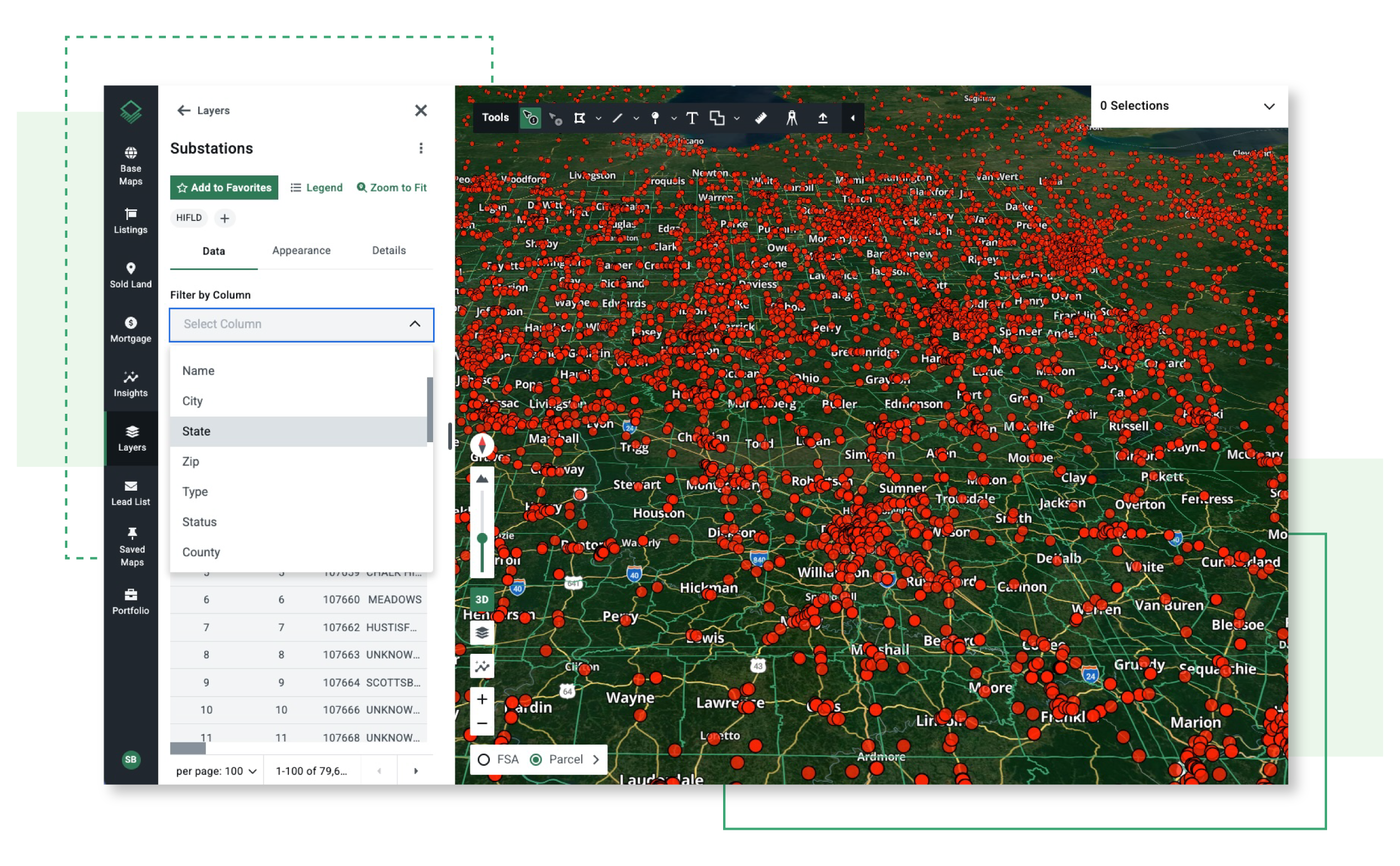
Rather than pulling substation data, parcel ownership records, transmission corridor maps, and zoning classifications from separate sources, Acres integrates all of these signals at the parcel level so substation proximity analysis runs alongside ownership, zoning, and transaction history in the same platform. The distinction between a parcel that is near a substation and a parcel that has genuine power access is visible in the data—and visible faster when it does not require assembling that data from a dozen separate portals.
How Acres Surfaces Substation Proximity as a Land Value Signal
Substation proximity is a parcel-level signal. Its value depends on the specific geography, the transmission infrastructure adjacent to each candidate site, and the ownership and transaction context of the surrounding parcels.
Acres gives data center development teams and landowners access to the most extensive, complete view of land data in a single system—parcel boundaries, ownership records, zoning classifications, infrastructure proximity signals, and transaction history—for over 150 million U.S. parcels. See a complete, connected view of ownership, risk, and opportunity, instantly. Explore substation proximity and infrastructure context on Acres.
For landowners evaluating whether their parcels qualify for data center development premiums, Acres provides the infrastructure proximity context that determines which side of the powered-land divide a specific parcel sits on. For development teams running multi-market screens, Acres compresses the substation proximity analysis from multi-week research into a same-session review. Use land value and infrastructure analysis on Acres to surface the signal before the market prices it.
The Signal Behind the Signal
Substation proximity is a primary land value signal in the data center market, but it is not a single-variable measure. Physical distance to a substation is the starting point, not the conclusion. What matters is whether that substation has available capacity, a viable timeline for new large-load interconnection, and the voltage level required for the load being planned. Distance without capacity is proximity without value.
The development teams and investors who can read this signal accurately are the ones finding assets that the market has not yet repriced. That advantage is built on parcel-level infrastructure data, current transaction records, and the ability to run a substation proximity analysis at geographic scale before other buyers have the same picture.
Ready to evaluate substation proximity and infrastructure signals for candidate parcels in your target market? Explore parcel-level power infrastructure context, ownership, and transaction history on Acres. Book a demo and start your substation proximity analysis on Acres.
.png)