Price per acre is a standardized ratio: total purchase price divided by total acreage. It is the most widely used metric in land buying and one of the most frequently misread. Two parcels in the same county can show identical price per acre figures while being separated by a 10-to-one difference in actual investment value. The number is not wrong, it is incomplete.
Knowing how to interpret land price per acre correctly is what separates buyers who make confident offers from those who make expensive mistakes. This article explains what the metric captures, what it misses, and what to check alongside it before any offer is written. Acres.com surfaces the parcel-level context that makes price per acre meaningful rather than misleading.
Why Price Per Acre Is the Most Misused Metric in Land Buying
Price per acre at its best lets buyers compare parcels of different sizes on a per-unit basis—the land equivalent of price per square foot in residential real estate. At its worst, it creates a false equivalence between parcels that have nothing in common except their acreage.
The national average cost of one acre of land in the U.S. is around $20,000, but that single number spans everything from $500 per acre for remote, roadless rural acreage to well over $100,000 per acre for commercial land near urban centers. Treating the national average as a benchmark for any specific parcel is like using national average home prices to evaluate a specific neighborhood.
Even within specific use categories the range is wide. U.S. farmland averaged $4,350 per acre in 2025, but cropland averaged $5,830 per acre while pastureland averaged $1,920—a ratio of more than three to one within the same asset class.
Price per acre tells you where a parcel sits on a spectrum. It does not explain why.
What Price Per Acre Does Well: Rapid Comparison
Within a well-defined geography and a consistent parcel type, price per acre is a genuinely useful screen. A buyer evaluating rural residential parcels in the same county can use it to quickly identify outliers such as parcels priced meaningfully above or below the local range. That outlier signal is actionable: a parcel priced well below comparables is either a deal or a problem. Finding out which one requires deeper research, but price per acre surfaces the question fast.
The calculation is straightforward. A 25-acre parcel listed at $309,900 has a price per acre of $12,396. A nearby 18-acre parcel at $247,500 works out to $13,750 per acre, making the first parcel cheaper on a per-unit basis even though its total price is higher. That comparison is genuinely useful at the screening stage.
|
With Acres:
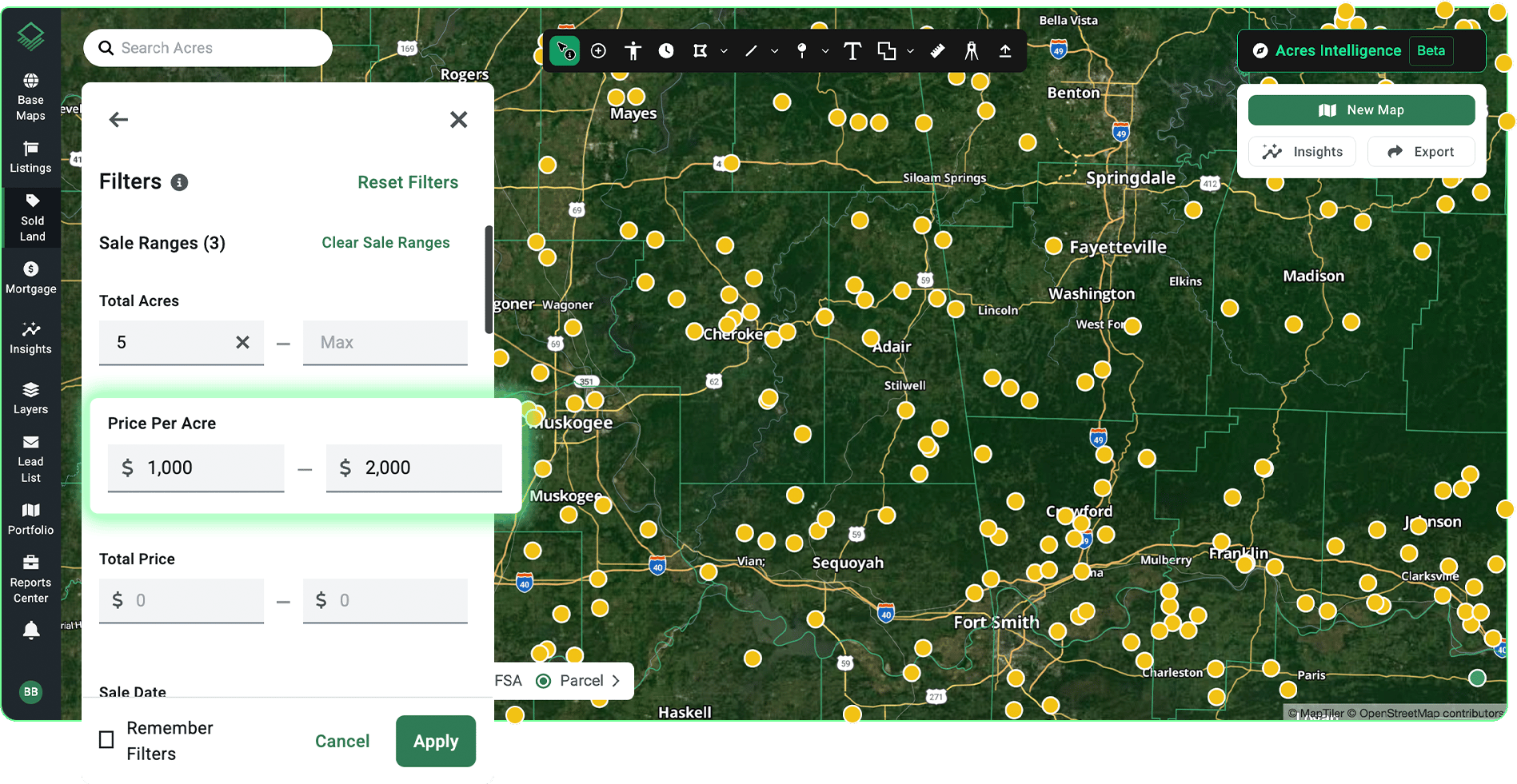
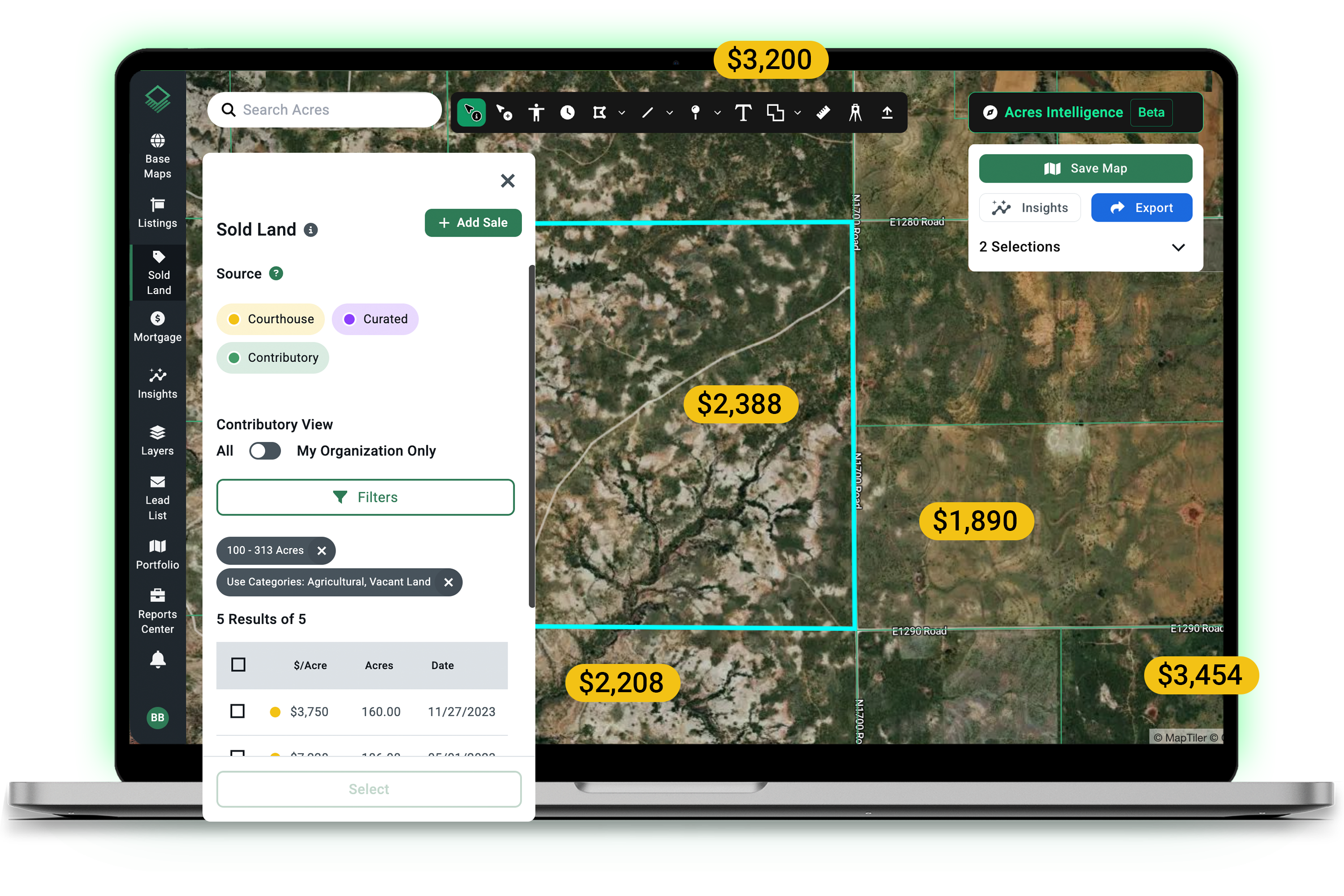
When building a comp set for any target parcel, use the Acres parcel search to filter recent comparable land sales by acreage range, zoning category, and county. Price per acre comparisons are only reliable when the underlying parcels are actually comparable - and the comparable sales filter on Acres makes that validation fast.
|
The Four Factors That Make the Same Price Per Acre Mean Very Different Things
Location within a market, not just the market itself, drives most of the price variation that identical price per acre figures hide. A parcel at the edge of a city's growth boundary can be worth multiples of a similar parcel 10 miles further from infrastructure, even in the same county, at the same acreage. Land in the path of development prices that future demand in advance.
Legal access determines whether a parcel is financeable and usable. A parcel with no recorded easement providing legal access to a public road is landlocked, regardless of how it is listed. Landlocked parcels usually cannot be financed through institutional lenders. Their price per acre is low for a specific reason.
Utility infrastructure availability adds or subtracts value that price per acre does not show. A parcel with water and power at the boundary is fundamentally different from one that requires a $60,000 utility extension before any construction is possible. Both parcels can show the same price per acre.
Zoning and permitted use sets the ceiling on what the land can become. Two adjacent parcels with identical acreage and access can have dramatically different values if one is zoned for residential subdivision and the other is locked into agricultural use with no path to rezoning. Price per acre is blind to this distinction.
Why Larger Parcels Can Show a Lower Price Per Acre and Why That Can Be Misleading
Larger tracts consistently sell at lower per-acre prices than smaller parcels in the same market. This is partly a liquidity discount —the buyer pool for 500-acre parcels is far smaller than for 5-acre lots—and partly a reflection of parcel composition. Large rural tracts often include lower-value acreage: steep terrain, wetlands, or remote areas with limited development potential.
A buyer comparing a 5-acre developed lot at $15,000 per acre to a 200-acre rural tract at $3,000 per acre and concluding that the large tract is the better value is comparing two entirely different assets. The per-acre discount on the large tract reflects its limited usability and smaller buyer pool, not an exploitable mispricing.
Understanding this distinction is why land valuation requires comparable sales analysis, not just price per acre math. Running land comps on Acres surfaces the transaction history and parcel context needed to make that comparison meaningful.
What to Check Alongside Price Per Acre Before Making an Offer
Price per acre earns its usefulness when paired with the data it cannot show on its own. Before any offer is written, buyers should verify: legal road access via recorded easement, utility availability and estimated connection cost, zoning classification and permitted uses, flood zone designation and environmental constraints, recent comparable sales in the same parcel type and geography, and ownership history including any title encumbrances.
Each of these factors can move the effective value of a parcel up or down relative to its listed price per acre. A parcel priced 20% below the local average is not necessarily undervalued, it may simply be priced accurately for its access, zoning, or environmental constraints.
The most reliable land price comparison happens when all of these variables are visible in the same research session. Rather than pulling flood zone data from FEMA, zoning from a county GIS portal, and sales history from a deed recorder, Acres brings ownership, parcel context, zoning, environmental signals, and transaction history into one platform, so price per acre sits alongside the variables that explain it.
How Acres Puts Price Per Acre in Context
Acres gives buyers access to the most extensive, complete view of land data in a single system—ownership, parcel details, zoning, environmental signals, and infrastructure context—for over 150 million U.S. parcels. That means price per acre figures are never isolated numbers. They sit alongside the access, zoning, environmental, and comparable sales data that explains them.
Weeks of land research become minutes with complete land data. If your team can describe the parcel type, geography, and price range they are targeting, they can find it on Acres with the context needed to evaluate it, not just list it.
Use Price Per Acre as a Screen, Not a Verdict
Price per acre is the right metric to start with but can be the wrong metric to close with. It works well for identifying where a parcel sits within a local range and for flagging outliers worth investigating further. It fails as a standalone valuation tool because it cannot see access, utilities, zoning, environmental constraints, or market-specific demand drivers.
Buyers who treat land price per acre as a complete picture tend to overpay for cheap parcels with hidden constraints or talk themselves out of well-priced parcels with embedded infrastructure value. The metric earns its usefulness when paired with the parcel-level context that explains it.
Ready to build a proper comparable sales report for your target parcels? Explore land price per acre data, comparable sales, and parcel context for any U.S. county on Acres. Book a demo with our team to see how.