For years, many of the largest homebuilders and real estate developers in the U.S. bet on building their own data and analytics platforms in house. A national homebuilder or master-planned community developer could stand up an internal GIS team, hire some data engineers, and reasonably expect that platform to serve a subset of business needs with modest upkeep.
For the country's largest residential and land developers managing thousands of parcels, dozens of active markets, and acquisition pipelines that move on weekly if not daily cycles, the rise of AI has flipped the build vs. buy decision framework.
What used to be a durable, multi-year investment in internal tooling is now depreciating faster. And that's putting even the most well-resourced development and land acquisition teams in a tough spot. While competitors move fast with better data and AI, teams can get stuck maintaining an aging, costly system often falling behind instead of keeping pace.
Contents
Understanding Build vs. Buy: Why Building In House Made Sense
AI is Moving Faster Than Internal Tools Can
Why More Teams Are Choosing to Buy
Build vs. Buy Software Comparison Table
What the "Buy" Advantage Looks Like for Development Teams
The Real Question Isn't Build vs. Buy Anymore, It's Speed vs. Maintenance
Understanding Build vs. Buy: Why Building In House Made Sense
Build vs. buy is a decision framework that companies use when they need a new capability. Building means creating a tool or system in house with an internal team. Buying means paying for an existing platform or vendor that already does the job. The choice usually comes down to cost, control, speed, and how much the capability matters to the core business.
For a long time, building in-house was well within reach. Large builders and developers have engineering budgets, data science talent, and proprietary deal flow that smaller competitors typically don't. Building an internal parcel database, a custom underwriting model, or market dashboard felt like a durable competitive advantage, something a public REIT or a top builder could justify with a sound strategy and dedicated internal team.
That model tended to work well when the underlying technology moved slowly. A data pipeline built in house could often run largely unchanged for years. Differentiation came from proprietary data and process, not from how quickly the underlying tech stack itself was evolving.
AI is Moving Faster Than Internal Tools Can
AI for zoning research, market intelligence, parcel-level risk analysis, and competitive tracking are evolving on a timescale of weeks and months, not years. New models, new data integration methods, and new capabilities are evolving constantly. That creates three specific problems for internal platforms at large development organizations:
1. Maintenance costs tend to compound rather than flatten out over time. An internal tool built years ago on a pre-AI framework often needs more than a simple refresh. It needs to be restructured to take advantage of what AI can now do: things like automated zoning ladder research, live market dashboards, LLC unmasking for competitive footprint analysis, and predictive demand modeling. Retrofitting AI into a legacy internal system is frequently more expensive than the original build.
2. The talent required to keep pace can also be harder to hire and retain than the talent required to build the first version. Standing up a v1 internal tool is one hiring problem. Keeping a team current on rapidly evolving model capabilities, data pipelines, and AI infrastructure, while also running day-to-day land acquisition and development operations, tends to be a different, ongoing hiring problem. For many development organizations, that's not the core business, and it's increasingly hard to compete for that talent against companies where AI infrastructure is the core business.
3. Opportunity cost tends to show up in deal velocity, not just IT budgets. Every month spent maintaining or rebuilding an internal data platform is often a month the land acquisition team isn't using best in class tools to move faster than competitors. In a market where the fastest team to underwrite, diligence, and act on a parcel often wins the deal, that opportunity cost can compound quickly, and it tends to be harder to see on a budget line than a software subscription would be.
Why More Teams Are Choosing to Buy
This is part of why many of the largest builders, developers, and land investors are reconsidering internal build-out and moving toward specialized, continuously updated platforms. The logic has become straightforward: a vendor whose business decisions are guided by powerful land data and AI are able to move faster, invest more, and iterate more consistently than an internal team juggling this alongside many other priorities.
That doesn't mean proprietary advantage goes away. It just means proprietary advantage moves up the stack, from owning the infrastructure to owning the strategy, the relationships, and the judgment applied on the data.
The differentiation shifts from "we built our own zoning database" to "we act on complete zoning and market data faster and more precisely than anyone else in this market."
Build vs. Buy Software Comparison
| Metric |
Building In-House (Custom Internal Software) |
Buying (Off-the-Shelf / (SaaS) |
| Customization |
Pro: Creative freedom with design, unique experience, and custom workflow/software integrations. |
Con: Varying levels of customization; must verify if vendor flexibility meets specific functionality needs. |
| Control & Features |
Pro: Control over system updates, feature rollouts, security, and niche business models. |
Pro: Built-in functionality to drive growth out of the box. |
| System Integration |
Pro: Can be tailored to blend with existing enterprise tools and cloud marketplaces smoothly. |
Depends on vendor capability and built-in integration support. |
| Updates & Maintenance |
Con: Internal team is responsible for system maintenance, repairs, and upgrades. |
Pro: Automatic updates, maintenance, and system upkeep provided by the SaaS vendor. |
| Cost |
Con: Higher upfront and ongoing costs (upgrades, maintenance, keeping up with trends). |
Pro: Net savings and generally lower costs over time. |
| Time & Deployment |
Con: Significant time and effort required to build. |
Pro: Available for immediate access and deployment upon acquisition. |
| Scalability |
Variable depending on internal architecture quality. |
Pro: Often more scalable and reliable under increased traffic or transaction volumes as the company grows. |
What the "Buy” Advantage Looks Like for Development Teams
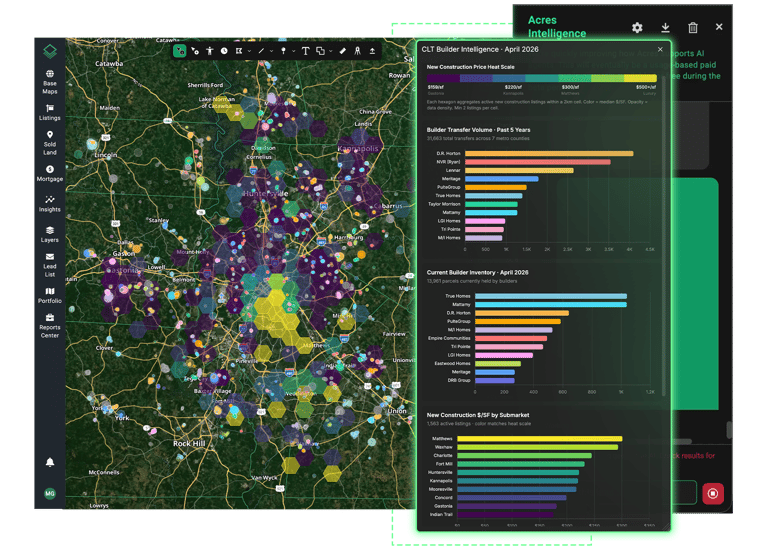
For national and regional builders and developers, this shows up as a shift toward platforms that combine complete, current land data with AI purpose-built for land decisions — rather than internal teams trying to build AI into legacy spreadsheets, static reports, or aging in-house GIS tools. In practice, that can look like:
- Automated zoning reports that translate municipal and county codes alongside state and federal datasets in seconds instead of weeks of manual research.
- Live, continuously updated market dashboards instead of Excel models that go stale the moment they're built.
- Competitive footprint visibility including LLC unmasking without a team of analysts digging through fragmented state filings and corporate registries.
- Predictive demand and site-selection intelligence built on nationwide parcel data rather than one team's regional dataset.
The teams making this shift aren't doing it because they lack the resources to build. They're doing it because the fastest way to keep pace with AI is to let a dedicated platform absorb the R&D burden, and redirect internal resources toward sourcing, underwriting, and closing deals.
The Real Question Isn't Build vs. Buy Anymore, It's Speed vs. Maintenance
For the largest developers in the U.S., the competitive edge was rarely about owning software. It was about acting on better information faster than the market. AI has made that possible at a scale and speed that internal teams, even the largest ones, struggle to match on their own.
The organizations moving faster on land deals right now are the ones that recognized this and redeployed their internal talent toward strategy and execution, while letting a dedicated land intelligence platform carry the weight of keeping pace with AI.
Book a demo to see how Acres Intelligence gives development teams complete land data and AI agents built specifically for site selection, zoning research, and competitive intelligence — without the internal build burden.
-Jul-21-2026-08-54-40-7123-PM.png)