By the time a land market shows up in the headlines, the best parcels are already under contract. Buyers who spot momentum early do not rely on median price reports or listing volume counts. They read building permit data, one of the few leading indicators in real estate that signals what is about to happen, not what has already occurred.
Building permits are filed before ground gets broken. A consistent rise in construction permit activity in a specific county or ZIP code tells you that builders see qualified demand. That is a buy signal worth acting on months before the market becomes competitive.
Acres.com surfaces parcel-level and market-level context so buyers can evaluate opportunity zones before they price up.
Contents
When Traditional Real Estate Analysis Fails Land Buyers
What Building Permits Actually Tell You
How to Read Permit Trends
Permit Data as a Land Acquisition Screen
Permit Type Breakdown: What to Watch
Using Market Context Alongside Parcel Data
When Traditional Real Estate Analysis Fails Land Buyers
Most real estate market analysis is backward-looking. Closed sales data, median price trends, and market statistics all describe what the market did. By the time those numbers are published and widely circulated, the window for early positioning has usually closed.
Land buyers face this problem acutely. Raw and transitional land takes time to develop. A buyer who identifies a growing market six months before peak competition can often negotiate better pricing and structure better deal terms than a buyer entering the same market 12 months later when demand is obvious to everyone.
Building permit data is one of the sharpest tools for this purpose. The U.S. Census Bureau and Department of Housing and Urban Development publish monthly permit counts by geography through the New Residential Construction Report. Permit volumes typically precede housing starts by several months, leading to completed single-family sales in 6 to 9 months, or up to 18 months for large-scale multi-family developments.
Tracking permit trends across target geographies gives land buyers an information edge that most of their competition does not have.
What Building Permits Actually Tell You
A building permit is a municipality's authorization for construction activity. Before any significant building work begins (new residential units, commercial structures, major renovations), a permit must be filed. That filing creates a public record.
When permit volumes rise consistently in a given area, builders are signaling confidence. They are committing capital to projects because they believe buyers and renters will be there when the units deliver. According to research from the University of Florida covering 100 years of local building permit data, permit volume volatility is a strong predictor of future asset market volatility—even after accounting for household leverage, population growth, and macroeconomic conditions.
For land buyers, the implication is direct: consistent growth in construction permit activity in a specific county or submarket indicates demand that is real and developer-validated, not just speculative.
How to Read Permit Trends by Geography
Permit data is most useful when read at a local level. National permit totals describe the housing economy in aggregate. What matters for land acquisition is the signal at the county, ZIP code, or submarket level.
Markets posting year-over-year permit growth tend to share common characteristics: population in-migration, job creation, affordability relative to larger metros, and available land for development.
In 2025, markets including Winston-Salem in North Carolina, Knoxville in Tennessee, and Des Moines in Iowa posted consistent permit gains while many coastal metros pulled back—a pattern that reflected job growth, affordable land, and strong demand rather than speculative activity.
Conversely, markets where permit volumes are falling sharply often signal builders pausing due to tightened lending, rising construction costs, or softening absorption. For buyers, a permit decline in a previously strong market is worth investigating before committing to an acquisition in that geography.
Permit Data as a Land Acquisition Screen
Smart buyers use building permit data as a first-pass screen for geographic focus. The workflow looks like this: identify metro areas or counties with consistent 12-to-24-month permit growth, cross-reference that activity with available land parcels in those geographies, then run deeper due diligence only on markets where the permit signal and the parcel opportunity align.
This approach helps buyers say no faster. A parcel in a county with flat or declining construction permit activity faces a harder path to development-driven demand than a comparable parcel in a permit-growth market. Filtering by market momentum before running parcel-level analysis saves significant time.
The permit signal is particularly useful for identifying markets in early growth phases. Market analysts and investors rely on building permit data to gauge economic activity and spot undervalued assets before the broader market catches on. The earlier the signal is read, the wider the acquisition window.
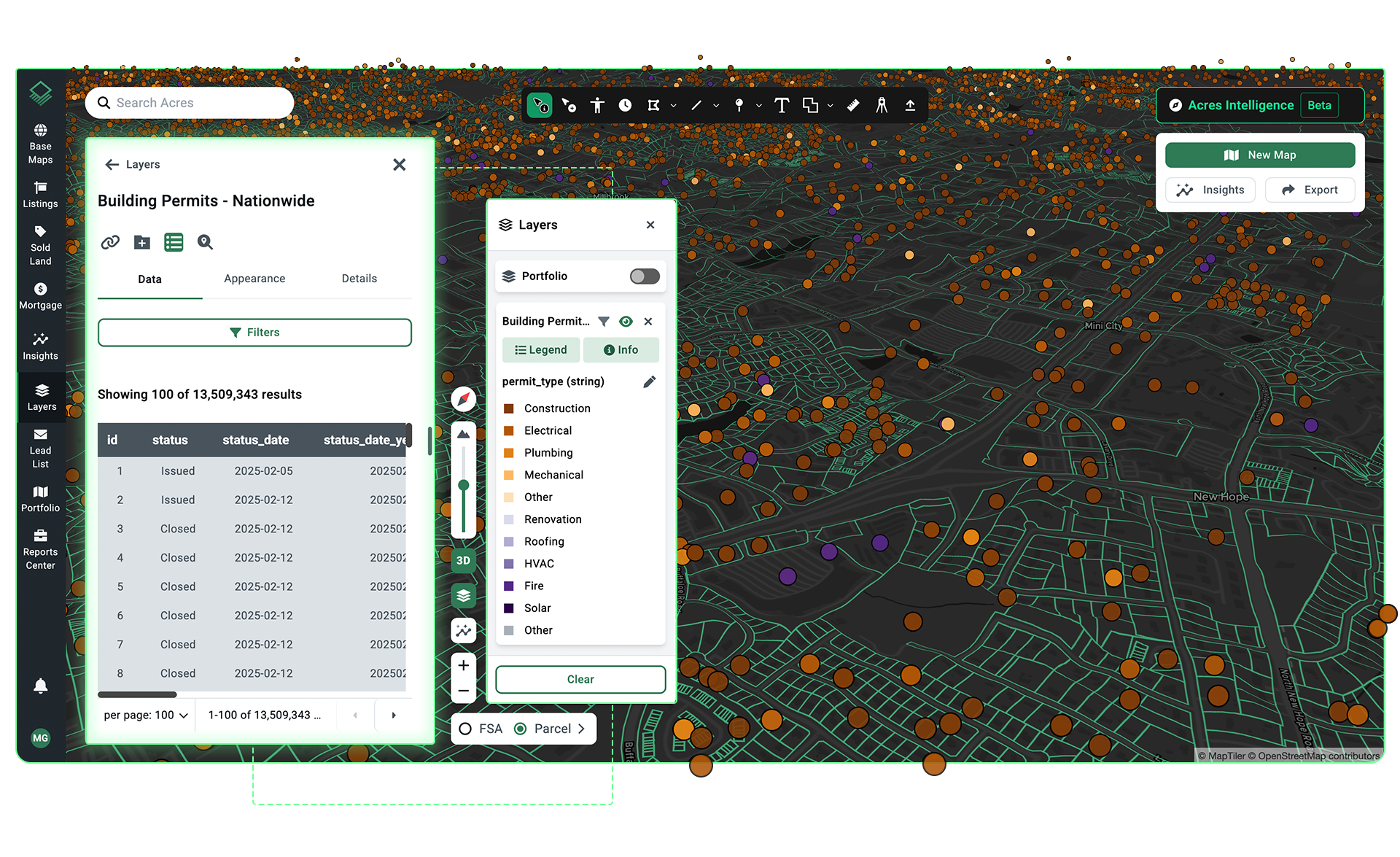
Acres Tip: Evaluate growth hotspots with building permit data players that you can visualize right on the map. Then, evaluate whether target parcels in high-permit-activity markets have the site characteristics (road access, zoning, environmental profile) you need.
Permit Type Breakdown: What to Watch
Not all permits signal the same thing. Single-family permits indicate demand for for-sale residential products and are the most direct signal for land buyers targeting lot development or rural residential markets. Multi-family permits point toward rental demand and urban infill opportunity. Commercial and industrial permits signal economic activity and employer growth - relevant context for buyers evaluating land near employment centers.
Tracking permit type alongside total volume gives a richer picture. Unlike lagging indicators like home sales or price indices, permit data provides a forward-looking lens, often signaling a shift in market conditions before other metrics catch up. A market posting strong single-family permit growth alongside population in-migration and job creation is a fundamentally different opportunity than a market posting multi-family growth driven primarily by investor activity.
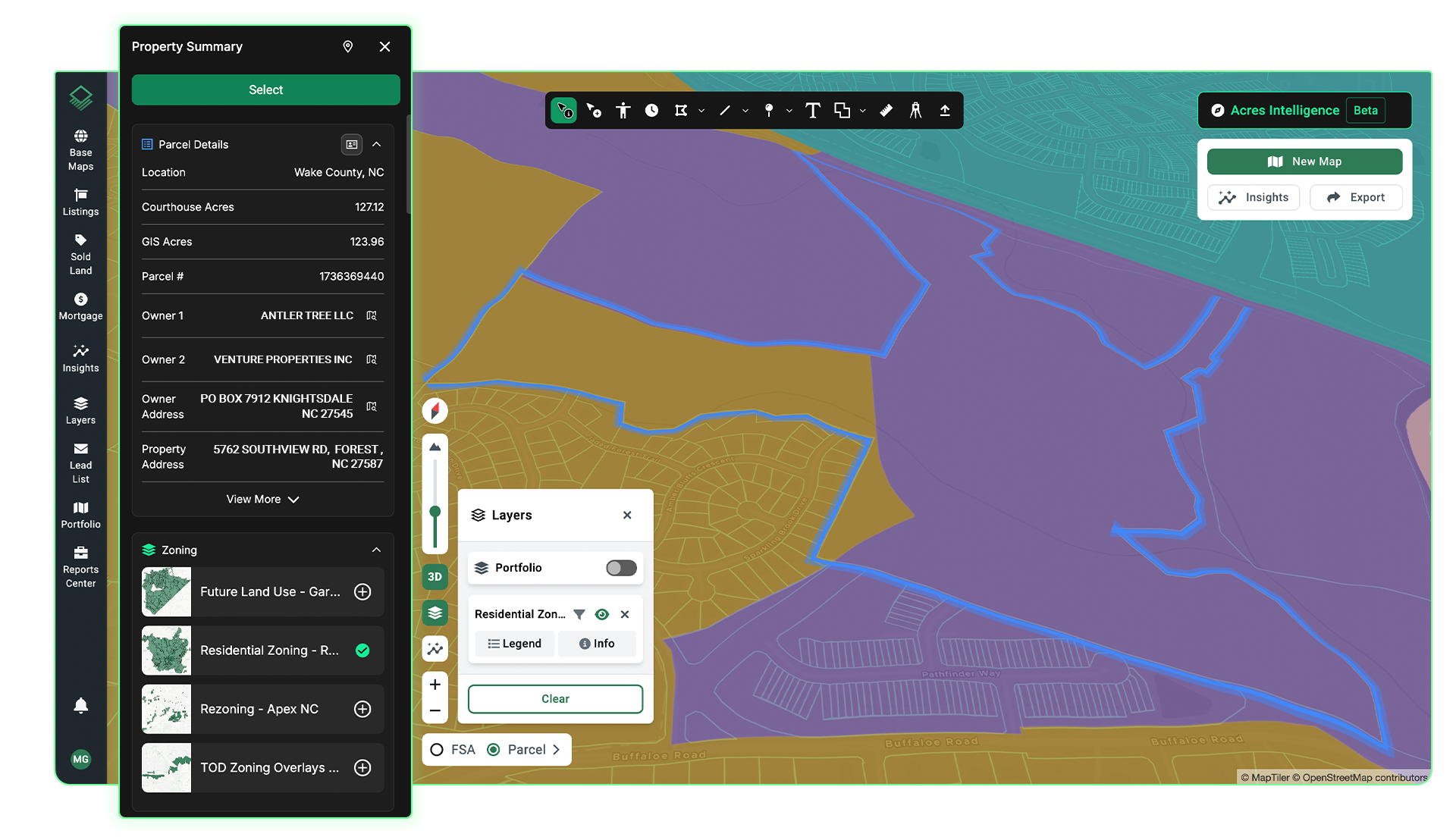
Building permit data does not give you the answer on its own. It tells you where demand is forming. Layering that signal with parcel-level context (zoning, access, ownership, environmental constraints) is what turns a market indicator into an actionable acquisition decision. Rather than pulling permit data from government portals and parcel data from county records separately, Acres brings the site-level context together so buyers can evaluate opportunity and risk in the same session.
Using Market Context Alongside Parcel Data
Identifying a high-permit market is the first step. The second is evaluating whether specific parcels in that market can support the demand driving the permit activity. That means checking zoning classifications, road and utility access, environmental risk factors, and ownership status, the information that determines whether a parcel is positioned to benefit from market momentum or sitting outside the path of development.
Acres gives buyers access to the most extensive, complete view of land data in a single system, for over 150 million parcels nationwide. When you identify a target geography through permit trend data, you evaluate the individual parcels within it—all within the same platform.
See a complete, connected view of ownership, risk, and opportunity, instantly.
Read the Signal Before the Market Does
Building permit data is one of the most underused tools in land acquisition. It is public, granular, and consistently forward-looking. Markets with rising construction permit activity are telling you, in quantified terms, that builders see viable demand. For land buyers, that is a reason to look closer—before the market gets crowded.
The most effective approach is to use permit trend analysis to focus geographic attention, then layer in parcel-level data to evaluate individual opportunities. The buyers who get ahead of the market are the ones who read both signals together and act before the momentum becomes obvious to everyone else.
Ready to evaluate building permits and parcels in your target markets? Contact our team and see how you can evaluate promising opportunities with confidence.