Trends
Kosciusko County, Indiana Farm Sells for $20,000 an Acre
Kosciusko County farm sells for $20,000 an acre, highlighting strong demand for high-quality farmland in Indiana.
Florida SB 686 creates a fast-track path to convert qualifying agricultural land for development. Learn how it works and who qualifies before 2028.
Once Florida Senate Bill 686 takes effect on July 1, 2026, land acquisition teams will have an 18-month window to convert qualifying agricultural parcels into development sites, compressing what historically took years of rezoning into under a year on qualifying sites.
This opportunity comes from Florida Senate Bill 686 (SB 686), signed into law in April 2026. The law creates an expedited path for "Agricultural Enclaves," giving developers and acquisition teams the ability to bypass the standard rezoning process and fast-track land-use changes on qualifying parcels.
Here's how SB 686 works, which parcels qualify, and how acquisition teams are finding the right sites before the broader market reacts.
What are the Eligibility Requirements for SB 686?
How to Identify SB 686 Opportunities with Acres Intelligence
The Developer Advantage: Faster Approvals and Regulatory Certainty
The SB 686 Sunset Provision and Deadline
Securing a Competitive Advantage in Florida Land Acquisition
SB 686 is designed to address agricultural parcels that have been isolated by suburban growth while remaining under restrictive rural zoning. Under the new law, if a property meets specific criteria, local governments lose their traditional discretionary power to deny development. Instead, the approval process becomes a mandatory, administrative action.
This shift ensures that if the land qualifies as an agricultural enclave, the local government must allow a land-use change that is consistent with the surrounding developed area.
To qualify under SB 686, a property must meet several requirements. The criteria must have been satisfied as of January 1, 2025. Parcels that became enclaves after that date may not qualify.
Qualifying parcels must meet the following:
For more in-depth details on SB 686 requirements and eligibility, please visit the official Florida Senate site.
For builders, developers, and acquisition teams, manual county-by-county searches won't surface qualifying parcels fast enough to beat competing teams to the owner.
This is where Acres Intelligence becomes a critical advantage for acquisition teams.
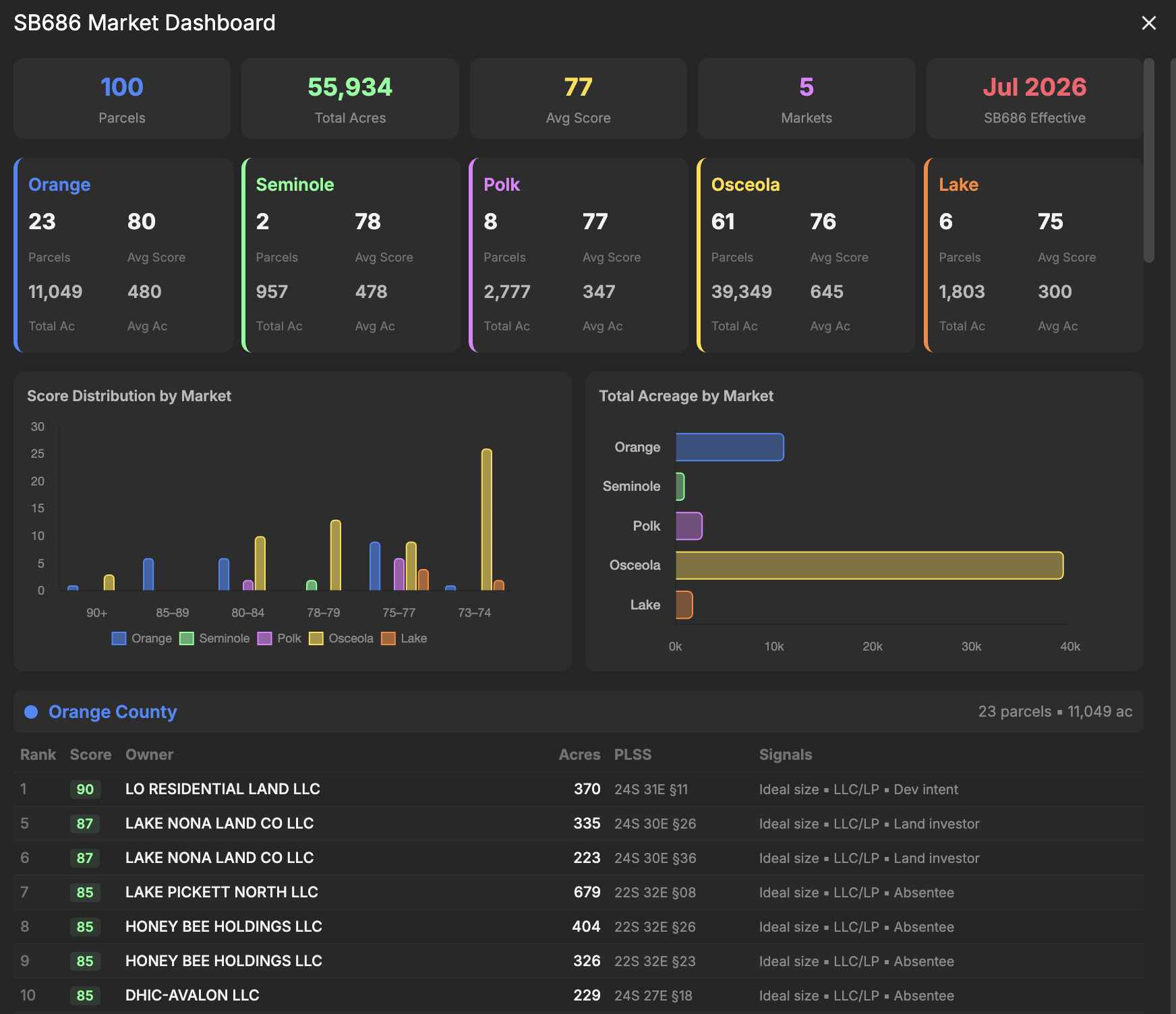
SB 686 Market Dashboard Generated by Acres Intelligence.
Rather than performing manual county-by-county searches, developers can use Acres Intelligence to generate a personalized, customizable market dashboard that ranks and scores parcels based on their suitability for residential development under SB 686.
With Acres, teams can:
Together, these capabilities compress weeks of manual research into a single workflow, and give acquisition teams a head start on the parcels worth pursuing. The result is a defensible pipeline of SB 686 candidates, scored and prioritized before competing teams have finished their first county search.
For developers in Florida, SB 686 provides a streamlined alternative to the standard land-use conversion process:
Developers are no longer required to petition local boards for higher density allowances. The law mandates that a certified enclave be granted the same density and intensity as the adjacent developed parcels. This ensures the new project remains consistent with the surrounding area while allowing for precise financial modeling.
Local governments often block projects by citing a lack of urban services like water and sewer. SB 686 requires municipalities to treat an enclave adjacent to an urban service district as if it is already within that district. This ensures the local government accommodates growth rather than using infrastructure as a reason for denial, provided the developer covers their proportionate costs.
Within 30 days of receiving an application, the local government must issue a written report on whether the application complies with the eligibility requirements. Within another 30 days, it must hold a public hearing to approve or deny certification. If the local government does not approve or deny the application within 90 days, the parcel is automatically certified by operation of law.
Once certified, the owner can submit development plans, and the statute caps the subsequent approval process at 180 days—meaning a realistic best-case timeline from application to approved plans is roughly nine months, a fraction of the multi-year traditional rezoning track.
This is not a permanent change to the law. SB 686 features a strict Sunset Provision. The law goes into effect on July 1, 2026, and applications must be submitted before January 1, 2028.
Builders and developers who do not act within this timeframe will be required to use the traditional, more restrictive rezoning process once the law reverts to its previous standards in 2028. Acquisition teams are already using Acres Intelligence to identify these parcels before this window closes.
SB 686 gives Florida acquisition teams something rare: a fixed, predictable path from agricultural land to development, backed by statutory timelines and clear eligibility criteria. For builders and acquisition teams, the 18-month window represents a limited, but powerful opportunity.
Understanding the nuances of SB 686 isn’t just a legal necessity, but the difference between underwriting the next master-planned community at agricultural-land pricing or watching your competitor do it.
Request a demo to see how Acres Intelligence can help your team identify SB 686-qualifying parcels, evaluate feasibility, and reach owners before competing teams do.

Kosciusko County farm sells for $20,000 an acre, highlighting strong demand for high-quality farmland in Indiana.
Farmland in Dekalb County, Indiana, sold for $22,566 per acre, highlighting the demand for high-quality, productive land with development potential.
Acres Farmland Value Index tracks Midwest land trends from 2018-2024, providing insights into market performance based on actual transaction data.