Many landowners assume a professional appraisal is the only reliable way to find out what their land is worth. That assumption can cost hundreds of dollars and weeks of waiting. Free land valuation is more accessible today than it has ever been, and with the right approach, you can build a confident estimate before you ever pay a professional.
Whether you are planning to sell, refinance, or simply want to understand what you own, this guide walks you through four proven methods to estimate land value at no cost. Tools like Acres.com now give landowners access to the same parcel-level data that professionals use, without the appraisal bill.
Contents
Why Getting an Accurate Land Value Estimate Is Harder Than It Looks
How to Do a Free Land Valuation in 4 Steps
How Acres Supports Your Free Land Valuation Workflow
Key Takeaways for Your Free Land Valuation
Why Getting an Accurate Land Value Estimate Is Harder Than It Looks
Land valuation is not like home valuation. Residential real estate has decades of standardized comparable sales data, established price-per-square-foot benchmarks, and automated valuation models that perform reasonably well. Raw land has none of that.
Every parcel is unique. Soil quality, zoning classifications, road access, water rights, and proximity to infrastructure all affect value independently. Two parcels side by side in the same county can differ in value by 300% or more based on these factors alone. In fact, data from the USDA NASS Land Values and Cash Rents Summary highlights this exact structural gap across the country, showing that highly productive U.S. cropland averages $5,830 per acre compared to just $1,920 per acre for pastureland.
According to the USDA, average U.S. agricultural land values increased ~5% in 2024 alone, making it even more important for owners to stay current on what their land is worth.
Most free tools online are built for homes, not land. County tax assessments are often a year or more behind market rates. Automated home valuation tools have little to no coverage of rural parcels or undeveloped tracts. That gap leaves many landowners either overpaying for an appraisal they do not need yet, or making decisions with outdated information.
The good news: the methods below cost nothing and can give you a working estimate within a few hours.
How to Do a Free Land Valuation in 4 Steps
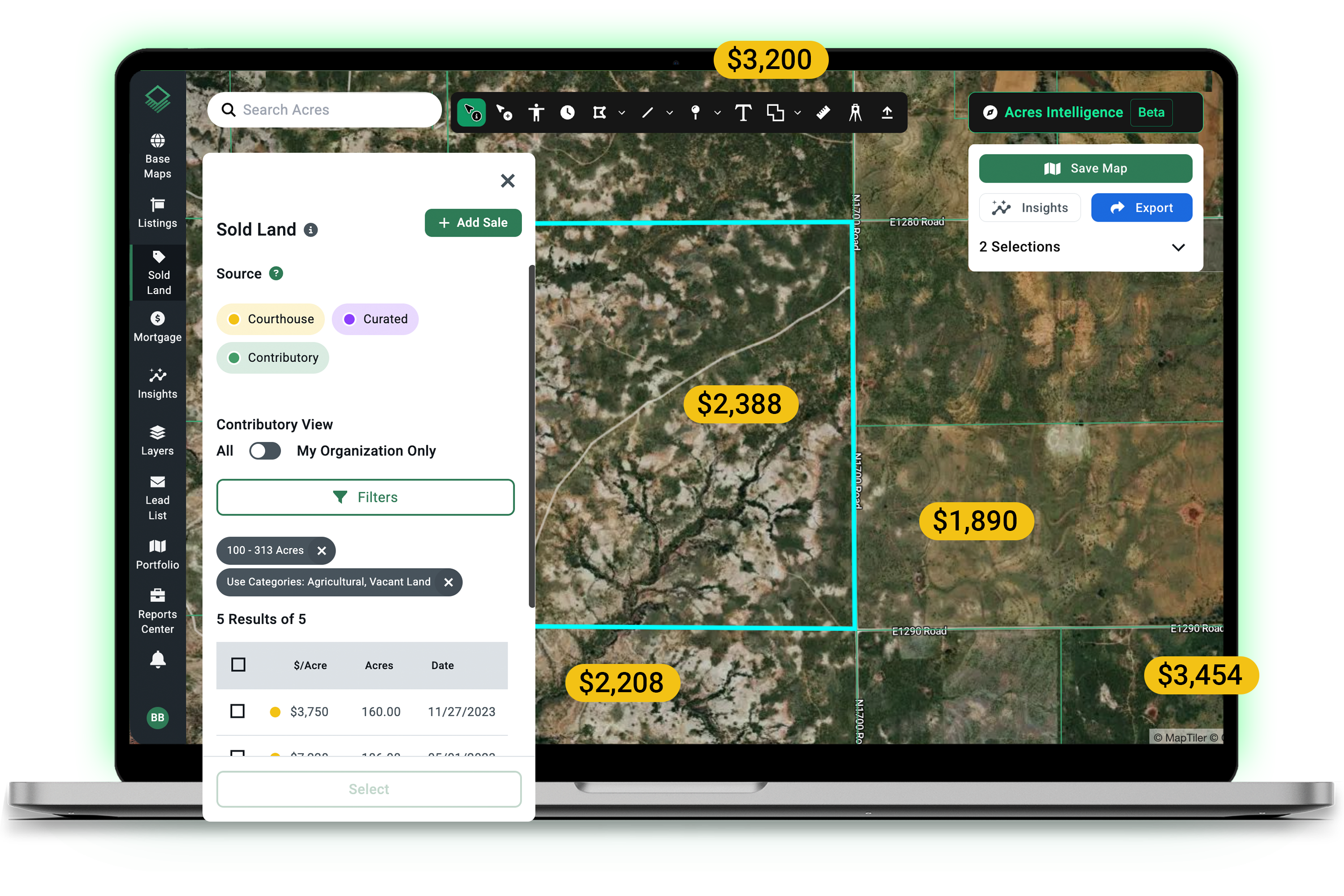
Step 1: Pull Recent Comparable Sales in Your Area
Comparable sales, also known as comps, are the foundation of any land value estimate. Look for raw land sales within the past 12 months in the same county and land type. Focus on parcels similar in size, zoning, and access. The closer the match, the more reliable the comparison.
County recorder offices and deed registries are primary sources for recorded sale prices. Local real estate listings can show active asking prices, though asking price and final sale price often differ. Use a minimum of three to five comps to establish a range. Fewer than three gives you a number, not a pattern.
With Acres: See parcel-level sales history and analyze comparable land transactions directly on the Acres map. Filter by parcel size, land type, and proximity to find recent comps without sorting through county records manually.
Step 2: Check Your County Tax Assessment for a Baseline
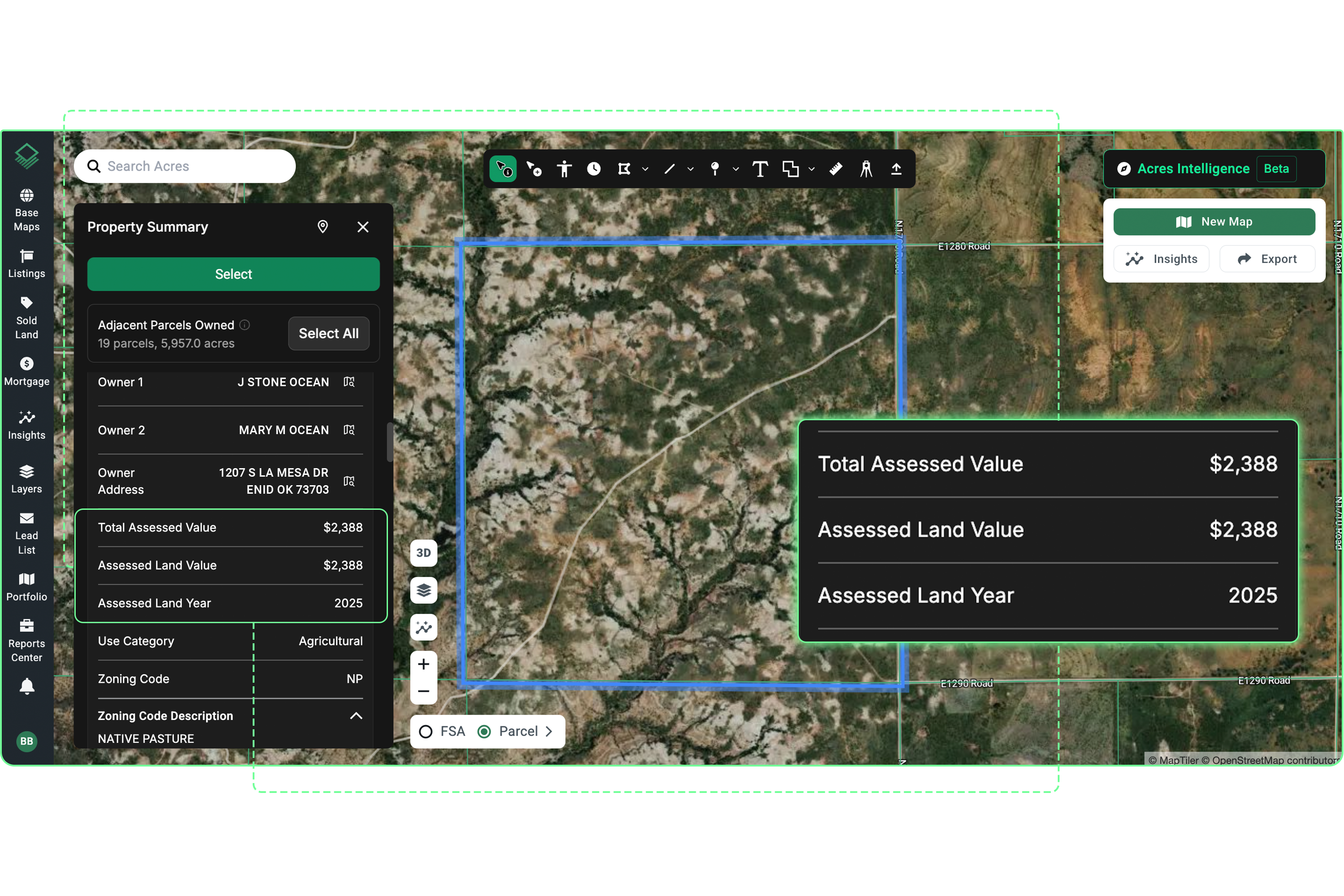
County assessors assign an assessed value to every parcel for property tax purposes. This number is not market value, but it is a useful baseline. Most counties assess at a fixed percentage of estimated market value, known as an assessment ratio, which ranges from 100% in some states down to less than 30% in others, depending on local state tax laws. Check your local assessor's website to find your assessment ratio and work backward to estimate market value.
Keep in mind that assessments lag the market. If land values in your area have appreciated significantly, the assessed value may understate current market value by a wide margin. Use the assessment as a floor, not a ceiling.
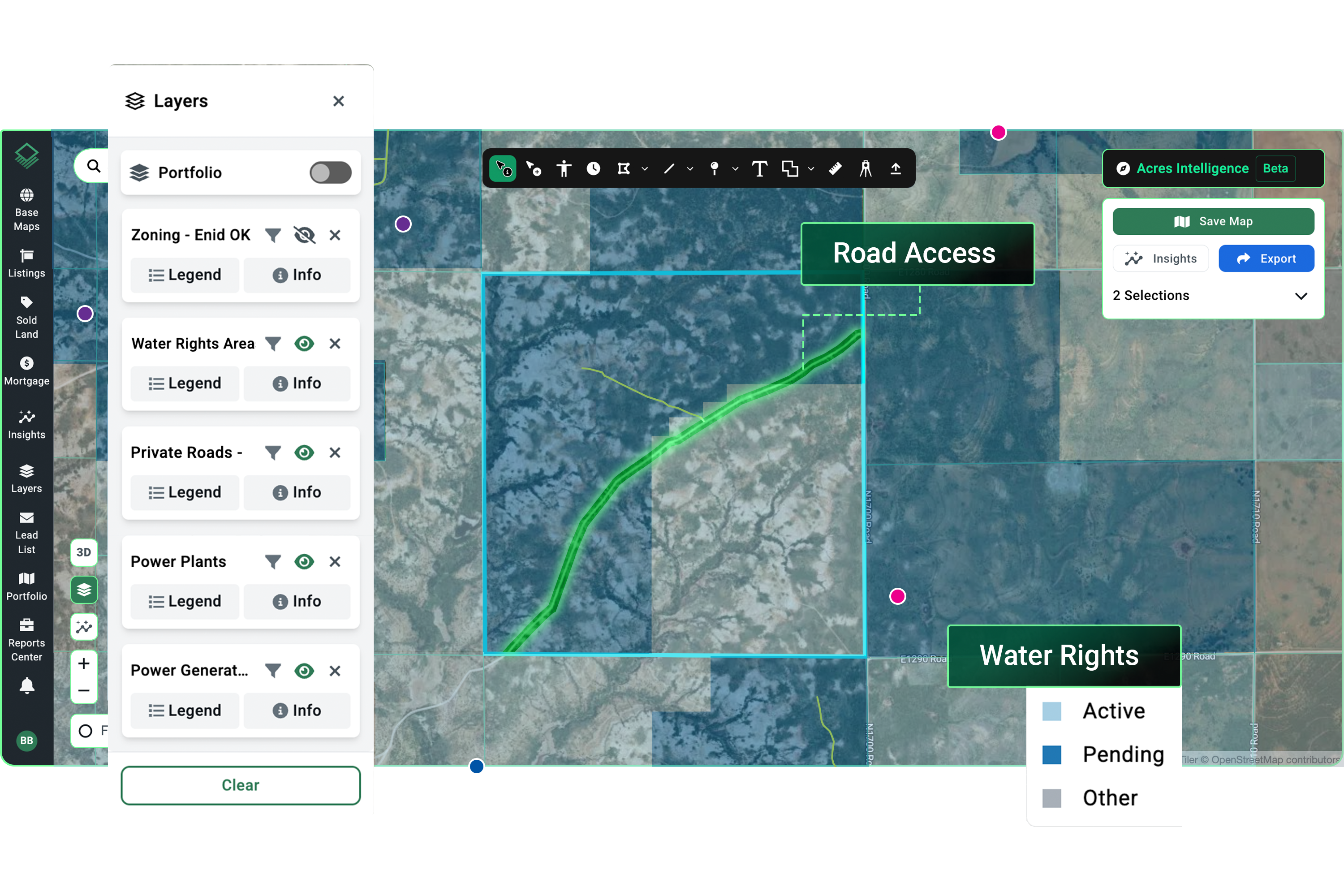
Step 3: Factor In the Key Value Drivers for Your Parcel
Raw comparables give you a range. Value drivers help you position your specific parcel within that range. The variables below have the most consistent impact on land value:
- Zoning and permitted use: Agricultural, residential, commercial, and industrial zoning all carry different value ceilings and buyer pools.
- Road access and frontage: Parcels with paved road frontage typically command a premium over landlocked tracts.
- Water features and rights: Parcels with deeded water rights or surface water access can drive up land value drastically.
- Utility availability: Access to power, sewer, and water lines directly affects development potential and buyer demand.
- Soil quality and topography: For agricultural land, soil quality has a direct relationship with per-acre value.
Review your parcel against each of these factors and compare how it stacks up against your comps. Adjust your estimate up or down accordingly. This step can convert a range into a position.
With Acres: Evaluate critical value drivers in minutes. Use data Layers to map out a parcel’s zoning, road frontage, water access, utility proximity, soil quality, elevation, and more—all in one place.
Step 4: Analyze Land Value Directly to Parcel-Level Context
Once you have your comps and your value drivers mapped, use a modern land research platform to validate your estimate. It is not a substitute for a formal appraisal, an efficient check before you make a decision.
With Acres: Find land value data and the most recent assessed year sourced from official county assessment records.
Before reaching for an outside appraisal, make sure you have completed the steps above. Most landowners who go through this process find that a formal appraisal either confirms their estimate or reveals a specific factor they had not accounted for. Either way, you walk in better prepared and better informed.
Getting More Precise With the Right Data
The steps above give you a solid free land appraisal estimate. Getting more precise requires deeper data: ownership history, zoning overlays, environmental risk layers, and infrastructure proximity. Collecting that manually across multiple sources takes hours.
Acres brings it all together in a single view. Instead of visiting county websites and state agency portals separately, you can pull every relevant data point for a parcel in one place, then layer in comps and value drivers without switching platforms.
That is the difference between a rough estimate and a confident one.
How Acres Supports Your Free Land Valuation Workflow
Acres is built for land professionals and individual landowners who need accurate, current data without the overhead of a full appraisal engagement. With data on over 150 million parcels, Acres gives you the most extensive, complete view of land data in a single system—ownership, parcel details, zoning, environmental risks, infrastructure context, and more.
The land valuation tools on Acres are designed to give you the full picture for every parcel, every time. That means fewer surprises, faster decisions, and a clearer understanding of what you own before you ever pick up the phone for a formal appraisal.
Key Takeaways for Your Free Land Valuation
Getting a free land valuation is a practical first step before any major land decision. Start with comparable sales, use county assessments as a baseline, pull land value data by zip code, factor in your parcel's specific value drivers, and cross-check with a land value estimator. Each step adds a layer of confidence to your estimate.
No free tool or methodology replaces a certified appraisal for formal transactions. But for planning, prospecting, or understanding your position before a sale, these methods give you a credible working range without paying for one. The more data points you layer in, the tighter your estimate becomes.
Your land has value. Knowing what it is should not cost you anything to find out.
See What Your Land Is Worth
Pull parcel-level data, comps, and value drivers for any property in the U.S. Explore the land valuation tools on Acres and build your estimate with confidence.