A data center deal can be announced, funded, and under construction, and still collapse under the weight of land, power, or community sentiment risk the team didn't see coming. By the time any one of these risks becomes public knowledge, whether that's a stalled interconnection queue, a permitting fight, or organized opposition, there's often little room left to change course.
The 2026 data center market demands visibility into land, power, and sentiment risk well before any of the three surfaces. The Acres Data Center Index gives you that visibility.
Navigating the 2026 Data Center Bottlenecks
More than 500 U.S. localities have stalled data center development, and over 75 projects worth roughly $130 billion were halted in the first three months of 2026 alone, nearly matching everything blocked in all of 2025. Active moratoriums now number well over 100 nationwide, representing hundreds of billions in paused investment.
Community opposition has become a primary driver of political and legal risk for data center expansion. As residents voice concerns over water depletion, noise pollution, and strain on the local power grid, elected officials are responding to voter pressure by enacting moratoriums, restricting zoning codes, and stripping away local tax incentives.
Interconnection queues in saturated hubs can now stretch 5-10+ years, and large power transformers carry lead times of 128 to 144 weeks, with some deliveries pushed into 2028. A site can have land, capital, and a signed tenant, and still stall for years without a viable path to power.
Even when evaluated independently of power grid access, finding suitable land in 2026 demands unprecedented scale and specialized environmental conditions. Beyond space for the buildings themselves, developers need acreage for on-site substations, water management systems, and increasingly on-site power generation, or a location close enough to existing transmission and generation to shorten the interconnection timeline. Viable land must satisfy strict physical constraints while minimizing neighborhood disruption.
The earlier developers, investors, and acquisition teams can understand a market and the land, the more time they have to structure a project the community and the infrastructure can sustain, instead of reacting to a moratorium after the fact.
De-Risk Data Center Site Selection With the Acres Data Center Index
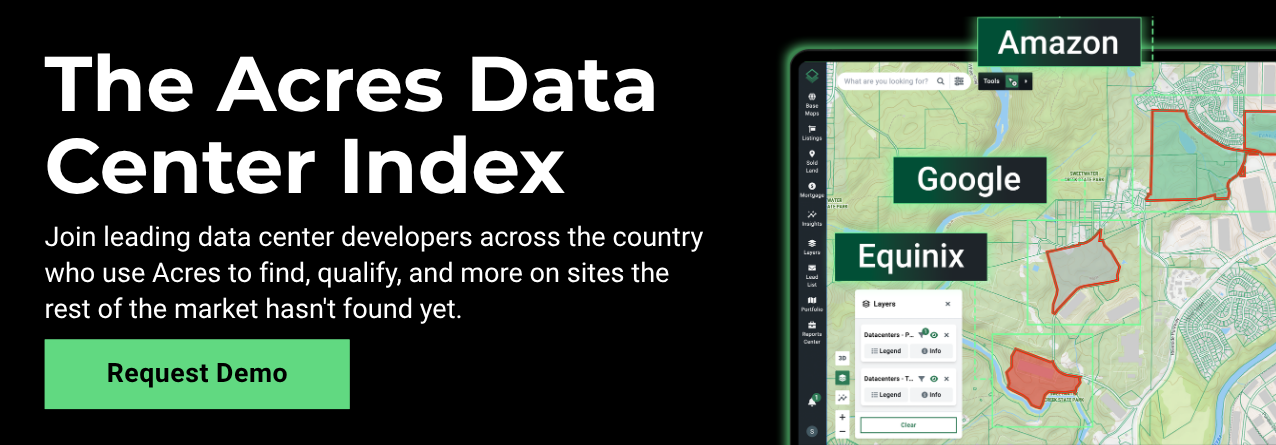
The Acres Data Center Index (DCI) gives teams the data to analyze land, power, and sentiment risk all at once. The index provides:
- Political Risk & Civic Sentiment: Track nationwide confidence levels and local meeting data across 3,000+ municipalities to see where communities are actively welcoming, opposing, or pausing data center projects.
- Entity Unmasking: Identify the entities and developers buying land behind anonymous LLC structures.
- Feasibility & Constraint Overlays: Parcel-level visibility into power availability, zoning, topography, flood risk, transmission proximity, and more.
- Monthly Expansion Reports: Gauge nationwide markets with monthly acquisition, transaction, and transfer reports.
- Market Intelligence: Visualize and identify emerging data center hubs before land prices spike, alongside saturated zones to avoid.
-2.png?width=760&height=502&name=Untitled%20design%20(3)-2.png)
The DCI gives your team the foresight to spot market shifts
before the rest of the industry reacts.
Analyzing Data Center Risk: San Marcos Case Study
Highlander SM One LLC proposed a $1.5 billion, 380 MW data center in San Marcos, Texas. All three risks were present from the start. The land sat within the Edwards Aquifer watershed and required rezoning for corresponding land use and development. The site's power draw would run through the already-strained ERCOT grid. Once the proposal became public, opposition organized quickly around water use and grid impact.
After more than eight hours of public testimony, the San Marcos City Council voted to deny the rezoning in February 2026. Four months later, the city went further and prohibited data centers across every zoning district.
Rezoning aquifer land triggered environmental pushback, grid strain provided opposition with technical arguments, and organized community sentiment carried the denial vote. Developers, investors, and acquisition teams need a way to see all three risks together beforehand.
Proactive Site Selection: Spotting Market Shifts Before the Competition
Access to this intelligence changes how data center teams operate. Instead of reacting to headlines, moratorium votes, or a competitor's announcement, teams using the DCI have the foresight to plan around risks and move ahead of the competition:
- Secure Prime Sites First: Identify emerging markets early to acquire land before values spike or competitors arrive.
- Protect Capital: Eliminate dead-end pursuits early by identifying grid bottlenecks and local political opposition before committing time or capital.
- Accelerate Due Diligence: Evaluate site readiness using instant infrastructure overlays rather than waiting weeks on costly third-party feasibility studies.
- Anticipate Competitor Strategy: Track land aggregation patterns and unmask hidden LLC acquisitions to map competitor footprints early.
- Reduce Deal Risk: Minimize risk by anticipating broader market shifts with the full picture upfront.
In a market where power allocation, land availability, and public sentiment can all turn against a deal before it’s even announced, foresight is the advantage.
Transform Site Selection from Reactive to Predictive
The teams winning in 2026 aren't the ones reacting fastest to a headline, but the ones who saw the deal, the power constraint, or the community risk coming before it made the news. Whether you're securing land, underwriting risk, or scouting the next market, the DCI gives you the intelligence to act early instead of reacting late.
Connect with our team to learn more about the Acres Data Center Index.
-Sep-15-2026-05-01-05-8604-PM.png)