Data center developers are moving site selection earlier in the deal cycle because power availability, not land availability or capital, has become the binding constraint on project delivery. The new model is power-first development: developers identify and control sites with confirmed or confirmable power capacity before finalizing design, before securing tenants, and in some cases before completed construction financing is in place.
This is a structural shift in how the data center asset class works, driven by grid interconnection timelines that now routinely exceed the construction timelines they are meant to support. Acres.com gives development teams the parcel-level data infrastructure to run earlier, conduct faster site screens, and surface sites with genuine power proximity before the window closes.
Contents
What Is Driving the Deal Cycle Compression?
How the Traditional Deal Cycle Has Changed
What Does Earlier Site Selection Actually Require?
Secondary and Tertiary Markets: Where Earlier Site Selection Creates Advantage
How Acres Supports Power-First Site Selection at Scale
What Is Driving the Deal Cycle Compression?
U.S. hyperscalers leased 7.4 gigawatts of data center capacity in Q3 2025 alone, exceeding the total leased across all of 2024. That single quarter's demand signals reflect AI compute buildout at a pace that the grid was not designed to accommodate on a two-to-three-year delivery timeline.
The fundamental mismatch is timeline. Data center construction takes two to three years from site control to delivery. Power infrastructure upgrades like new substations, transmission lines, and interconnection agreements, involve lead times of eight or more years for large grid modifications.
A project that cannot confirm power before construction begins is not viable, because the grid work that would deliver the power will not complete until years after the facility is built.
The interconnection queue is the clearest indicator of the constraint's scale. As of mid-2025, U.S. interconnection queues contained approximately 1,570 gigawatts of generation projects waiting to connect—more than the total installed capacity of the entire U.S. grid. Data centers account for a growing share of that backlog.
Projects that enter the queue today may not receive power in 2026 nor 2027.
This is not a temporary bottleneck. The lead times on heavy electrical equipment like high-voltage transformers, switchgear, and large-scale UPS systems, have extended to two to four years in their own right, independent of interconnection queue delays.
The site selection decision is now the first constraint in a chain of long-lead-time dependencies, not the last.
How the Traditional Deal Cycle Has Changed
In the traditional data center development cycle, site selection followed customer commitment. A hyperscaler or colocation provider signed a letter of intent, a development team identified and evaluated sites, and land control followed. Power confirmation was part of due diligence, not a prerequisite.
That sequence no longer works in markets where power is the binding constraint. Customers are themselves securing capacity 18 to 24 months in advance in constrained markets. Development teams that wait for customer commitment before beginning site selection arrive at the land control phase in a market where the sites with confirmed power have already been optioned.
The new sequence inverts this logic. Development teams now identify and control sites with confirmed or confirmable power access before they have customer commitments in hand. They are, in effect, pre-positioning the land and power assets that customers will need and competing to be the party that controls those assets when demand materializes.
The most sought-after sites in this model are those that can deliver power within 18 to 24 months. Sites that require grid upgrades beyond that window are effectively development-stage assets rather than delivery-stage assets.
|
With Acres:
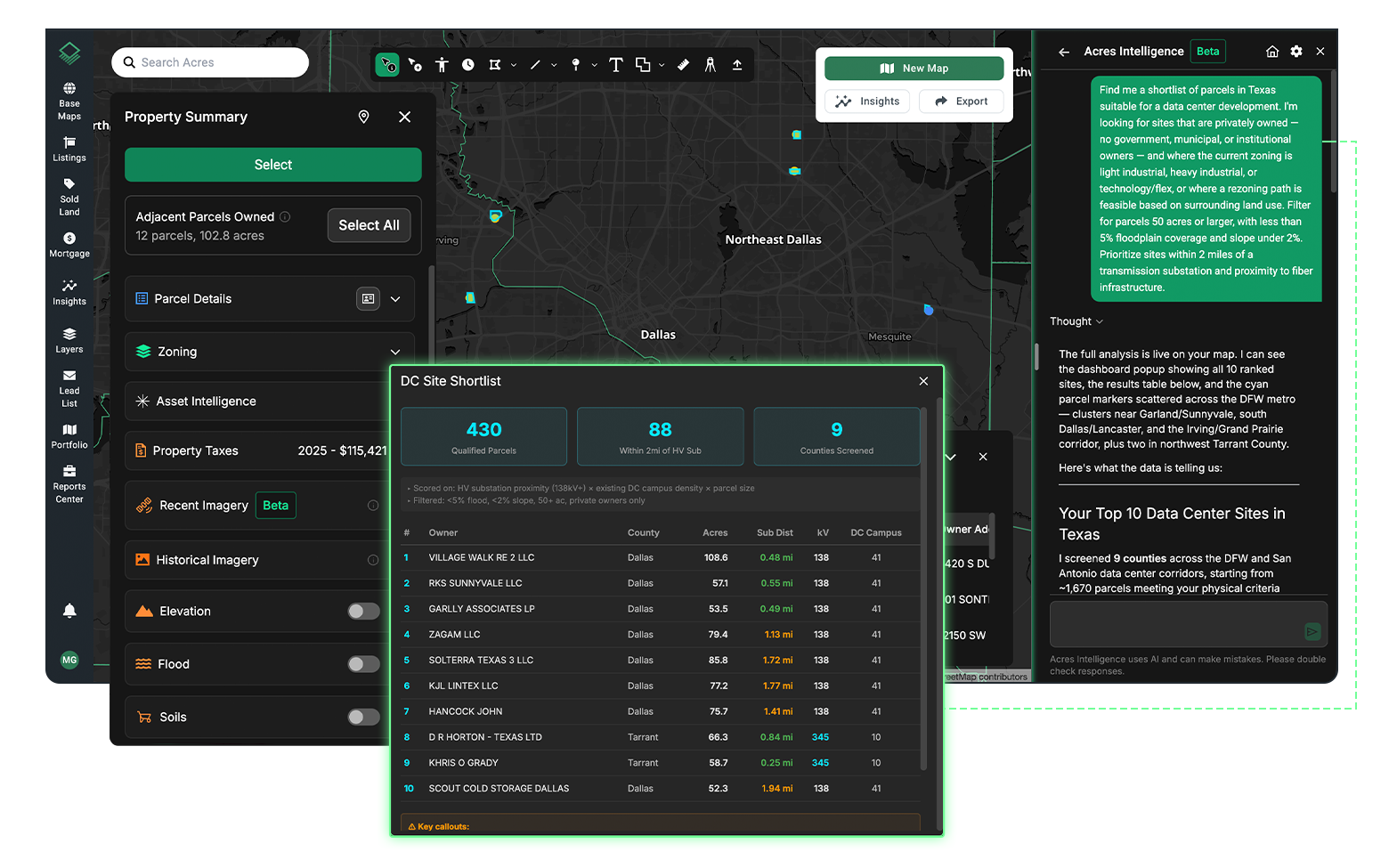
For site selection teams running power-first screens across secondary and tertiary markets, Acres surfaces parcel-level infrastructure proximity signals - substation adjacency, transmission corridor presence, and utility easement data - alongside zoning and ownership records. This enables the pre-qualification screen that determines which sites are worth engaging the utility on, before formal interconnection studies begin.
|
What Does Earlier Site Selection Actually Require?
The scale of committed capital reinforces why the cycle has moved earlier. The cumulative data center capital expenditure outlook approaches $1 trillion by 2030, with Project Stargate alone representing $500 billion over the next four years in AI data center construction. At that deployment velocity, site selection is not a one-at-a-time exercise. It has to be a systematic, geography-spanning screen for sites that clear a defined set of infrastructure criteria.
Earlier site selection requires three capabilities that traditional real estate workflows do not natively support.
First, it requires parcel-level infrastructure proximity data at geographic scale. A development team screening secondary markets across five states for sites within viable transmission proximity cannot efficiently, manually pull GIS data from each county. They need an aggregated view of parcel-level infrastructure context that covers the full search geography.
Second, it requires current ownership and transaction data. Sites move fast in constrained markets. A parcel that was available three months ago may be under option today. Development teams running early screens need current transaction records and ownership data to avoid investing research resources in sites that are already controlled.
Third, it requires zoning and permitting risk intelligence that goes beyond the current county zoning map. As state and local regulatory environments evolve with moratorium proposals active in many states as of mid-2026, development teams need a forward-looking view of jurisdictional risk. A site with favorable zoning today may face a regulatory constraint next year that materially changes its development timeline.
Secondary and Tertiary Markets: Where Earlier Site Selection Creates Advantage
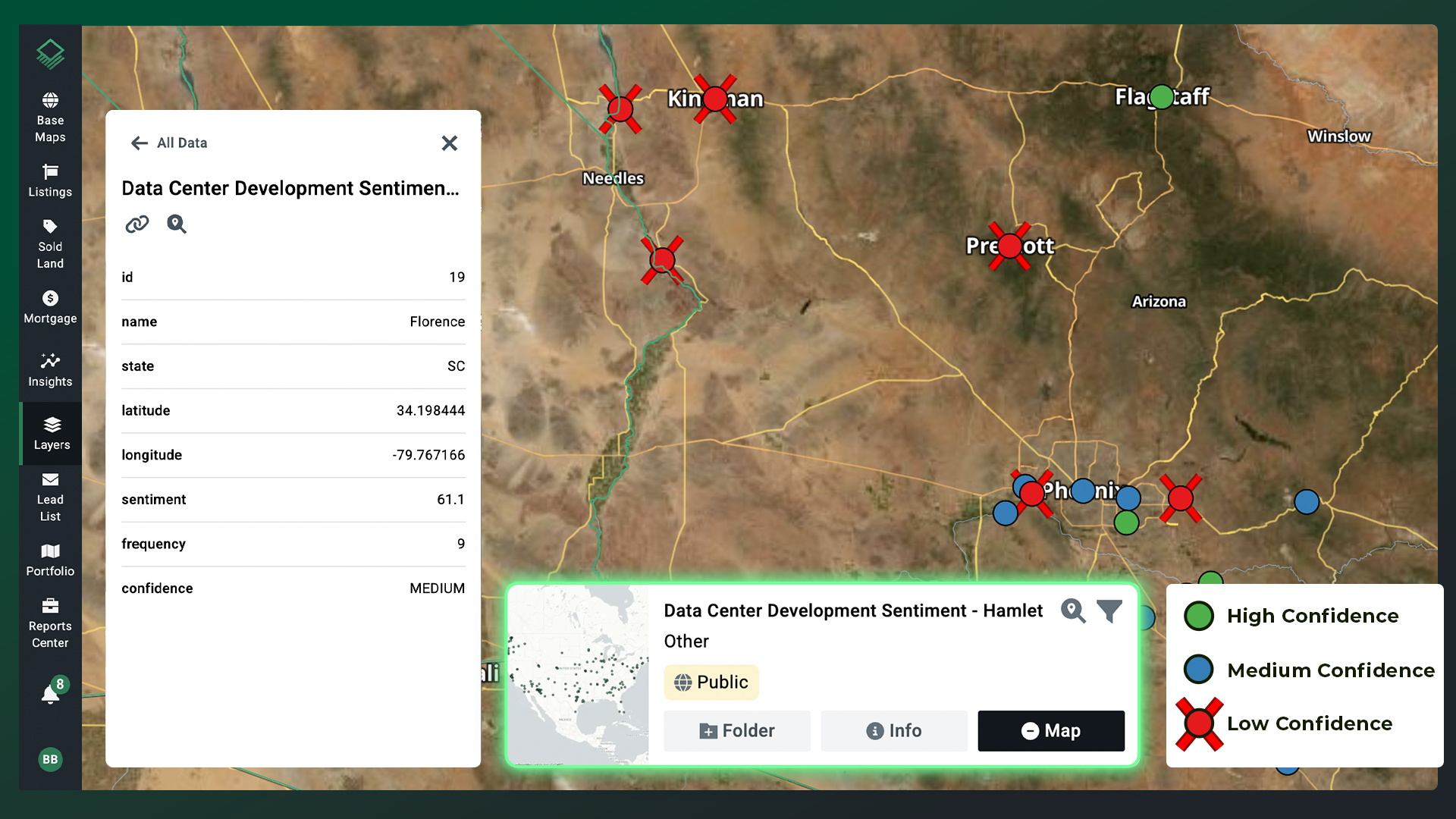
The shift to earlier site selection is particularly significant in secondary and tertiary markets, where infrastructure confirmation is less certain but competition is lower. Markets in Texas, Arizona, the Southeast, and the Midwest have attracted data center investment precisely because land availability, business-friendly regulatory environments, and utility engagement programs create more favorable conditions than saturated primary markets.
In these markets, early site control before a submarket becomes a recognized data center corridor, provides both pricing advantage and optionality. A development team that enters a secondary market before other teams have confirmed the power corridor can control sites at pre-development pricing. Once the corridor becomes established, pricing reflects the scarcity of confirmed-power parcels, not undeveloped land.
Reading the signals that indicate a submarket is moving toward data center corridor status like accelerating price velocity, increasing absorption of large industrial parcels, utility engagement activity, economic development incentive announcements, is the research capability that creates the early-mover advantage. It requires the same parcel-level data infrastructure as power-first site selection: current transactions, infrastructure proximity, and zoning trajectory at geographic scale.
The deal cycle has moved earlier because the constraint has moved earlier. Power confirmation is now the gating factor that determines project viability, and power confirmation timelines run ahead of construction timelines in most markets. Development teams that treat site selection as a later-stage activity in the deal cycle are systematically locked out of the sites that will deliver on the timelines their customers require.
Closing that gap requires parcel intelligence that goes beyond what traditional real estate research tools provide. Rather than compiling data from separate sources, Acres consolidates parcel boundaries, ownership, zoning, environmental signals, infrastructure proximity, and transaction history so the pre-qualification screen moves in hours rather than weeks.
How Acres Supports Power-First Site Selection at Scale
Earlier site selection requires earlier data. Acres gives data center development teams access to the most extensive, complete view of land data in a single system including parcel boundaries, ownership records, zoning classifications, environmental signals, and infrastructure proximity context for over 150 million U.S. parcels.
For teams screening secondary and tertiary markets for sites with genuine power proximity before the submarket becomes competitive, Acres surfaces the infrastructure signals that determine which candidate sites are worth investing research resources in. Explore infrastructure and parcel context on Acres for any target data center market.
Weeks of land research become minutes with complete land data. For development teams running multi-state screens across secondary geographies, parcel risk and infrastructure screening on Acres compresses the pre-qualification phase so that formal utility engagement begins with a validated site list rather than a broad candidate pool.
Site Selection Has Become a Strategic Capability, Not a Transactional Step
The data center deal cycle has moved earlier because power scarcity has made site control a precondition for project viability rather than a step that follows customer commitment. Development teams that run power-first site selection—identifying and controlling sites with confirmed or confirmable power capacity before formal design and financing—are the ones delivering on the timelines the market requires.
Executing that model requires parcel-level intelligence at geographic scale: infrastructure proximity data, current transaction records, zoning trajectory, and ownership information across wide geographies, accessible in a single research workflow.
The teams that leverage that data infrastructure early are the ones that find the sites before they become competitive.
Running a power-first site screen in secondary markets? Surface infrastructure proximity, zoning, ownership, and transaction history for any U.S. geography on Acres. Start your data center site search on Acres.
.png)