The decision to build an in-house site selection team usually pencils out only after a developer is running five or more concurrent land evaluations. Below that threshold, the fixed costs of maintaining dedicated site selection staff—salary, data subscriptions, GIS tooling, and the institutional overhead of managing a specialized team—rarely justify the expense compared to broker relationships or platform-based screening.
For renewable energy developers who have reached the scale question, the real issue is not whether to hire people but what capability those people actually need. A site selection team that cannot move faster than a broker with access to the same data platforms provides no competitive advantage, it just converts a variable cost into a fixed one.
The advantage comes when the in-house team operates with proprietary data access, screening discipline, and the institutional knowledge to move from candidate to contracted site faster than competitors. Acres.com gives in-house renewable development teams the parcel-level data infrastructure to execute that capability across over 150 million U.S. parcels.
Why Most Project Delays Trace Back to Site Selection
Most project delays in renewable energy development are predictable in hindsight, and most of them trace back to the site selection phase: assuming grid proximity equals grid access without verifying interconnection capacity, underestimating permitting timelines in jurisdictions with complex approval processes, skipping community engagement until opposition is already organized, and choosing the lowest-cost land without fully modeling the infrastructure upgrade costs it will require.
The teams that move projects from site selection to construction fastest tend to be the ones who treat each of these as a real risk to be evaluated at the screening stage, not discovered during due diligence.
The broker model provides access to listed opportunities and market relationships, but it typically does not provide the systematic screening infrastructure to identify grid access issues, environmental constraints, or community opposition risk before a site becomes a formal candidate. Brokers optimize for transactions. In-house teams can optimize for speed and disqualification, eliminating bad sites faster and accumulating the local market knowledge that makes each subsequent evaluation more efficient.
The platform model (using data tools and software to screen sites without building a dedicated headcount) has become more viable as the quality of parcel-level land data has improved. But platforms alone do not substitute for the judgment and negotiation capability that characterize effective site origination in contested or complex markets.
What Does an In-House Site Selection Team Actually Do That a Platform Cannot?
The capabilities that justify building in-house are the ones that require institutional knowledge, negotiation skill, and sustained local market presence, not the ones that require data access or analytical horsepower, which platforms increasingly provide.
Landowner Relationship Development
In competitive renewable energy markets, the best sites are often not available on a listing platform, but are acquired through direct landowner outreach, relationship cultivation, and proactive option agreements negotiated before a parcel is actively marketed. An in-house team builds this capacity over time in specific geographies. A broker or platform handles it reactively.
Qualifying Suitable Sites with Powerful Data
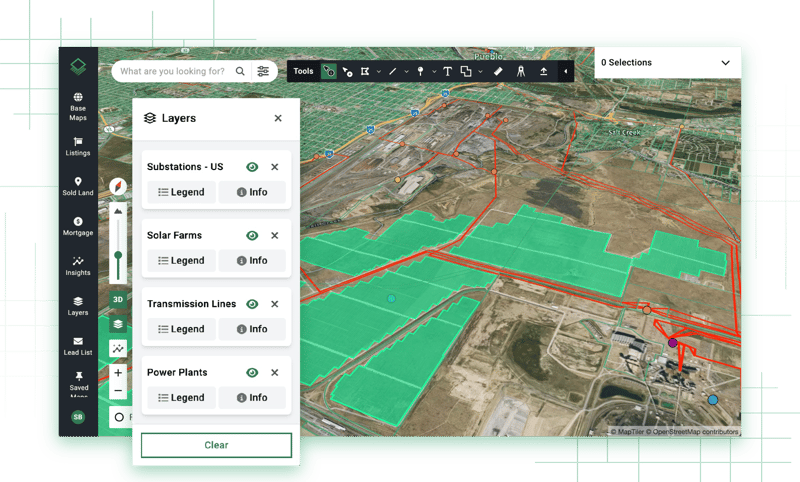
Suitability analysis for renewable sites scores locations based on how well they match a project's specific needs, weighting factors like land use, parcel size, accessibility, and proximity to transmission infrastructure to find the strongest candidates. A parcel near existing transmission infrastructure is easier to connect to the grid while a site too close to residential areas may trigger community concerns that cannot be screened out by data alone.
The judgment layer on top of that data, like understanding which constraints are resolvable and which are not, and how long resolution takes, is the in-house team's core value.
Permitting and Regulatory Navigation
The in-house team builds familiarity with specific jurisdictions -such as county commissioners, planning departments, utility interconnection personnel, and state regulators that reduces uncertainty in future projects in those geographies. That familiarity is not replicable by a broker who engages episodically or a platform that provides regulatory data but not regulatory relationships.
Multi-Project Portfolio Management
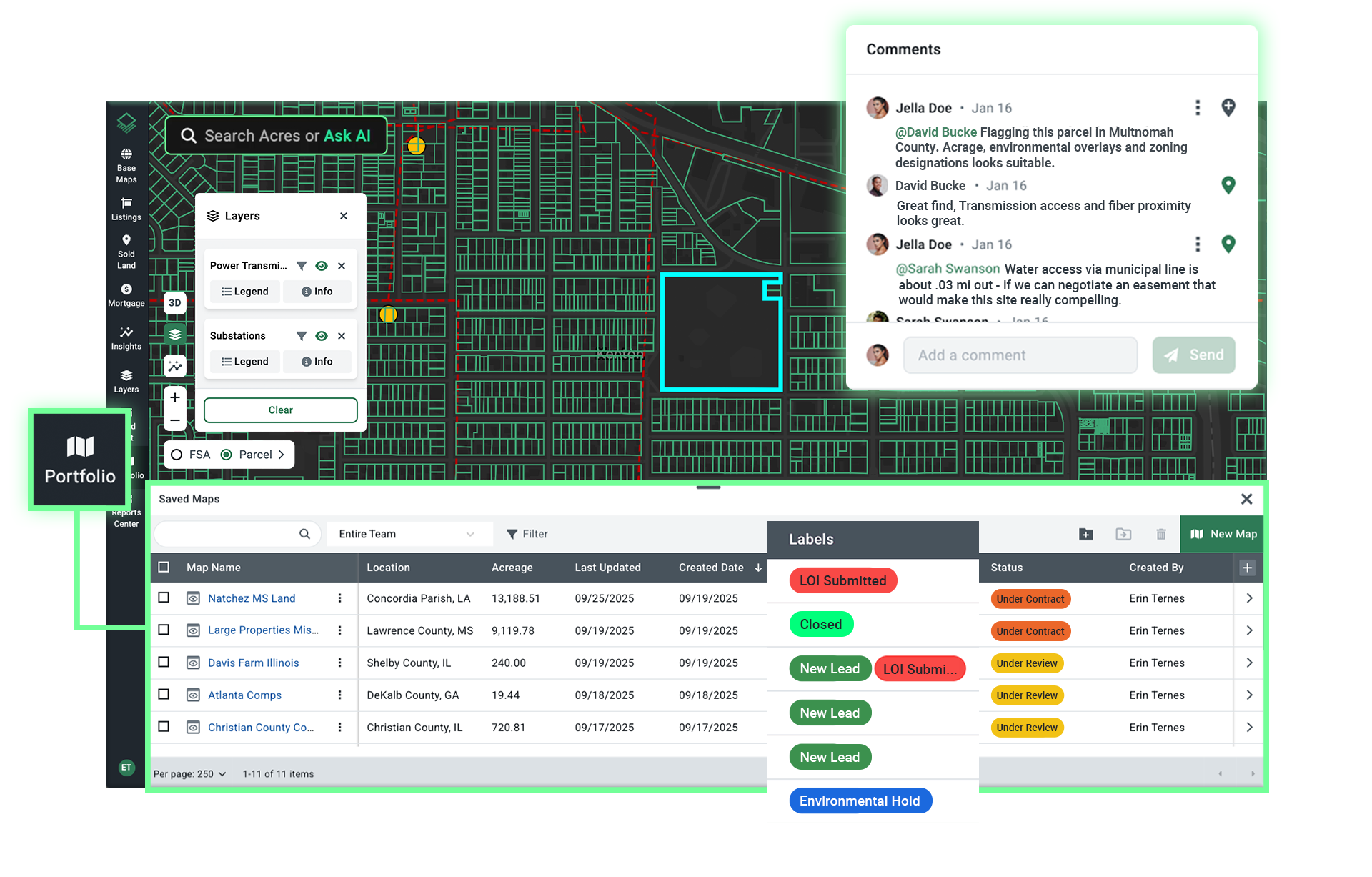
Running five or more concurrent land evaluations across different geographies, at different stages of the development cycle, with different utility and permitting timelines, requires systematic tracking and coordination that is difficult to manage through broker relationships alone. The in-house team creates the operational infrastructure to manage this pipeline without every evaluation reinventing the process.
|
With Acres:
Acres surfaces parcel-level site evaluation data—transmission proximity, environmental risk, ownership history, and zoning context—across any U.S. geography. For in-house renewable development teams running multi-project portfolios across secondary markets, Acres provides the data infrastructure layer that makes systematic site screening faster than broker-dependent processes, without adding headcount to the data collection function.
|
The Five-Site Threshold: Where In-House Investment Starts to Make Sense
The five-concurrent-evaluation threshold is not arbitrary. It reflects the point at which the fixed costs of an in-house site selection function begin to be offset by three specific advantages.
First, the marginal cost of each additional site evaluation falls significantly once the team, tools, and data subscriptions are in place. A team running five concurrent evaluations can carry roughly the same overhead as one running three. The per-site cost can drop with volume in a way that broker fee structures do not.
Resilient land teams that operate in multiple regulatory and landowner environments must become experts in local politics: tracking county-level decommissioning bonds, setback requirements, and political dynamics alongside the core site data.
Using centralized platforms to store local ordinances alongside lease and parcel records ensures that the team's local knowledge compounds across projects rather than residing only in individual team members. That institutional knowledge accumulation is the second advantage of in-house capability.
Third, in-house teams build the landowner relationship depth that produces non-marketed deal flow—sites that are never listed because the landowner contacted the developer directly based on an established relationship. In competitive markets like Texas, the Southeast, and the Mountain West, non-marketed deal flow is often where the best site economics are found.
When Does the In-House Investment Stop Making Sense?
The geographic concentration question is particularly important. A team with deep expertise in specific Texas or Midwest markets may not have the same productivity advantage in a new Pacific Northwest or Northeast geography where landowner dynamics, utility engagement processes, and permitting environments are different. Expanding in-house capability into new geographies requires either geographic hiring or a platform-first approach until local knowledge is built.
The hybrid model (in-house team plus platform infrastructure) is increasingly the standard for developers who have cleared the volume threshold but want to maintain geographic flexibility. The in-house team handles relationship origination, negotiation, and portfolio management. The platform handles data screening, environmental risk analysis, and comparable transaction research. The combination delivers the full value of in-house capability without requiring the team to be its own GIS department.
Rather than building proprietary data pipelines to compile parcel ownership, transmission proximity, environmental risk, and zoning data from separate sources, in-house renewable development teams use Acres as the data foundation that makes their screening process systematic and scalable. The competitive advantage the in-house team creates is in judgment, relationships, and execution speed, not in data assembly, which Acres handles.
How Acres Powers In-House Renewable Site Selection Teams
Acres gives renewable development teams access to the most extensive, complete view of land data in a single system, with data on parcel boundaries, ownership records, zoning, environmental signals, and infrastructure proximity context for over 150 million U.S. parcels.
Weeks of land research become minutes with complete land data and powerful AI. If your team can describe the geography, parcel size range, and infrastructure profile they need, they can find it on Acres. Explore renewable energy site selection tools on Acres.
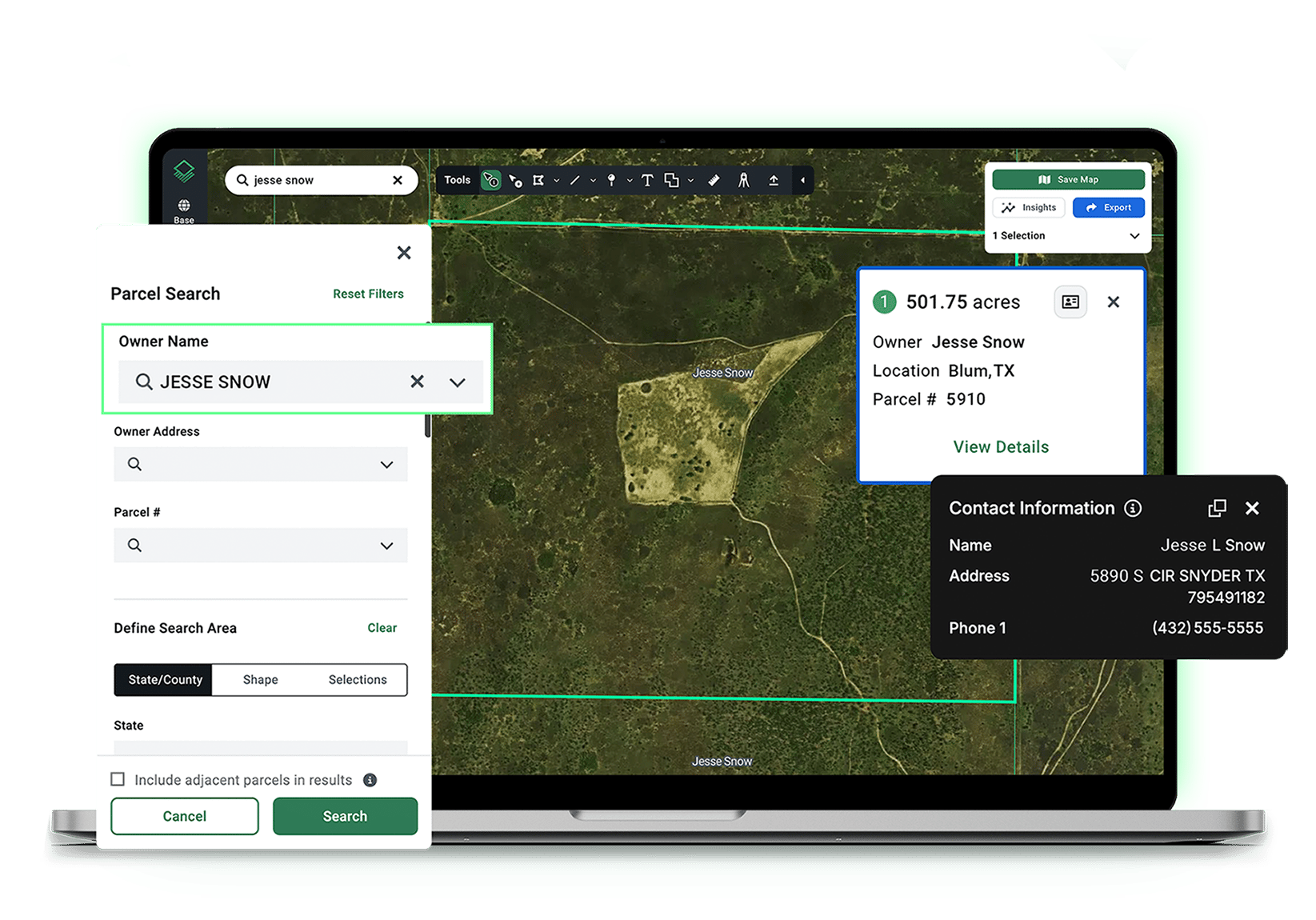
For in-house teams building their portfolio management and prospecting capability, Acres' prospecting and owner outreach tools surface ownership data, contact information proxies, and comparable transaction history that accelerate the non-marketed deal flow origination that makes in-house teams most valuable at scale.
Build the Capability, Not Just the Headcount
A team that has the right data infrastructure, screening discipline, and geographic relationship depth delivers a competitive advantage that compounds over time. A team that replicates what a broker does without the institutional advantages of in-house operation just adds fixed cost.
The threshold is real: five or more concurrent evaluations is where the fixed-cost model typically becomes more efficient than transaction-based alternatives. Below that threshold, the platform plus broker hybrid is usually the better model. Above it, building the in-house capability with the right data infrastructure behind it is how leading renewable developers are building a durable origination advantage in competitive land markets.
Ready to equip your in-house site selection team with parcel-level land data across any U.S. geography? Explore ownership records, transmission proximity, environmental risk, and comparable transactions on Acres. Start your renewable site selection on Acres.