A renewable land deal that looks cheap on a per-acre basis can still fail economically once interconnection network upgrade costs are allocated back to the project. The land acquisition price is fixed at closing. Meanwhile, the interconnection cost is not fixed until the interconnection study process is complete, and that process can allocate tens or hundreds of millions of dollars in transmission upgrade costs directly to the developer that were not in the original project financial model.
For renewable energy developers and land investors, the cost of interconnection has overtaken the cost of the land as the variable most likely to determine whether a project is financially viable.
Understanding where this shift came from requires knowing the regulatory framework that governs cost allocation in each grid region, and knowing which parcel-level infrastructure characteristics determine whether a project will face manageable interconnection costs or project-defeating ones. Acres.com surfaces parcel-level transmission proximity and power infrastructure context nationwide, helping renewable land teams identify which sites carry grid access before the formal study process begins.
Why Has Network Upgrade Cost Allocation Become the Dominant Cost Variable?
FERC Order 1920 requires transmission providers to conduct long-term regional transmission planning on a 20-year horizon and to allocate the costs of transmission solutions across beneficiaries. The order represents a systematic shift in how the cost of grid expansion is allocated between utility ratepayers and the generators connecting to the grid.
Before the current regulatory environment, much of the cost of grid upgrades needed to accommodate new generators was socialized across all ratepayers. Under the cost causation principle that FERC and the Department of Energy have been progressively advancing, those upgrade costs are increasingly allocated to the specific projects that require them.
The practical result is that a renewable project that triggers the need for a substation upgrade or new transmission line may be required to fund a significant portion of that infrastructure in addition to its own project construction costs.
A $100 per kilowatt interconnection cost means that a 100-megawatt solar project must pay $10 million in transmission upgrades to connect to the grid. In ISO-NE (New England), interconnection costs for projects that withdrew from the queue tripled—rising from $200-300 per kilowatt in the 2010-2017 period to $600 per kilowatt in the 2018-2021 period.
These costs are comparable to or exceeding the land acquisition cost in many secondary markets.
What Does This Mean for How Renewable Developers Evaluate Land?
The Department of Energy's October 2025 framework recommends that 100% of network upgrade costs be assigned to the interconnecting load—pushing the regulatory dial fully toward cost causation and away from cost socialization. A region's choice between full cost causation, a hybrid split, or continued socialization can change a large campus's all-in grid power costs by an order of magnitude. Ultimately, this single variable determines whether a project connects to the grid or pivots to on-site generation.
The implication for land evaluation is direct. A parcel near a substation that has available load headroom is worth substantially more to a developer than a parcel that is physically closer to the substation but whose connection would require a major upgrade. The upgrade cost difference between those two scenarios can be tens of millions of dollars, none of which is visible in the land price.
This means that two parcels in the same county, trading at the same price per acre, can have fundamentally different total project costs depending on the transmission upgrade obligation each one carries. The land comp is identical. The project economics are not.
Interconnection Network Upgrade Cost - Scenarios by Site Proximity Chart
Formula: (Cost per kW) x (1,000 kW per MW) x (100 MW) = Total Estimated Cost
Interconnection network upgrade costs scale on a per-megawatt basis according to site proximity and local grid headroom. The matrix below uses a benchmark 100 MW project to show how physical infrastructure requirements and regulatory cost-allocation models directly impact total developer costs.
| Site Profile |
Interconnection Cost Scenario |
Estimated Developer Cost |
Impact on Project Economics |
| Adjacent to substation with available capacity |
Minimal upgrade required
|
$0-$50/kW ($0-5M per 100MW)
|
Land premium justified; strong project economics |
| Near substation at capacity - needs expansion |
Substation upgrade required
|
$100-$300/kW ($10-30M per 100MW)
|
Significant add; model carefully against land price |
| Transmission line upgrade required |
New or upgraded line to substation |
$300-$600/kW ($30-60M per 100MW) |
Material risk; may require renegotiation or site exit |
| New substation required |
Full substation construction |
$600-$1,500/kW ($60-150M per 100MW) |
Project-defeating unless developer has dedicated path |
| FERC full-causation allocation scenario |
100% of upgrade costs to developer |
$1,500–$2,000+/kW ($150–$200M per 100MW) |
All-in cost per MW can flip project from viable to infeasible |
Note: The cost ranges and site profiles above reflect illustrative order-of-magnitude estimates derived from historical interconnection queue data across major U.S. regional transmission organizations. Actual network upgrade costs, local utility requirements, and regulatory cost allocations can vary significantly depending on point-of-interconnection voltage, available transformer capacity, and regional tariff rules.
How Does the Interconnection Study Process Work and When Do Costs Become Known?
The interconnection study process is a formal utility engineering analysis that determines what network upgrades are needed to connect a specific project to the grid at a specific point of interconnection. Most grid regions run studies in three phases: feasibility study, system impact study, and facilities study. At each stage, the estimated network upgrade costs are refined, and those estimates can change significantly from phase to phase.
The practical risk for land teams is that interconnection costs are not fully known at the time of land acquisition. A developer who options or acquires land before completing a feasibility study is committing capital before the project's largest cost variable is resolved. The standard practice of filing an interconnection application as early as possible in the development cycle can reduce this exposure.
|
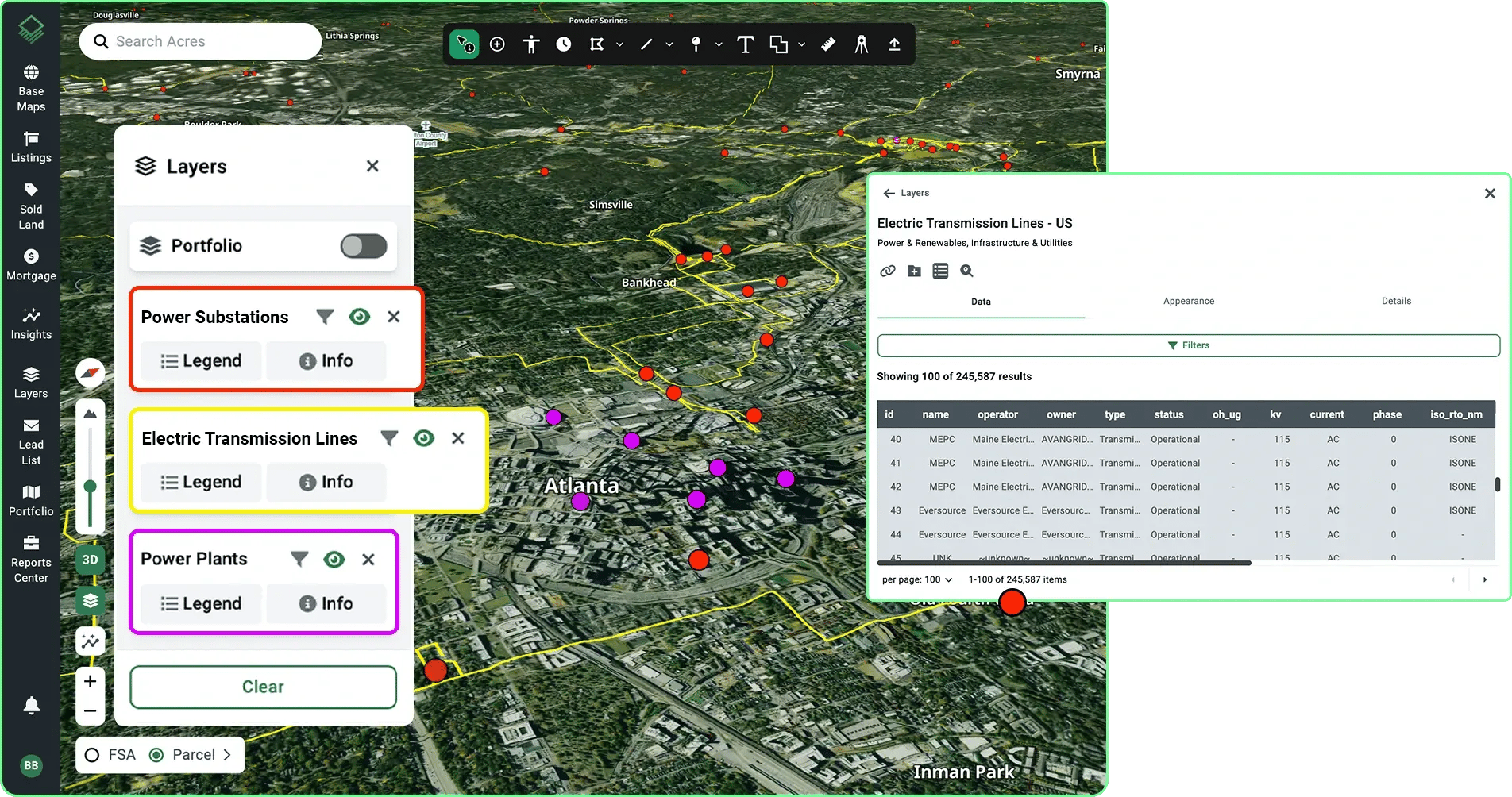
Acres gives renewable land teams access to a robust library of dedicated energy and infrastructure map layers. Teams can access nationwide data layers covering substations, transmission lines, power lines, power plants, and existing renewable infrastructure alongside parcel boundaries, ownership records, zoning, and environmental risk context nationwide. Acres provides dedicated power infrastructure Layers that help differentiate sites likely to face minimal upgrade requirements from sites that may trigger substantial upgrade obligations.
|
What the Cost-Per-Megawatt Framework Means for Land Pricing
FERC Order 1920's changes to transmission planning and cost allocation require grid planners to develop transmission plans looking ahead at least 20 years using multiple scenarios, and gives states a more robust role in the cost allocation process. The multi-decade planning horizon means that infrastructure investments made today will be allocated across future project costs in ways that are not yet fully visible, adding a layer of regulatory uncertainty to interconnection cost modeling that was not present in prior years.
Renewable developers are now pricing interconnection cost risk into land offers. A site with low interconnection cost probability commands a land price premium over a site with high interconnection cost risk, even if the physical characteristics and per-acre market value look similar. This pricing discipline is becoming the standard in competitive markets, which means that developers who are still evaluating land primarily on per-acre cost are increasingly at a disadvantage in deal competition against those who are evaluating it on total project cost including estimated interconnection exposure.
Grid congestion, AI load growth, and queue delays are combining to make interconnection risk a primary underwriting consideration for renewable energy projects in 2026. The combination of a constrained grid, rising demand, and evolving cost allocation rules creates a situation where the interconnection cost for any given project is both larger and less predictable than it was five years ago. That unpredictability is itself a cost driving up the risk premium developers require before committing capital to land acquisition.
How Acres Supports Interconnection-Cost-Aware Land Analysis for Renewable Developers
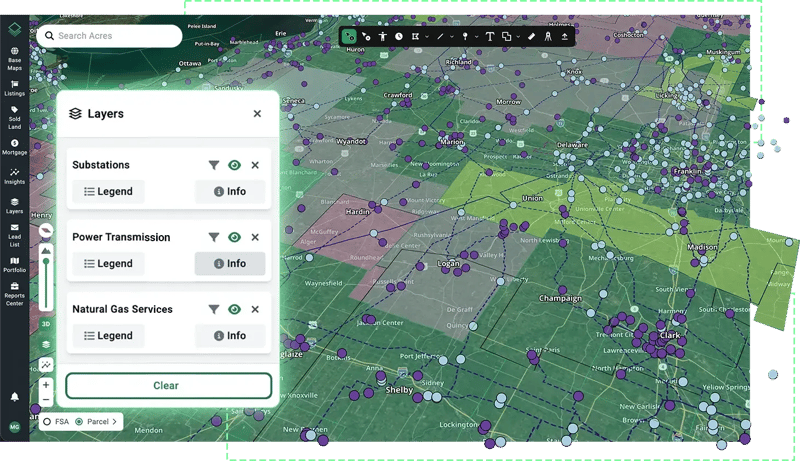
Instead of evaluating utility territory maps and cost filings separately, Acres gives renewable energy developers and land teams access to the most extensive, complete view of land data in a single system—parcel boundaries, ownership records, zoning, environmental signals, and infrastructure proximity context—for over 150 million U.S. parcels.
For teams running transmission proximity screens as part of their interconnection cost risk assessment, parcel-level infrastructure and land analysis on Acres surfaces the substation adjacency and transmission corridor data that determines whether a site is positioned for low-cost interconnection or faces substantial upgrade exposure.
Weeks of land research become minutes with complete land data and powerful AI. For renewable land teams building total-project-cost models rather than per-acre-price models, Acres' prospecting and land analysis tools identify which candidate sites in a target geography sit in the transmission proximity profiles that correlate with lower interconnection cost risk—the first filter in any cost-allocation-aware site evaluation process.
Summary: Land Price Is the Input. Interconnection Cost Is the Variable.
A renewable land deal evaluated only on per-acre purchase price is an incomplete analysis. The interconnection cost allocation that follows land acquisition can be larger than the land cost itself, and it is determined by factors that are independent of the per-acre market price. Two parcels at the same land price can have project economics separated by tens or hundreds of millions of dollars in interconnection cost exposure.
The correct evaluation framework is total project cost per megawatt, not land cost per acre. That framework requires a preliminary grid access analysis alongside the land analysis: evaluating transmission proximity, substation capacity indicators, and regional cost allocation posture before land control is established.
The developers who have built this capability are the ones who close on land with confidence that the interconnection economics support the project, rather than discovering the cost exposure after the land transaction has closed.
Ready to evaluate renewable candidate sites against transmission proximity and interconnection cost risk before committing to land? Surface parcel-level infrastructure context and grid access data for any U.S. geography on Acres. Book a demo to see how.
-2.png)