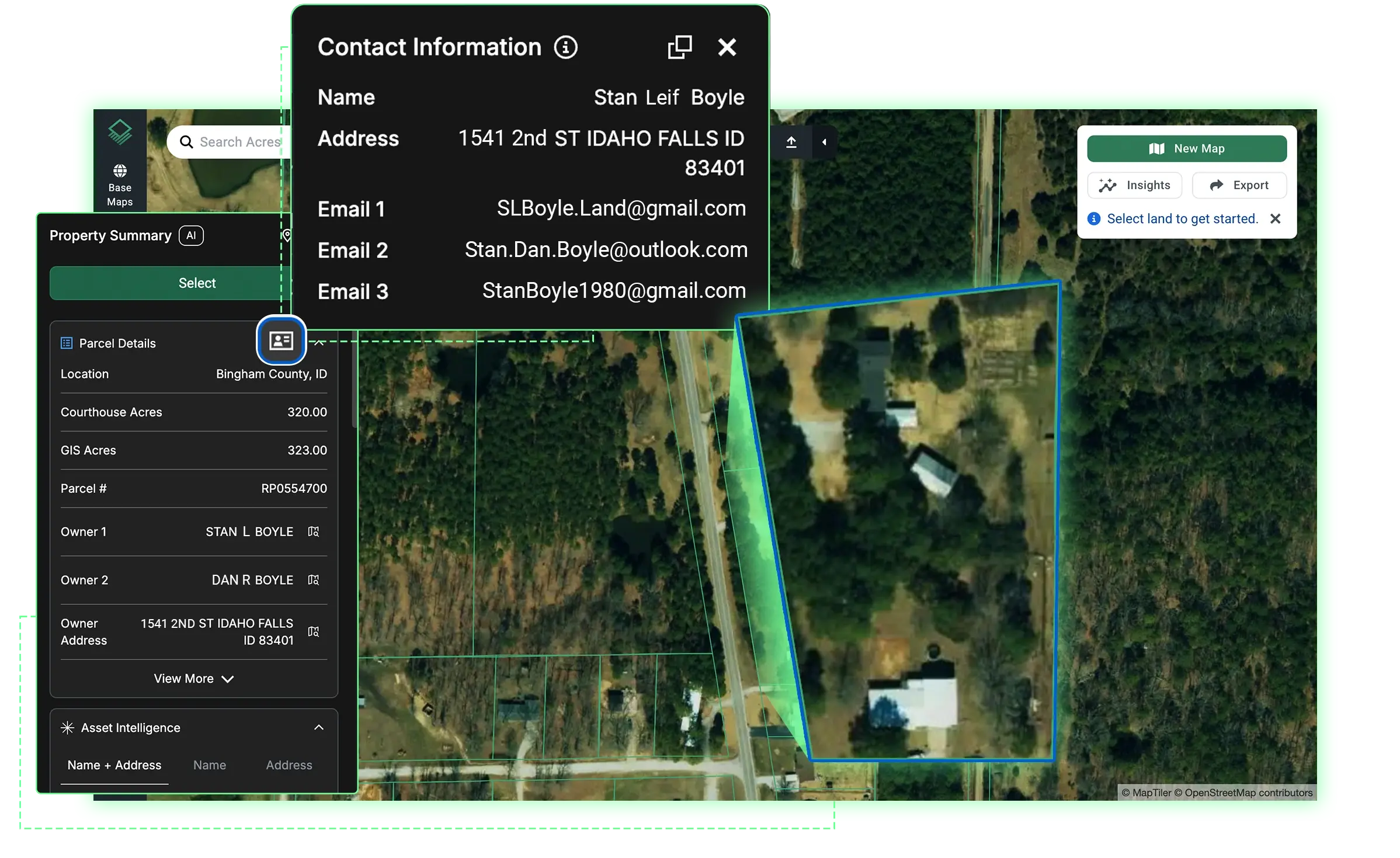
Most valuable parcels never hit the open market. The owner has not listed the property, has not responded to a mailer, and has no public-facing contact information. For land buyers and acquisition teams, that wall between a promising parcel and the person who controls it is one of the most common blockers in the business.
Skip tracing for land buyers is the method used to find that connection, to locate owner contact data when public records alone will not close the gap. Acres.com surfaces ownership details across more than 150 million parcels nationwide, so acquisition teams spend less time hunting for who to contact and more time on deals that are worth pursuing.
This post explains exactly how skip tracing works in a land context, when it makes sense to use it, and what modern parcel owner lookup tools have changed about the process.
Contents
Why Reaching Parcel Owners Is Harder Than It Looks
What Skip Tracing Actually Means in a Land Context
How to Find Out Who Owns a Property - and Then Reach Them
When Skip Tracing Makes Sense - and When It Does Not
How to Find the Owner of a Building or Parcel Without Skip Tracing
How Acres Approaches Parcel Owner Lookup
The Bottom Line on Skip Tracing for Land Buyers
Why Reaching Parcel Owners Is Harder Than It Looks
Public property records tell you who owns a parcel on paper, but they rarely tell you how to reach that person. County assessor databases capture the legal owner of record at time of filing, which may be a trust, an LLC, a deceased individual, or a business entity with no obvious contact point.
According to USDA data, ~39% of U.S. farmland is rented or leased, meaning the person farming the land is rarely the same person making decisions about selling it. For non-agricultural rural parcels, ownership through LLCs and trusts is increasingly common, which layers additional steps between a parcel record and a real human decision-maker.
That gap is where skip tracing for land buyers fits in. It bridges the space between parcel owner lookup data and actionable owner contact data: a phone number, email address, or mailing address that is actually current.
What Skip Tracing Actually Means in a Land Context
"Skip tracing" originated in debt collection and bounty hunting, the practice of tracking down someone who had left without a forwarding address. In real estate and land acquisition, it has been adopted as a term for any process that goes beyond basic public records to identify and locate a property owner's current contact information.
In practice, skip tracing for a land buyer typically means:
- Starting on Acres to pull ownership details, entity flags, and deed history for the target parcel.
- Running the confirmed owner name or entity through additional data sources to find contact details.
- Cross-referencing against phone number databases, email repositories, social profiles, or mailing lists.
- Verifying that the contact information is current and tied to the right individual.
For LLCs and trusts, skip tracing often requires an extra step: identifying the registered agent or beneficial owner behind the entity before any contact attempt is possible.
How to Find Out Who Owns a Property - and Then Reach Them
There are two distinct steps most buyers conflate: ownership identification and owner outreach. Parcel owner lookup handles the first. Skip tracing handles the second.
Step 1 - Ownership Identification
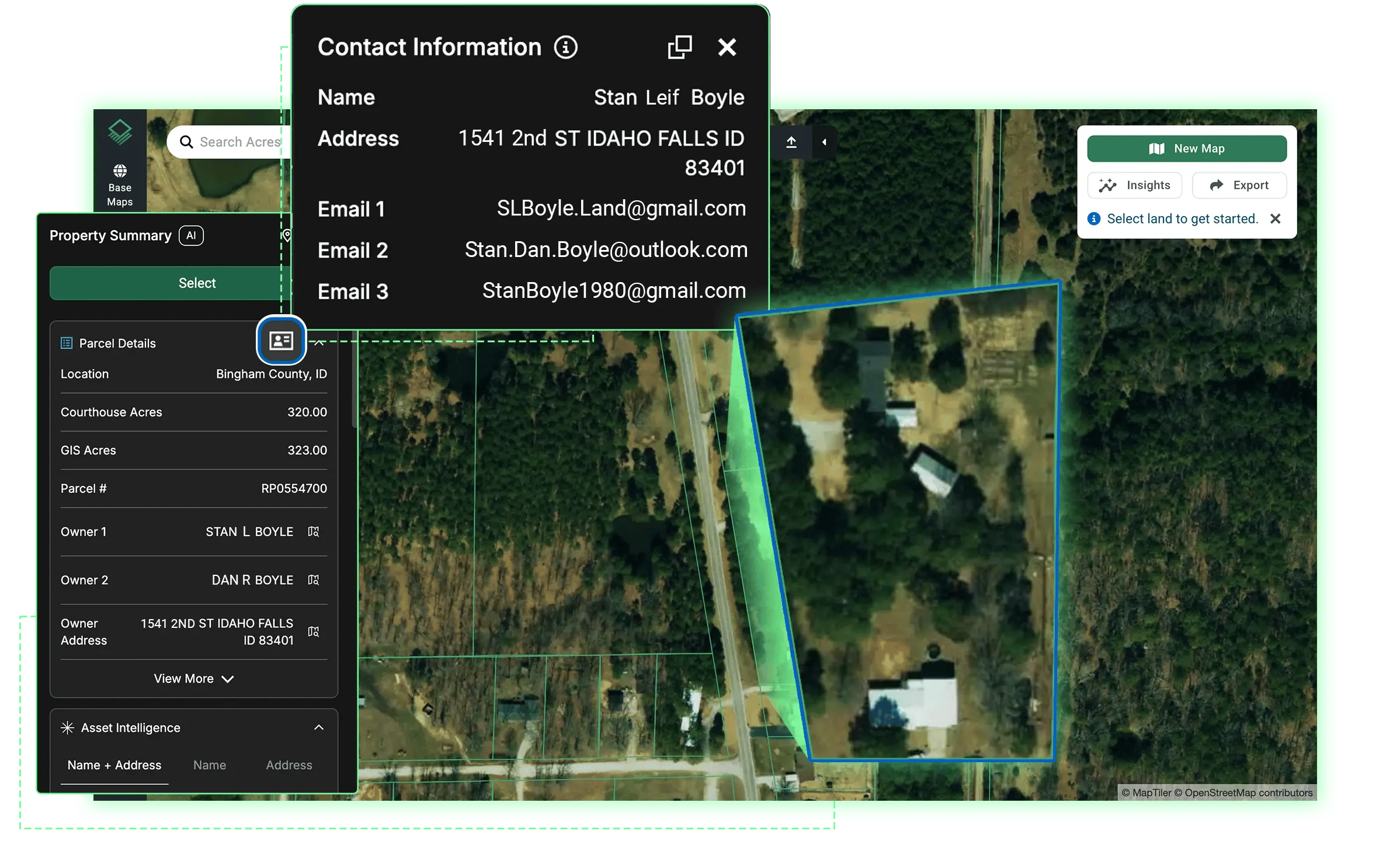
The fastest starting point is pulling the parcel up on Acres. Ownership details, deed history, and entity flags surface immediately for more than 150 million parcels, without submitting individual county records requests. County assessors, deed records, and GIS databases all feed into that view, but they can run months or years behind on transfers and filings. Ownership through trusts and LLCs adds another layer: the name on the deed may be "Smith Family Revocable Trust" with no obvious point of contact.
There is a growing share of rural land held through legal entities rather than individuals, a figure that has risen steadily as land values have increased and owners have sought liability protection.
With Acres: Pull up any target parcel and ownership history, entity flags, and deed transfer records all surface in the parcel detail view. Acres Intelligence scores each parcel against your acquisition criteria so you can prioritize outreach before committing to outreach.
Step 2 - Owner Contact Data (Skip Tracing)
Once you have confirmed the legal owner, skip tracing fills in the missing piece. This can involve:
- Commercial skip trace services that aggregate phone numbers and emails from consumer databases.
- Secretary of State filings to identify LLC registered agents.
- Probate and trust records when ownership has passed through an estate.
- Neighbor or tenant outreach when the owner is genuinely unreachable through data.
The quality of skip trace results varies significantly. Older contact records, common names, and entity-held properties all reduce hit rates. That is why the best land acquisition teams treat skip tracing as one tool in a broader land acquisition outreach strategy, not a guaranteed shortcut.
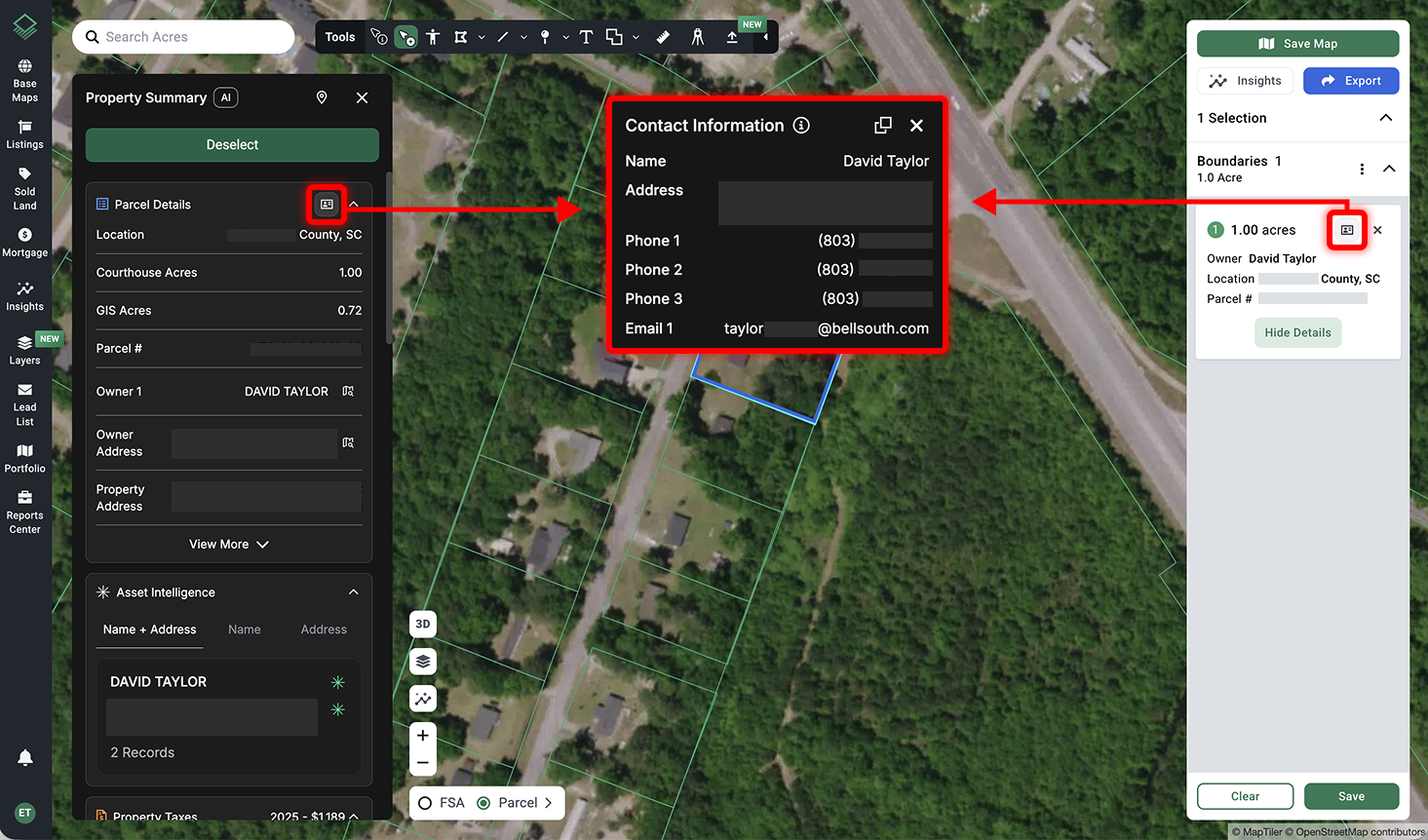
With Acres: Access landowner names, phone numbers, and email addresses for faster outreach.
When Skip Tracing Makes Sense - and When It Does Not
Skip tracing is not the right move for every prospecting situation. It is most valuable in specific scenarios:
When to Use It
- High-value parcels: If a specific parcel is worth pursuing aggressively, the effort of a full skip trace is justified.
- Entity-held properties: When the owner of record is an LLC or trust with no obvious contact, skip tracing is frequently the most direct path to a conversation.
- Absentee owners: Landowners who do not live near or actively manage a parcel are common skip trace targets, since they are more likely to consider an unsolicited offer.
- Inherited land: Heirs who have recently acquired land through an estate often have not decided what to do with it and may not have been found by other buyers yet.
When to Skip Skip Tracing
- High-volume campaigns: If you are mailing to hundreds of parcels, individual skip tracing is not cost-effective. Batch owner contact data from a parcel data platform is more efficient at scale.
- Clear public records: If the county record already shows a direct owner with a matching mailing address, the extra step is not necessary.
- Small deal size: Skip tracing takes time and money. For smaller acquisitions, the economics may not justify it.
How to Find the Owner of a Building or Parcel Without Skip Tracing
For many acquisition scenarios, especially when working at volume or in markets with strong public record infrastructure, a dedicated parcel data platform removes the need for traditional skip tracing entirely.
The Lincoln Institute of Land Policy has noted that fragmented and inconsistent county records remain one of the biggest barriers to efficient land acquisition outreach, particularly in rural markets where digitization lags urban areas.
For land buyers working across multiple states or counties, the ability to query parcel ownership data at scale is one of the most meaningful workflow improvements available. Rather than piecing together data from county portals, state GIS systems, or third-party databases, Acres brings ownership records, deed history, and entity data into a single parcel view.
Teams can qualify leads faster and focus skip tracing on the parcels that actually move the needle.
How Acres Approaches Parcel Owner Lookup
Acres covers more than 150 million parcels nationwide, with ownership data drawn from county assessors, deed records, and additional data layers, all updated on a rolling basis. For land acquisition teams, that means ownership information is available without submitting individual county requests or patching together data from multiple sources.
When a team identifies a target parcel on the Acres map, ownership details surface immediately, including entity-held properties where additional research may be needed. Acres Intelligence helps teams prioritize which parcels warrant deeper outreach and which can be filtered out early, reducing time spent on dead-end leads before skip tracing is ever considered.
For teams running active land acquisition outreach campaigns, that layer of qualification changes the math: fewer wasted skip trace attempts, more effort on parcels that are actually worth pursuing.
The Bottom Line on Skip Tracing for Land Buyers
Skip tracing is a targeted tactic, most valuable when a specific high-priority parcel is held by an entity or absentee owner with no obvious contact path. Understanding when to use it, and when a more direct data approach is sufficient, is what separates acquisition teams that move fast from those that chase dead ends.
The most efficient land buyers combine solid parcel data infrastructure with targeted skip tracing on the deals that actually warrant it.
Contact our team to learn more about parcel prospecting and owner outreach tools on Acres.