The three-point test for data center land evaluates a candidate parcel against the three infrastructure inputs that determine whether a site can support data center operations: power availability (confirmed utility capacity at or near the parcel), water access (supply volume and permitting for cooling), and fiber connectivity (carrier-diverse routes at sufficient bandwidth).
A parcel that fails any of the three points is not data-center-ready regardless of acreage, zoning classification, or asking price.
Most of the land marketed as data-center-suitable today fails at least one of these tests. Power is the most common failure point. Water is the emerging constraint in arid markets. Fiber is rarely the binding problem but remains a necessary pass condition.
The three-point test gives development teams and landowners a structured framework for qualifying or disqualifying any candidate parcel before formal due diligence resources are committed. Acres.com surfaces the infrastructure proximity signals behind all three tests at the parcel level across over 150 million U.S. parcels.
Contents
Why Most Candidate Parcels Fail Before the Site Visit
What Does the Power Test Actually Require?
What Does the Water Test Check?
What Does the Fiber Test Check?
Applying the Three-Point Test Before the Site Visit
How Acres Supports the Three-Point Screen
Summary
Why Most Candidate Parcels Fail Before the Site Visit
Data center electricity consumption reached 176 terawatt-hours in the U.S. in 2023 and could reach between 325 and 580 terawatt-hours by 2028 according to Lawrence Berkeley National Laboratory research—a potential doubling or tripling of demand in five years. That trajectory is why infrastructure has become the determinative variable in land qualification, and why the three-point test exists.
The traditional approach to data center site screening—start with land price and location, then confirm infrastructure—no longer works in a market where power availability has a two-to-seven-year confirmation timeline in many geographies. Development teams that do not front-load the infrastructure test spend months of due diligence resources on parcels that fail a power or water screen that could have been completed in the first week.
The three-point test reorders the qualification sequence. Power, water, and fiber are evaluated first, as pass-or-fail conditions, before any pricing analysis, design work, or formal utility engagement begins. A parcel that does not clear all three points in a first-pass screen does not advance, regardless of how attractive it looks in other aspects.
What Does the Power Test Actually Require?
Power is the first and most constraining test. A parcel passes the power test when it meets four conditions, each of which must be independently verified.
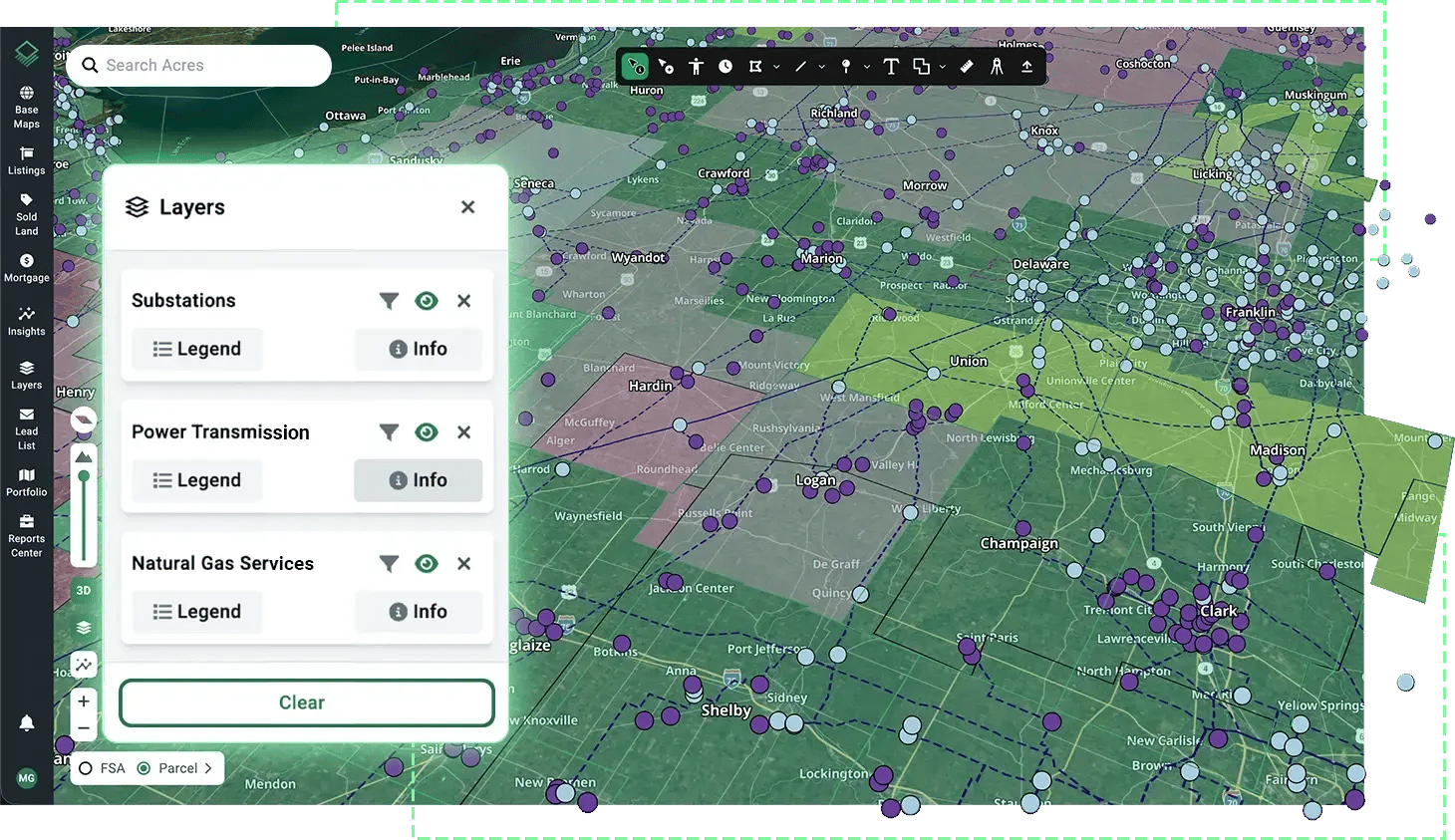
Substation proximity
The parcel must be within a viable distance of a high-voltage substation, typically 138kV to 500kV transmission infrastructure, with a direct interconnection path that does not require construction of new transmission lines. Sites requiring new transmission infrastructure face interconnection timelines that routinely exceed five years in constrained markets, making them unsuitable for near-term development.
Available capacity
Proximity to a substation is not the same as available capacity at that substation. The serving utility must have load headroom available for a new large connection. Substations that are already committed to other projects in the interconnection queue provide no practical advantage to a new applicant, even if they are physically adjacent.
Interconnection timeline
The utility must be able to provide service within a timeline that aligns with the development schedule, typically 18 to 36 months. Sites where the utility quotes timelines longer than 36 months to full energization are effectively speculative land assets for the current development cycle, not operational sites.
Power access premium
Sites that can offer 20 or more megawatts of confirmed power access command a serious premium, often doubling or tripling baseline land values in a given area. The power test is not just a development feasibility check, it determines the value category the parcel belongs to. A parcel that passes the power test is a fundamentally different asset from one that does not, even if they sit on adjacent lots.
Three-Point Test Summary
| Test Point |
Pass Condition |
Fail Signal
|
|
Power
|
Substation within viable distance, confirmed available capacity, interconnection timeline under 36 months. |
No confirmed load headroom, 5+ year queue position, new transmission required. |
| Water |
Municipal supply or permitted groundwater at required volume for cooling load, discharge permitting in place. |
Arid market with active water use restrictions, no discharge pathway, consumptive-use permit required. |
| Fiber |
Two or more carrier-diverse fiber routes at the parcel boundary or within cost-effective extension distance. |
Single provider, no carrier-grade infrastructure within 5+ miles, easement conflicts on the shortest route. |
Acres surfaces infrastructure proximity signals—substation adjacency, fiber corridor presence, and utility easement data—alongside parcel boundaries, zoning classifications, and ownership records in a single map view. Before committing any formal diligence resources, development teams use Acres to run the power and fiber proximity screens at geographic scale across all candidate parcels in a target market.
What Does the Water Test Check?
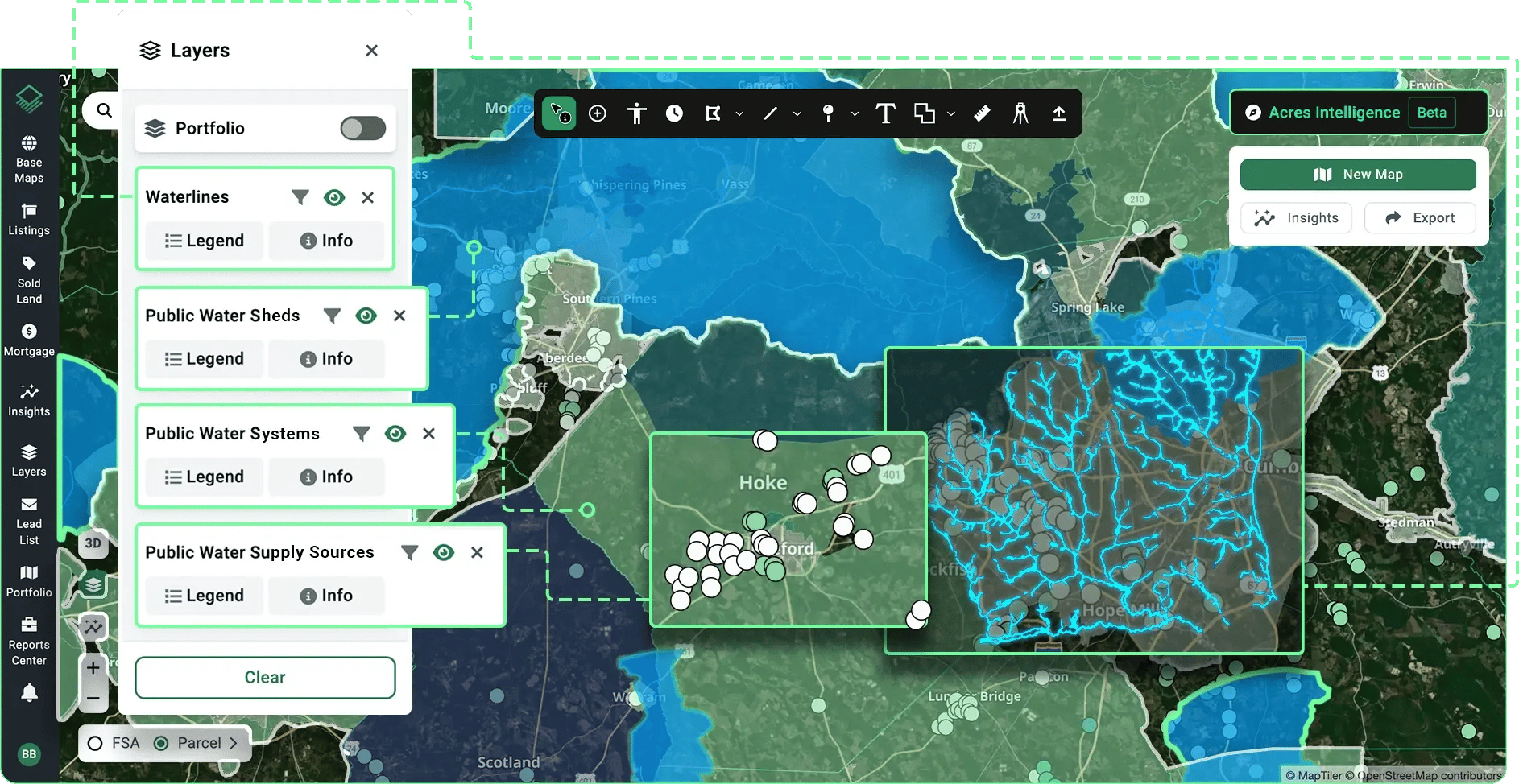
Water is the second test point and the one most likely to surprise development teams that focus exclusively on power. Data centers require large, reliable volumes of water for cooling. The specific requirement depends on the cooling architecture: air-cooled systems use less water than evaporative cooling towers, and liquid cooling systems for high-density AI workloads introduce their own water and heat rejection requirements.
The water test has two components: supply and discharge. Supply requires confirmation that municipal water service, a permitted groundwater source, or a recycled water supply is available at the required daily volume. Discharge requires that the site has a permitted pathway for cooling water or wastewater disposal, either to a municipal sewer system, an approved reuse program, or a permitted industrial discharge facility.
Water permitting has become an outcome-determinative variable in data center site selection, particularly in markets with water scarcity or regulatory sensitivity. Arid markets including Phoenix and Las Vegas face gigawatt-scale cooling demand that is placing direct pressure on regional water budgets.
A parcel that passes the power test but is located in a water-constrained market with no recycled water supply pathway, no municipal sewer access, and no permitted discharge option does not pass the three-point test. Water is a genuine disqualifying variable, not a secondary consideration.
What Does the Fiber Test Check?
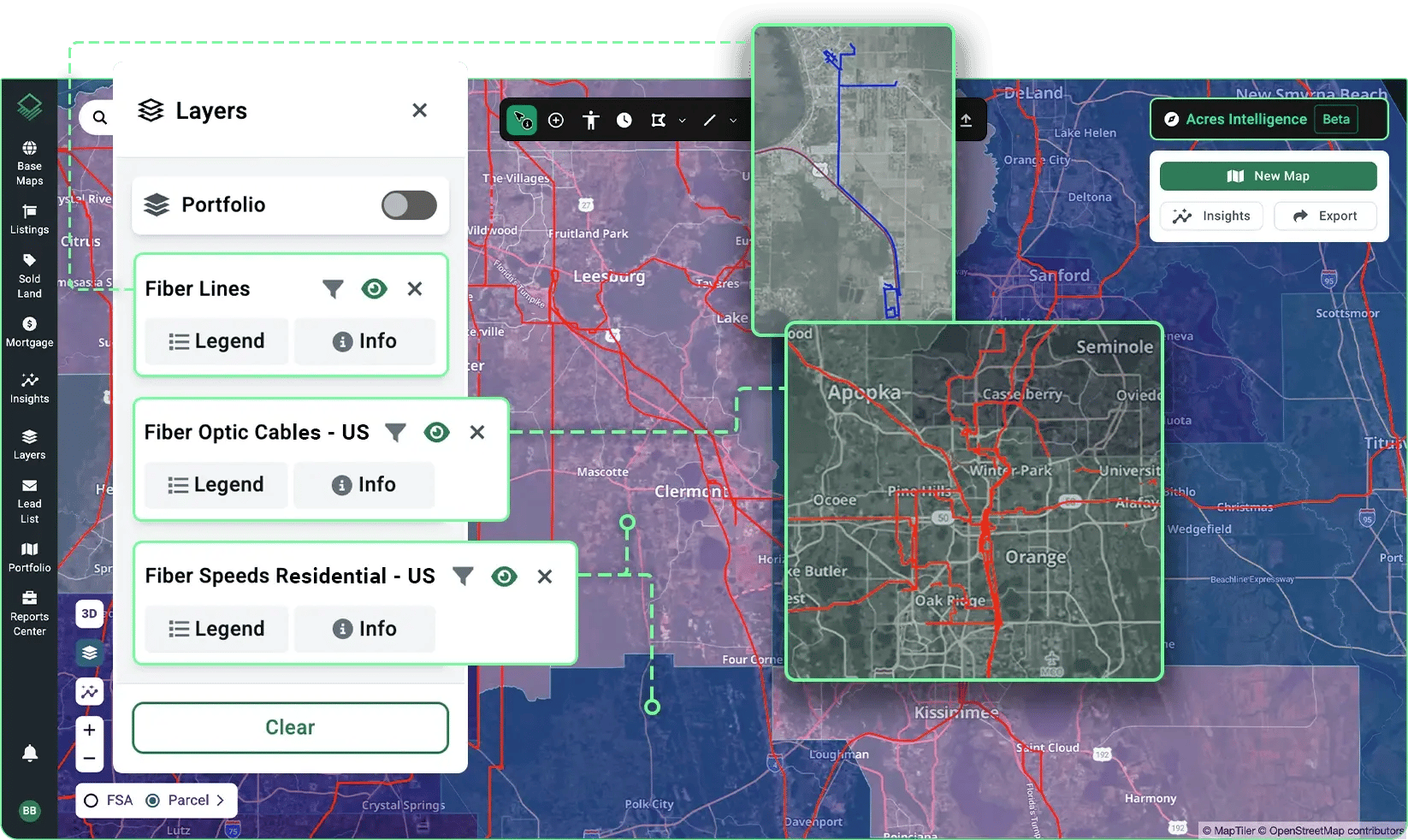
Fiber is the third test point and the one that most often resolves favorably. Unlike power and water, fiber infrastructure is relatively extensible: if fiber is not present at a parcel boundary, it can frequently be brought to the site through available public right-of-way or through privately negotiated easements, at a cost and timeline that is typically manageable relative to the power and water challenges.
The fiber test checks two things: carrier diversity and route diversity. A parcel with access to a single fiber provider fails the test regardless of bandwidth, because single-provider connectivity does not support the redundancy requirements of enterprise and hyperscale data center operations. A parcel with two or more carrier-grade providers at diverse entry points passes, assuming the bandwidth and latency profile matches the intended use case.
In markets where fiber is genuinely absent (rural and exurban locations that sit outside established fiber corridors e.g.), the test requires estimating the cost and feasibility of extension. Fiber extension that requires crossing privately owned parcels where easement acquisition is uncertain adds development risk and timeline, even if the raw distance appears short.
Fiber is increasingly not the constraint in secondary and tertiary markets that have received investment from major telecom carriers in recent years. The more common scenario is that fiber is present but lacks carrier diversity, which requires a supplementary route or carrier arrangement as part of the development plan.
Applying the Three-Point Test Before the Site Visit
The three-point test is most valuable when applied before formal due diligence, specifically, before utility engagement letters are requested, before site visits are scheduled, and before any capital commitment is made. At that pre-commitment stage, the test relies on proxy data rather than confirmed utility studies: infrastructure proximity information, parcel-level GIS data, known fiber routes from carrier filings, and water system service territory maps.
That proxy data is not perfect, but it is sufficient to disqualify sites that have obvious infrastructure gaps and to flag sites that merit formal utility engagement. A site that has no substation within 10 miles and sits in a jurisdiction with active water use restrictions fails the test on proxy data alone. A site with a high-voltage corridor running along its boundary, municipal water service, and two carriers in the vicinity passes the initial proxy screen and advances to formal utility engagement.
Rather than pulling infrastructure proximity data from separate GIS portals, carrier maps, and utility service territory databases, Acres integrates these signals at the parcel level so the three-point proxy screen runs in the same session as the ownership and zoning review.
How Acres Supports the Three-Point Screen
The power, water, and fiber tests are only as reliable as the parcel-level data behind them. Institutional buyers value land near critical power infrastructure at a premium of roughly $150,000 to $400,000 per megawatt of confirmed available capacity, which means getting the power screen right before a site is optioned or acquired is a direct value driver.
Acres gives data center development teams access to the most extensive, complete view of land data in a single system—parcel boundaries, ownership records, zoning classifications,
environmental signals, and infrastructure context—for over 150 million U.S. parcels. Explore data center site infrastructure screening on Acres.
For development teams running the three-point test across a broad candidate set, Acres compresses the proxy screen from days of multi-source research to a single session. Use parcel risk and infrastructure context on Acres to identify which sites clear the power, water, and fiber prerequisites before any formal diligence begins.
Run the Test First
Power, water, and fiber are the three necessary conditions for data center land viability. A parcel that cannot confirm power capacity within a viable timeline, does not have a water supply and discharge pathway for cooling, or lacks carrier-diverse fiber access is not ready for data center development regardless of how it is marketed. The three-point test applies these conditions in a systematic first-pass screen before any formal due diligence investment is made.
The test's value is in what it eliminates. Development teams that run the three-point proxy screen at scale across a target geography narrow a wide candidate set to a short list of sites that merit formal utility engagement. That shortlist compression, from dozens of candidates to a handful of genuinely viable options, is where due diligence efficiency is built in the current market.
Ready to apply the three-point test to your data center land candidates? Book a demo to see how your team can surface infrastructure proximity, zoning, and parcel context for any U.S. geography on Acres.
.png)