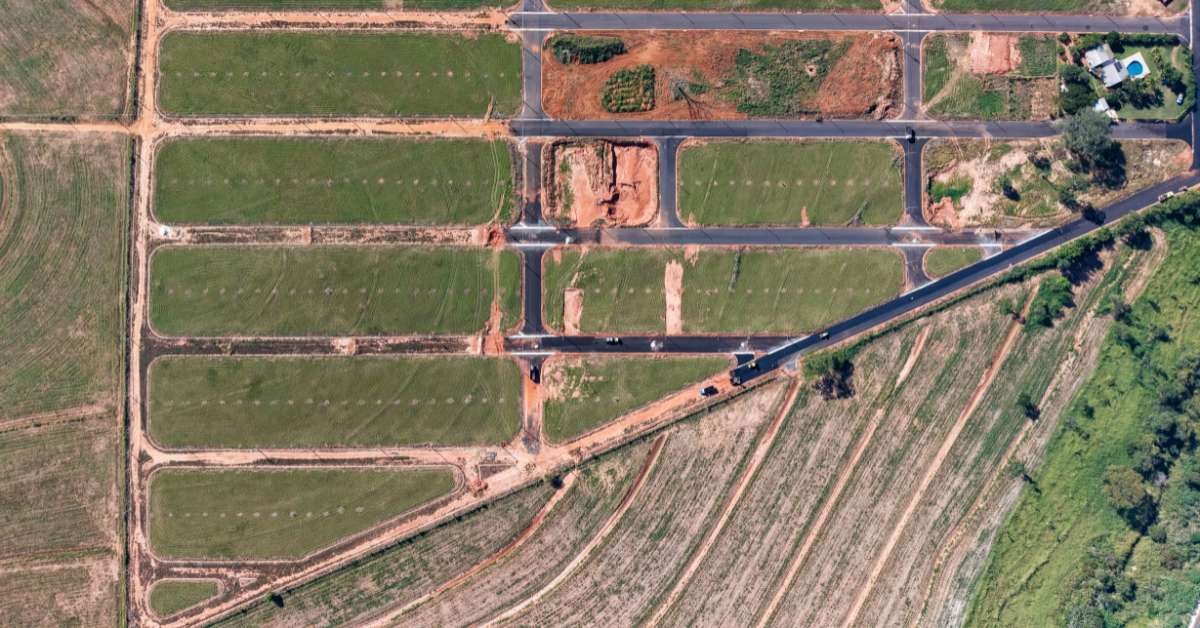
A glossary of land investing terms is a reference guide that defines the legal, financial, and transactional vocabulary used when buying, selling, developing, or researching land. The terms in this guide cover every stage of a land transaction from identifying a parcel and reviewing title records to understanding zoning, financing, and valuation.
Land deals have their own language. A buyer who does not know the difference between a deed and a title, or between an easement and an encroachment, can miss a critical deal risk buried in a public record. These are the terms that show up in every contract, every assessor record, and every lender's checklist.
Acres.com aggregates the parcel-level data behind most of these concepts so buyers can verify what a term actually means in practice for any specific parcel, rather than relying on a listing description.
Contents
Why Land Investing Terms Are Different From General Real Estate Vocabulary
Parcel Basics Every Buyer Must Know
Ownership and Title: The Land Deed Definition and Key Terms
Rights and Restrictions: Land Easement Meaning and Related Terms
Valuation and Finance: Key Land Investing Terms for Buyers and Investors
Zoning and Development Terms
How Acres Surfaces the Data Behind Every Land Investing Term
Why Land Investing Terms Are Different From General Real Estate Vocabulary
Much of real estate education focuses on residential or commercial property. The terminology can overlap but is not identical. Land investing involves concepts like entitlement, highest and best use, parcel splits, mineral rights, residual land value. While these may not always be essential in a single-family home transaction, they are central to every land deal.
A buyer who confuses assessed value with market value may pay the wrong price. A buyer who treats a recorded easement as trivial may acquire a parcel they cannot develop. A seller who does not understand lien priority may close a transaction with unresolved title defects. The land investing terms in this glossary are the ones where confusion can carry significant financial consequence.
This glossary organizes the most important real estate land terms into five groups: parcel basics, ownership and title, rights and restrictions, valuation and finance, and zoning and development. Each entry gives a definition and a note on why the term matters for a land buyer specifically.
What Is a Land Parcel? Parcel Basics Every Buyer Must Know
These land real estate terms define the physical object you are researching before any offer is made:
Parcel: A defined area of real estate with legally recorded boundaries, a specific legal description, and an owner of record. Each parcel is assigned a unique Assessor’s Parcel Number (APN) by the county for tax and identification purposes. Every parcel’s details are maintained in public county records, which land investors evaluate to verify ownership, check boundaries, and source property data.
APN (Assessor's Parcel Number): The APN is the unique alphanumeric code a county assigns to each parcel for tax and record-keeping purposes. It is the anchor identifier for all public records searches. Any time you search a parcel in a county database or on a platform like Acres, the APN is what links the parcel to its deed history, tax status, and ownership record.
Acreage: The total area of a parcel measured in acres (one acre = 43,560 square feet). Acreage is used as the basis for price per acre comparisons, but size alone does not determine value. Access, zoning, topography, and utility availability all affect what a given acreage is worth.
Legal Description: The formal written description of a parcel's boundaries as recorded in the deed. Legal descriptions use one of several systems—metes and bounds, Public Land Survey System, or lot-and-block—to define the parcel's precise location and shape.
Plat Map: A plat map is a recorded map of a subdivision or land area that shows individual parcel boundaries, lot numbers, street rights-of-way, and easements. Plat maps are official public records, approved by local governments and filed with the county recorder. They are the most reliable visual reference for parcel boundaries within a recorded subdivision.
Survey: A land survey is a professional measurement of a parcel's boundaries conducted by a licensed surveyor. Surveys are required for many lenders and recommended for any raw land purchase where boundary uncertainty exists. A boundary survey establishes the parcel's corners and confirms whether improvements (fences, structures) sit within the parcel lines.
|
With Acres:
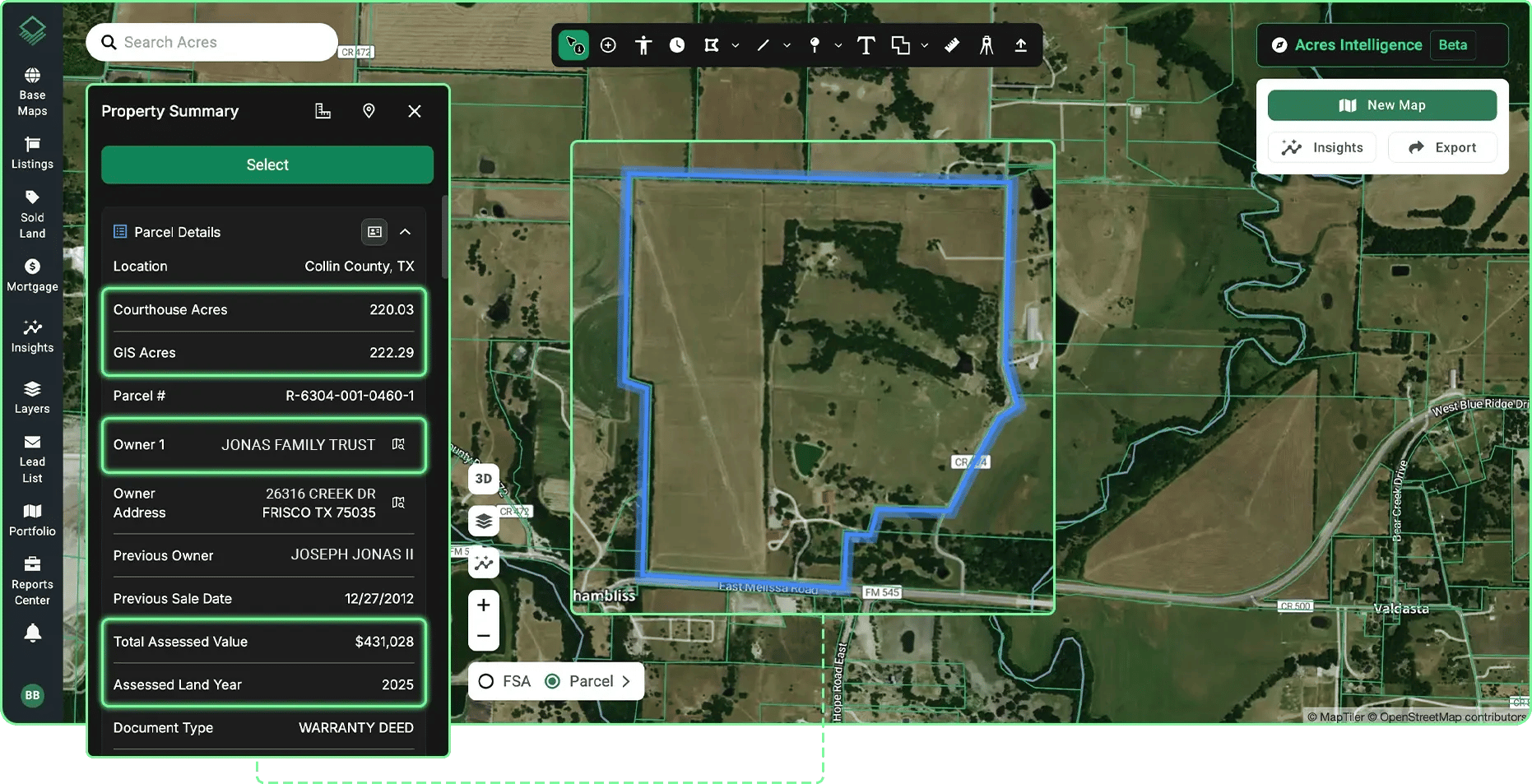
Acres displays parcel boundaries and ownership records for over 150 million parcels in a single map view. Rather than pulling individual records from separate county assessor portals, buyers can click any parcel on the Acres map to surface its record including acreage, values, and transaction details, in one panel.
|
Ownership and Title: The Land Deed Definition and Key Terms
These land buying terms cover how ownership is recorded, transferred, and verified:
Deed: A deed is the legal document that transfers ownership of a parcel from one party to another. For land buyers, verifying the type and validity of a deed is critical, as transferring property without clear warranties or proper title history can carry significant risk. Always review every recorded deed in the chain of title before closing.
Title: Title is the legal concept of ownership of real property. A property has clear title when there are no outstanding liens, disputes, or encumbrances that cloud the owner's legal right to sell or develop it. Title and deed are related but distinct: the deed is the document, title is the legal status it conveys.
Title Search: A title search is a review of all recorded public records for a parcel to verify the chain of ownership and identify any liens, encumbrances, judgments, or unresolved claims. Conducting a title search ensures a buyer does not inherit legal or financial liabilities attached to the property before closing.
Title Insurance: Title insurance is a policy that protects the buyer (and lender) against losses arising from defects in the title discovered after closing. Owner's title insurance is a one-time premium paid at closing. It covers claims from prior owners, recording errors, fraud, and other title defects that were not surfaced in the title search.
Chain of Title: The chain of title is the full chronological history of ownership for a parcel, documented through recorded deeds. Gaps in the chain like missing conveyances and heirs who never formally received the property, are title defects that must be resolved before a parcel can be cleanly transferred. Land held in rural areas for generations often has chain-of-title issues.
Lien: A lien is a legal claim or financial encumbrance placed against a property that must be satisfied before the title can be transferred free and clear (security for a debt). Certain liens (like unpaid property taxes) stay attached to the land itself regardless of owner transfers, meaning a buyer will inherit those debts if they are not satisfied prior to closing.
Rights and Restrictions: Land Easement Meaning and Related Terms
These terms define what owners can and cannot do with their land - and what rights others may hold over it:
Easement: An easement is the legal right of a third party to use a portion of a parcel for a specific purpose without owning it. Easements are recorded against the parcel and survive ownership changes. A parcel subject to a significant easement may have restricted development potential or reduced value.
Right-of-Way: A right-of-way is a specific type of easement that grants the right to travel across a parcel, typically for roads, utilities, or railroads. Understanding a right-of-way is critical when evaluating access, as a right to cross another's land does not grant full ownership and may carry restrictions on maintenance, road expansion, or permanent development.
Mineral Rights: Mineral rights are the legal rights to extract minerals (oil, gas, coal, metals) from beneath a parcel's surface. Mineral rights can be severed from surface rights and owned separately. A buyer who purchases surface rights only does not own the subsurface resources. In areas with resource extraction activity, mineral rights can affect development potential and should be verified in the title search.
Encroachment: An encroachment occurs when a structure, fence, or improvement from one parcel physically extends onto an adjacent parcel. Encroachments are boundary violations that can generate legal disputes and title defects. A boundary survey will identify encroachments that would not be visible from a deed review alone.
Covenant: A covenant is a recorded restriction on how a parcel can be used, typically imposed by a prior developer or subdivision. Covenants run with the land and bind all future owners. They may restrict the type of structures allowed, minimum lot sizes, or use classifications.
|
With Acres:
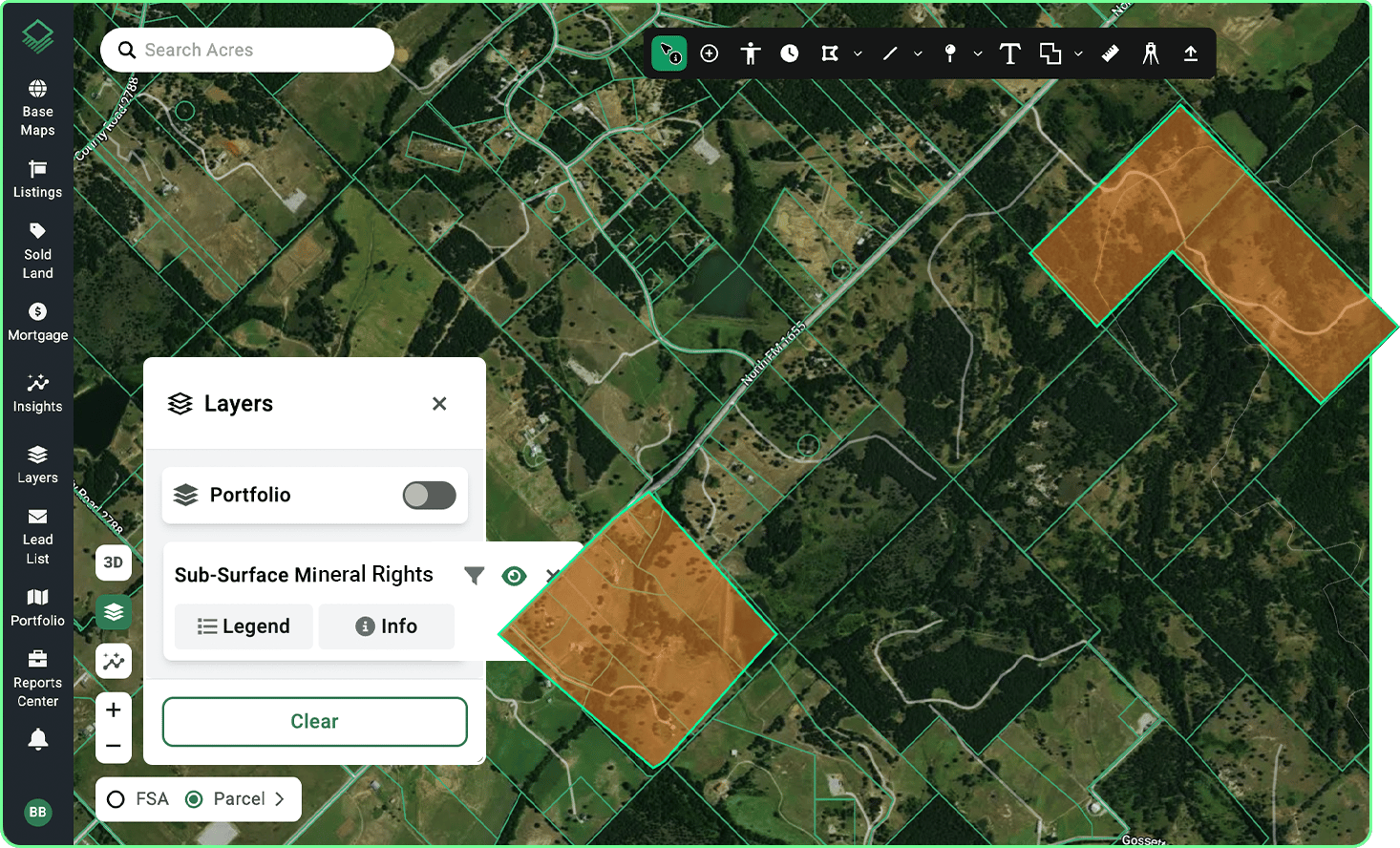
Identify hidden site restrictions before making an offer. Acres lets you overlay documented easements, mineral rights, and parcel boundaries directly onto high-resolution satellite imagery. You can instantly visualize property access, flag utility or access burdens, and see whether a parcel can actually be developed without toggling between separate county GIS portals.
|
Valuation and Finance: Key Land Investing Terms for Buyers and Investors
These land investing terms define how parcels are priced, financed, and evaluated for investment potential:
Assessed Value: The assessed value is the value assigned to a parcel by the county assessor for property tax calculation purposes. Assessed value is not the same as market value. In many jurisdictions, assessed values lag market conditions significantly and should not be used as a primary valuation reference. They are, however, publicly available and useful as a baseline data point.
Market Value: Market value is the price a willing buyer and seller would agree on in an arm's-length transaction—meaning an open-market deal between unrelated parties with no pressure to buy or sell. Established through comparable sales analysis rather than assessed value or asking price, market value is established through comparable sales analysis, not assessed value nor asking price.
Residual Land Value: Residual land value is a valuation method that works backward from finished development. A developer subtracts all development costs (construction, permits, financing, margin) from the expected revenue of the completed project. The remainder is the maximum price the developer can afford to pay for the land.
Price Per Acre: Price per acre is the unit metric for comparing land costs across parcels of different sizes. It is calculated by dividing the total purchase price by the total acreage. Price per acre is useful for screening within a consistent parcel type and geography, but misleading when used to compare parcels with different access, zoning, or utility profiles.
Seller Financing: Seller financing is a purchase arrangement where the seller acts as the lender, allowing the buyer to pay for the parcel over time rather than through a bank loan. Seller financing is common in raw land transactions because institutional lenders require larger down payments on raw land. Understanding seller financing terms (e.g. interest rate, balloon payment, default provisions) is essential before entering this type of agreement.
Due Diligence: Due diligence is the research process a buyer completes before closing on a parcel such as verifying title, confirming access and utilities, reviewing zoning, and assessing environmental constraints. In land transactions, due diligence is almost entirely the buyer's responsibility. Missing a flood zone designation, an unrecorded easement, or a zoning restriction during due diligence can eliminate a parcel's development potential after purchase.
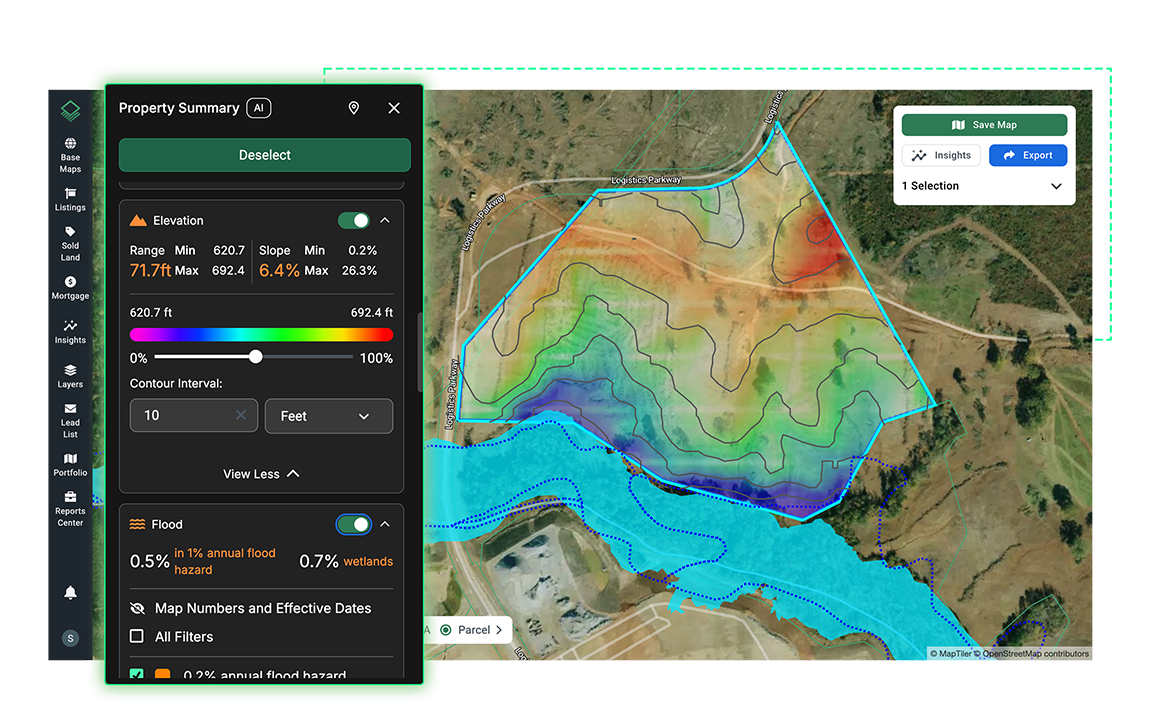
Tip: Use land risk screening on Acres to surface environmental, zoning, and infrastructure constraints for any parcel before due diligence begins in earnest.
What Does Highest and Best Use Mean? Zoning and Development Terms
These real estate land terms define how land can be used and how development potential is evaluated:
Zoning: Zoning is the legal classification of land by permitted use. Local governments assign zoning categories—residential, commercial, industrial, agricultural, mixed-use—that determine what can be built or operated on a parcel. Zoning is the single most important variable in determining a parcel's development potential.
Entitlement: Entitlement is the process of obtaining government approvals to develop land for a specific use. Entitlements include rezoning, subdivision approval, site plan approvals, and environmental clearances. An entitled parcel (one with its development approvals in place) commands a significant premium over raw land because the buyer avoids a lengthy and uncertain approval process.
Highest and Best Use: Highest and best use (HBU) is the legally permissible, physically possible, financially feasible, and maximally productive use of a parcel. It is not the most profitable use in isolation, it must also be realistic given zoning, access, and market conditions. HBU analysis is the framework appraisers and developers use to determine what a parcel is actually capable of supporting before committing capital.
Floor Area Ratio (FAR): Floor area ratio is the ratio of a building's total floor area to the size of the land parcel it sits on. A FAR of 2.0 means the building can contain twice the area of the lot (through multiple stories). FAR limits are set by zoning and directly constrain how intensively a parcel can be developed. Higher FAR = more buildable density = higher land value in most urban and suburban markets.
Setback: A setback is a zoning requirement that specifies the minimum distance a structure must be placed from a property line, road, or other boundary. Setback requirements reduce the buildable area of a parcel. A parcel with narrow frontage and deep setbacks may have substantially less usable area than its total acreage suggests.
Subdivision: Subdivision is the process of legally dividing a larger parcel into smaller lots. Each resulting lot receives its own legal description, APN, and recorded deed. Subdivision requires county approval and typically involves engineering, surveying, road and utility infrastructure, and recordation of a final plat. The ability (or inability) to subdivide a large parcel directly affects its value for residential development.
Understanding these land real estate terms is the foundation, but the data behind them is what drives smart decisions.
How Acres Surfaces the Data Behind Every Land Investing Term
Every term in this glossary corresponds to data that is scattered across county assessors, recorder offices, GIS portals, and state databases. Rather than pulling each layer from a separate source, Acres brings ownership, zoning, parcel boundaries, environmental signals, and transaction history into one platform so buyers can move from vocabulary to verified data in the same session.
Acres gives teams access to the most extensive, complete view of land data in a single system— spanning ownership, parcel details, zoning, environmental signals, and infrastructure context—for over 150 million parcels, without the multi-source research process.
Weeks of land research become minutes with complete land data and powerful AI. Teams researching a parcel's APN, deed history, easement burden, zoning classification, and flood exposure can verify all of those factors in a single Acres session rather than across a dozen county portals.
If your team can describe what they are looking for, they can find it. Explore the full land analysis tools on Acres to see how these data layers work together for any parcel in the country.
Using This Glossary of Land Investing Terms
The terms in this glossary cover basic vocabulary every land buyer and investor needs before an offer is written.
Parcel basics establish the physical object. Title and ownership terms define who controls the land and how cleanly. Rights and restrictions terms reveal what third parties can do on the land and what the buyer cannot. Valuation terms connect the physical parcel to its financial reality. Zoning and development terms determine what the land can become.
Get started with Acres and see how you can spot hidden risks, verify ownership and property lines, and evaluate market potential before making an offer.